
Most crypto hunters are currently staring at their wallets waiting for the next big BZZONE airdrop. But here is the twist that catches many off guard: Bzzone doesn't really do traditional airdrops. If you are following the standard playbook of joining testnets and liking tweets on Twitter, you might be missing the actual mechanism for getting these tokens. The project operates on a mining-based acquisition model tied directly to the PangolinSwap ecosystem, which changes how you need to approach it.
This guide breaks down exactly what Bzzone is, why the "airdrop" label is misleading, and how you can actually secure tokens in this unique algorithmic stablecoin setup. We will look at the tokenomics, the role of the supporting tokens, and where to find official updates so you don't fall for scams.
What Is Bzzone (BZZONE)?
Bzzone is the first algorithmic stablecoin operating within the BEP-20 ecological chain. Unlike typical stablecoins like USDT or USDC that rely on centralized reserves of fiat currency, Bzzone uses an algorithmic protocol to maintain its value. It sits within the Binance Smart Chain (BSC) ecosystem, leveraging the speed and low fees of the BEP-20 standard.
The project was developed and issued by PangolinSwap, a cross-chain aggregation platform that integrates NFT functionality, decentralized exchange (DEX) services, and mining operations. The primary use case for BZZONE centers on investing in non-fungible tokens (NFTs) based on virtual worlds and blockchain games. This positions the token firmly within the growing GameFi and metaverse ecosystem, where stable pricing is crucial for in-game economies.
Key attributes of the token include:
- Total Supply: Fixed at 1,127,001 BZZONE.
- Circulating Supply: Currently listed as 0 on major trackers like CoinMarketCap, suggesting distribution is in early stages or ongoing via mining.
- Network: BEP-20 (Binance Smart Chain).
- Issuer: PangolinSwap.
The "Airdrop" Myth vs. Reality
When people search for "BZZONE airdrop," they are often looking for free tokens dropped into their wallets for completing simple tasks. However, the available documentation suggests a different reality. Bzzone is not distributed through a traditional airdrop campaign where you sign up with your email and wait for a claim link.
Instead, the distribution mechanism is mining-based. To acquire Bzzone, you generally need to participate in the mining pools associated with the PangolinSwap ecosystem. This means the "free" aspect comes from the yield or reward generated by holding specific support tokens, rather than a one-time giveaway. This model diverges significantly from recent high-profile airdrops like Berachain or Kaito AI, which targeted testnet users and NFT holders directly.
If you have been waiting for a snapshot date or a claim portal, check the official channels. The absence of Bzzone on mainstream airdrop tracking platforms suggests that any distribution events are conducted through alternative channels, likely tied to DeFi participation or gaming engagement rather than social media metrics.
How the Token Ecosystem Works
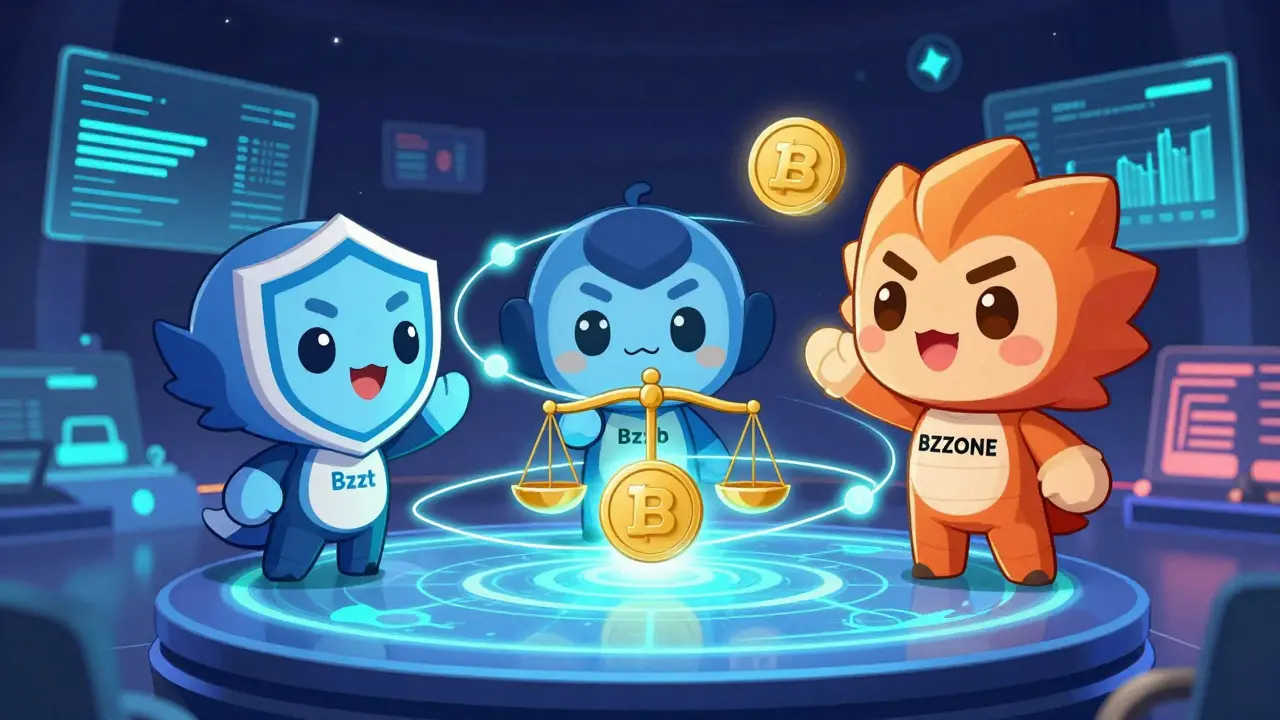
Understanding how to get BZzone requires understanding the three-token architecture of the system. The protocol incorporates three distinct tokens that work together to stabilize the main asset.
- Bzzt: Functions as the stable currency component of the system, anchored to a $1 USD value. It provides the stability foundation for the broader algorithmic framework.
- Bzzb: Maintains a 1:1 exchange ratio with Bzzt. Both tokens are required for participation in mining pools.
- Bzzone (BZZONE): The primary algorithmic stablecoin that can only be obtained through mining activities rather than direct purchase on open markets initially.
The logic here is straightforward but important: you cannot simply buy BZZONE on a spot market if it hasn't started circulating yet. You must engage with the underlying infrastructure. By holding or providing liquidity with Bzzt and Bzzb, you gain access to the mining pools that emit BZZONE. This creates a closed-loop economy where stability is maintained through internal mechanics rather than external collateral.
| Token | Role | Value Anchor | Acquisition Method |
|---|---|---|---|
| BZZONE | Main Algorithmic Stablecoin | Algorithmic Protocol | Mining Pools |
| Bzzt | Stable Currency Component | $1 USD | Platform Integration |
| Bzzb | Supporting Token | 1:1 with Bzzt | Platform Integration |
How to Participate in Bzzone Mining
Since the primary route to BZZONE is mining, your strategy should focus on engaging with the PangolinSwap platform. Here is what that typically involves:
- Connect Your Wallet: Ensure you have a MetaMask or Trust Wallet connected to the Binance Smart Chain network.
- Access PangolinSwap: Navigate to the official PangolinSwap interface. Look for sections dedicated to "Mining" or "Earn."
- Check Pool Requirements: Identify which pools require Bzzt or Bzzb. You may need to swap other assets for these tokens first if they are available on DEXes.
- Provide Liquidity or Stake: Deposit the required tokens into the mining pool. The rewards emitted will be BZZONE.
- Monitor Rewards: Keep track of your accumulated BZZONE. Since the circulating supply is currently low, early participants may see higher relative yields.
Note that because the circulating supply is listed as 0, liquidity might be thin. Always check the slippage settings before swapping into Bzzt or Bzzb to avoid losing significant value to transaction costs.
Risks and Things to Watch Out For
Algorithmic stablecoins carry inherent risks. Unlike fully backed stablecoins, Bzzone relies on its protocol's ability to maintain equilibrium. If demand drops or the algorithm fails to adjust, the price could deviate from its target. This is a common challenge in the DeFi space, seen in past projects that struggled with depegging.
Additionally, because Bzzone is not widely listed on major exchanges yet, you face illiquidity risk. Getting out of your position might be difficult if there isn't enough trading volume. Scams are also prevalent; always verify URLs. Do not trust random Telegram messages claiming to be "official Bzzone airdrop claims." Only use links from the verified PangolinSwap website or their official Telegram channel.
The project's focus on GameFi and metaverse NFTs adds another layer of speculation. The value of BZZONE is partly tied to the success of the virtual world investments it facilitates. If the gaming sector cools down, demand for the token could decrease.
Where to Find Official Updates
Given the lack of mainstream coverage, staying close to the source is critical. The project maintains an official presence through Telegram channels. These are the best places to hear about any potential shifts in distribution strategy, such as a formal airdrop announcement or new mining pool launches.
Keep an eye on:
- PangolinSwap Official Telegram: For announcements regarding platform updates and token emissions.
- CoinMarketCap/CoinGecko: For real-time data on circulating supply and market cap changes.
- GameFi News Sources: Since Bzzone targets the metaverse, news about major game integrations could impact token utility.
If you are a long-term holder in the BEP-20 ecosystem, monitoring the development activity on GitHub (if public) or the team's regular AMAs (Ask Me Anything) sessions can provide deeper insights into the roadmap. The key takeaway is that patience and active participation in the mining pools are more valuable than passive waiting for an airdrop that may never come in the traditional sense.
Is there a confirmed BZZONE airdrop date?
There is no widely confirmed public airdrop date in mainstream listings. The primary method of acquisition appears to be through mining pools on PangolinSwap using Bzzt and Bzzb tokens. Monitor official Telegram channels for any changes to this model.
Can I buy BZZONE directly on an exchange?
Currently, the circulating supply is listed as 0, meaning it is not widely available for direct purchase on major centralized exchanges. You likely need to mine it or trade for it on decentralized exchanges once liquidity becomes available.
What is the total supply of Bzzone?
The total and maximum supply of BZZONE is fixed at 1,127,001 tokens. This hard cap is part of the algorithmic design to manage inflation and scarcity.
What is the difference between Bzzt and Bzzb?
Bzzt is anchored to $1 USD and acts as the stable base. Bzzb has a 1:1 exchange ratio with Bzzt. Both are required to participate in the mining pools that emit BZZONE, serving as the entry ticket to the ecosystem.
Who developed the Bzzone token?
Bzzone was developed and issued by PangolinSwap, a cross-chain aggregation platform that combines DEX services, NFT functionality, and mining operations within the BEP-20 ecosystem.



Jade Brown
August 17, 2026 AT 00:58Let’s be real for a second. This isn’t an airdrop, it’s a liquidity trap dressed up in a tuxedo. You’re not getting free money; you’re providing the fuel for their algorithmic firecracker to explode in your face. The 'mining' aspect is just a polite way of saying 'lock your capital and pray.'
Jennifer Ulmer
August 17, 2026 AT 18:28I think she makes a good point though. I always get excited when I see 'free tokens' but then I read the fine print and realize I have to stake something else first. It feels like a lot of work for maybe nothing.
Jade Brown
August 18, 2026 AT 12:15Exactly. It's the classic DeFi rug pull setup. You provide the liquidity, they take the yield, and if the algo depegs, you're holding the bag while the devs buy back at a discount. Smart money knows this is a zero-sum game where only the insiders win.
Patrick Pat
August 18, 2026 AT 23:21Or maybe it's just another one of those 'innovative' projects that will last exactly three months before the whitepaper gets updated to say they're pivoting to AI. But sure, let's pretend it's sustainable mining.
Kiran Jayaram
August 19, 2026 AT 02:18stop being so negative about everything you guys are such a pain in the neck why do you always have to ruin the fun with your toxic analysis its just a token what is the big deal anyway just buy some and see what happens stop overthinking it
Patrick Pat
August 20, 2026 AT 23:55Overthinking is how we survive in this market, mate. Blind optimism is how you end up with a wallet full of dust and a headache.
Kiran Jayaram
August 21, 2026 AT 15:28yeah well suit yourself i guess some people like to worry all the time instead of just making money its sad really very sad
Nikki keller
August 22, 2026 AT 13:52It is interesting to consider the philosophical implications of 'algorithmic stability' versus 'centralized trust.' We often assume that decentralization equals security, but here we see a system that relies on complex internal mechanics rather than external collateral. Is that truly more secure, or just more opaque? The distinction between a 'stablecoin' and a 'speculative asset' becomes blurred when the value proposition is tied to gaming utility rather than fiat reserves.
miranda gamboa
August 23, 2026 AT 17:14This is a great point! I've been looking into GameFi integrations lately and the demand for stable pricing is huge. If BZZONE can actually hold its peg in volatile gaming economies, it could be a game changer for in-game transactions. The APY from the mining pools looks promising too, especially with low circulating supply right now.
Nikki keller
August 25, 2026 AT 14:21Promising is a strong word for a protocol with zero circulating supply. In my experience, high initial yields are often a lure to attract early liquidity providers who will eventually be diluted by later emissions. We must remain cautious and observe the burn mechanisms closely.
miranda gamboa
August 26, 2026 AT 20:39Fair enough. I guess I should watch the GitHub activity before diving in headfirst. Do you think the NFT integration will drive enough organic demand to support the price long-term?
Nikki keller
August 27, 2026 AT 22:40Only if the games themselves succeed. Token utility is only as strong as the user base using it. Currently, it feels like a house of cards built on speculation rather than adoption.
Patrick Quairoli
August 29, 2026 AT 00:42they are hiding something for sure look at the total supply 1127001 thats a weird number why would they pick that specific amount its clearly a signal to the whales that the retail investors are just exit liquidity the team is definitely planning a massive dump once the liquidity is deep enough dont believe the marketing hype
Uday N M
August 30, 2026 AT 11:20The number is likely arbitrary or derived from a mathematical constant. Conspiracy theories are easy to spin when data is scarce.
Patrick Quairoli
August 31, 2026 AT 03:32mathematical constant? yeah right probably pi or e squared or something nobody cares about the point is there is no public audit report yet which means the code could be doing anything behind the scenes stay skeptical everyone
Linda Leeuwesteijn
September 1, 2026 AT 10:32Just a reminder to check the official Telegram channel before clicking any links! 🚀🔗 Scams are everywhere with these new tokens. Always verify the contract address on CoinGecko. Happy hunting! 😊💎
Shawn Schaerer
September 2, 2026 AT 16:09Adequate advice, though perhaps overly optimistic given the current state of the BEP-20 ecosystem. One must exercise due diligence beyond mere link verification. The smart contract itself requires scrutiny. Are the admin keys renounced? Is the mint function disabled? These are the questions that matter, not just the URL bar.
Linda Leeuwesteijn
September 4, 2026 AT 08:37Good catch! 🕵️♀️ I forgot to mention checking the admin rights. Definitely important to make sure they can't just mint infinite tokens later. Thanks for adding that! 💡
Alexander Scheel
September 5, 2026 AT 03:20One wonders if the general public truly understands the concept of an algorithmic stablecoin. They see 'stable' and assume safety, ignoring the fact that without hard collateral, it is merely a promise enforced by code. A fragile promise. How quaint, the belief that mathematics alone can sustain value in a market driven by human emotion and greed.
Ashley Snyder
September 6, 2026 AT 07:40I mean, most people don't understand USDT either, they just trust Tether. So maybe it's not that different? Just different tech under the hood.
Alexander Scheel
September 6, 2026 AT 18:50Trust is a dangerous commodity in finance. With USDT, there is at least a company to sue (theoretically). With an algorithm, there is only the void. A stark contrast indeed.
alex fordy
September 7, 2026 AT 23:11Hey everyone! 👋 Just wanted to share that I've been tracking the PangolinSwap volume and it seems pretty steady. Not explosive, but consistent. For anyone interested in the technical side, the algorithm uses a bonding curve mechanism similar to Balancer but with dynamic fees. Pretty cool stuff if you dig into the docs! 📈🧠
Darren Moon
September 9, 2026 AT 10:51'Steady' is a relative term in this sector, isn't it? Often, 'steady' precedes the cliff-edge drop. The dynamic fee mechanism you mention is essentially a tax on volatility, which sounds efficient until the volatility exceeds the fee cap. Then you have slippage issues that render the 'stable' moniker somewhat ironic. One must question the efficacy of such micro-adjustments in macro-economic shifts.
alex fordy
September 10, 2026 AT 05:20True, slippage is a real concern. That's why I mentioned checking the settings before swapping. It's all about risk management. 🛡️