

The Cratos (CRTS) airdrop was one of the more straightforward crypto community events in mid-2024. It wasn’t flashy, didn’t require complex tasks, and didn’t promise life-changing returns-but it did exactly what it said it would: reward active participants with real tokens. If you were part of the Cratos community back then, you likely got something. If you weren’t, you missed it. And now, over a year later, it’s worth looking back at what actually happened.
How Many Tokens Were Given Out?
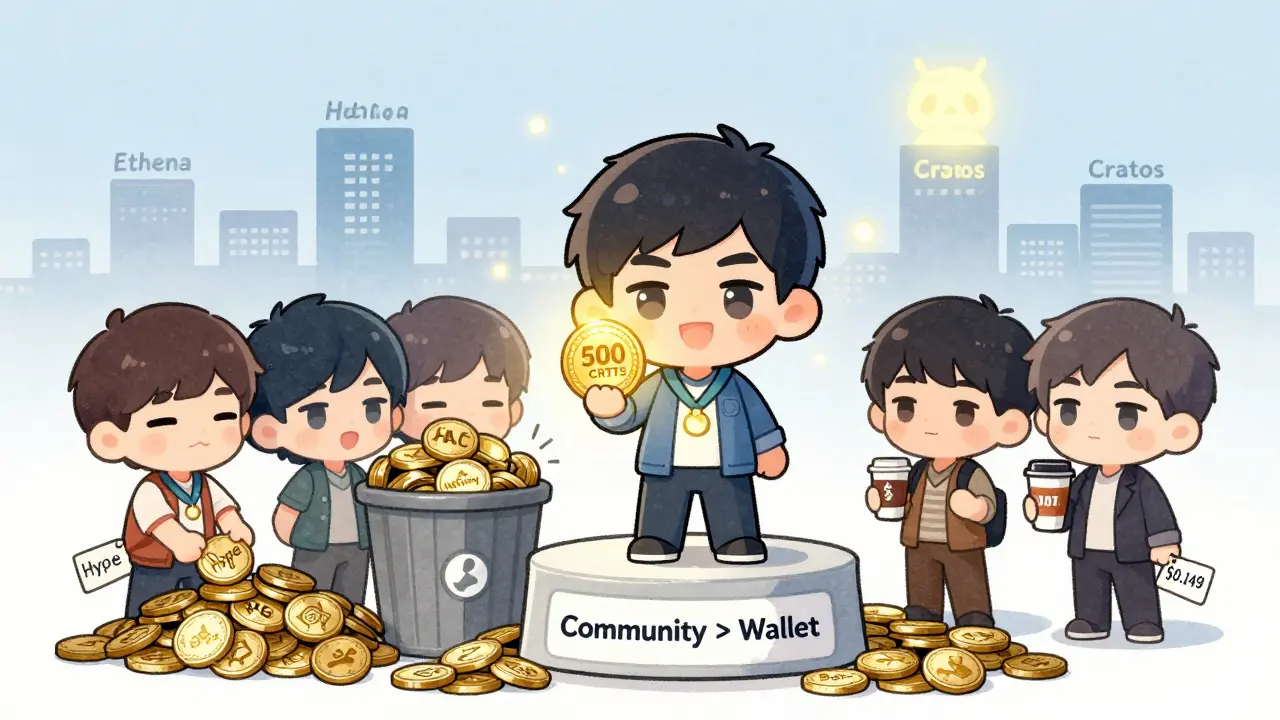
Cratos distributed exactly 500 CRTS tokens to each of 5,000 winners. That’s 2.5 million CRTS tokens total. Not a huge number in the grand scheme of crypto-especially when you consider the circulating supply was over 62 billion-but enough to make a difference to everyday users. At the time of the airdrop, each CRTS token was worth about $0.00029888. That meant each winner received roughly $0.149 in value. Not a fortune, but enough to cover a coffee or two.
The airdrop wasn’t meant to make people rich. It was meant to get people involved. Cratos wanted users to join their Discord, follow their Twitter, and start talking about the project. The token wasn’t a prize-it was a handshake.
When Did It Happen?
The airdrop officially ended on July 5, 2024, at 8:00 AM UTC+9. That’s not a random time-it’s Japan Standard Time. Cratos clearly had its eye on Asia, where crypto adoption was growing fast and community-driven projects were gaining traction. The deadline was strict. No extensions. No exceptions. If you didn’t complete the requirements before that moment, you didn’t get anything.
Interestingly, the announcement itself triggered a market reaction. Within a day of the airdrop news breaking, CRTS jumped 17.7% in price. Two days later, it was up 18.47%. By the time the airdrop closed, the token had gained 37.33% from its pre-announcement price. That’s not typical. Most airdrops don’t move the needle like that. It suggests the community was already primed, and the announcement was the spark.
Who Got Selected?
Cratos never published a full list of winners. They didn’t need to. The selection process was based on community activity-not technical requirements like holding a certain amount of tokens or staking. If you were active in their Discord, shared their posts on Twitter with #CRATOS2024, or engaged in their Telegram group, you had a shot. No KYC. No wallet address submission. No complicated forms.
This was a classic “social airdrop.” It rewarded people who cared enough to show up. Not people who were just hunting for free tokens. That’s why the price surged. The people who got the tokens were already believers. They didn’t dump them the second they arrived. They held. They talked. They brought others in.
How Did It Fit Into the Bigger Picture?
In 2024, there were 36 major airdrops across the crypto space. Projects like Ethena, PENGU, and Hyperliquid handed out millions in value. Some raised tens of millions in funding before even launching. Cratos didn’t have that kind of backing. It didn’t have Andreessen Horowitz or Sequoia behind it. But it didn’t need to.
Cratos was small, focused, and real. It didn’t overpromise. It didn’t create a multi-phase, 60-day claim window like Midnight Network. It didn’t bury the airdrop in a labyrinth of mining tasks. It just said: “If you’re here, you’re part of this. Here’s your share.” And it worked.
The project’s market cap sat at $18.7 million during the airdrop. Daily trading volume hit $29.6 million. That’s a healthy ratio for a project this size. It meant liquidity was there. People were buying and selling. The airdrop didn’t flood the market-it fed it.
What Happened After?
The price didn’t crash after the airdrop ended. That’s rare. Most projects see a dump once tokens are distributed. But CRTS held steady. The community kept talking. The team kept updating. The token kept trading. By the end of 2024, CRTS was still moving, still active, still on exchanges. It wasn’t a moonshot, but it wasn’t dead either.
Today, over a year later, CRTS is still around. It’s not a top 100 coin. It’s not in the headlines. But it’s still trading. The 2.5 million tokens given out? They’re still in wallets. Some were sold. Some were held. Some were used in early ecosystem features-like staking or voting on governance proposals. The airdrop didn’t just hand out tokens. It handed out ownership.
Why This Matters Now
If you’re looking for an airdrop today, you’re probably chasing something bigger: RedotPay, Andrena, Espresso. Projects with millions in funding, VC backing, and complex eligibility rules. But Cratos shows something different. You don’t need millions to build a community. You just need honesty.
Cratos didn’t promise moon missions. It didn’t claim to be the next Bitcoin. It just said: “We’re building something. If you care, show up. We’ll reward you.” And they did.
That’s the real lesson here. Not how much you got. But why you got it.
What You Can Learn From It
If you’re thinking about joining the next airdrop, here’s what Cratos teaches:
- Be active, not just present. Following a Twitter account isn’t enough. Comment. Share. Ask questions.
- Timing matters. The airdrop closed on a specific date, at a specific time. Set a reminder.
- Don’t chase hype. CRTS wasn’t a “100x” token. But it was real. And that’s worth more than a fake promise.
- Community > Wallet. The people who got rewarded weren’t the ones with the biggest wallets. They were the ones who showed up.
The Cratos airdrop didn’t change the crypto world. But it reminded people that not every project needs to be a unicorn to be worth supporting.
Was the Cratos airdrop real?
Yes. The Cratos (CRTS) airdrop was real and completed on July 5, 2024. A total of 2.5 million CRTS tokens were distributed to 5,000 verified community members. The airdrop was announced on official Cratos channels, and the token price movement following the announcement confirms its legitimacy.
How much was each Cratos airdrop worth?
Each winner received 500 CRTS tokens. At the time of distribution, CRTS was trading at approximately $0.00029888 per token, making each airdrop worth around $0.149. While small in dollar value, the tokens represented actual ownership in the Cratos ecosystem and were not just speculative.
How were winners selected for the Cratos airdrop?
Winners were selected based on community activity, not technical requirements. Participation in Cratos’s Discord, Twitter, and Telegram channels, along with using official hashtags like #CRATOS2024, were the main criteria. No wallet submissions, KYC, or minimum token holdings were required. The project prioritized genuine engagement over automated or bot-driven entries.
Can I still claim Cratos (CRTS) tokens from the airdrop?
No. The airdrop deadline was July 5, 2024, at 8:00 AM UTC+9. No claims were accepted after that time. The distribution was completed, and the tokens were sent to eligible wallets. There is no ongoing claim period or extension.
What was the market impact of the Cratos airdrop?
The airdrop announcement caused a 37.33% price increase in CRTS from its pre-announcement level. Daily trading volume surged to $29.6 million, and the project’s market cap reached $18.7 million. The price held steady after distribution, indicating that recipients held rather than dumped their tokens-showing real community support.
How does the Cratos airdrop compare to other 2024 airdrops?
Unlike large airdrops like Ethena or Hyperliquid, which distributed millions in value with complex requirements, Cratos took a simpler, community-first approach. It gave 500 tokens to 5,000 people with minimal barriers. It didn’t have VC backing or multi-phase claim structures. Instead, it focused on rewarding active participants, making it a model of grassroots token distribution.
What’s Next for CRTS?
Cratos hasn’t announced another airdrop. That’s not because it’s gone quiet-it’s because it doesn’t need one. The community is already there. The tokens are in circulation. The ecosystem is growing slowly, steadily. If you’re looking for the next big thing, you’ll find it in the louder projects. But if you’re looking for something real? Cratos is still there.

George Suggs
February 21, 2026 AT 17:56Cratos got it.
Samantha Stultz
February 23, 2026 AT 07:15Daisy Boliaan
February 23, 2026 AT 14:17McKenna Becker
February 24, 2026 AT 15:14Jessica Carvajal montiel
February 26, 2026 AT 13:39Tanvi Atal
February 26, 2026 AT 21:09Colin Lethem
February 27, 2026 AT 07:57Dianna Bethea
February 27, 2026 AT 19:18bella gonzales
March 1, 2026 AT 12:20Dee Resin
March 2, 2026 AT 19:53Kaitlyn Clark
March 3, 2026 AT 00:57Derek Sasser
March 3, 2026 AT 04:24Michael Rozputniy
March 3, 2026 AT 04:29Cathy Sunshine
March 4, 2026 AT 09:12