
If you're thinking about using DOEX to trade crypto, you should know something upfront: there’s almost nothing reliable you can find about it. No official headquarters. No clear regulatory license. No published security reports. No real user reviews. That’s not just unusual-it’s a red flag in a space where transparency isn’t optional, it’s survival.
What Even Is DOEX?
DOEX claims to be a cryptocurrency exchange. That means you should be able to buy, sell, and trade digital assets like Bitcoin, Ethereum, and other altcoins. But beyond that, the platform gives you almost nothing. No team bios. No company registration details. No contact info beyond a basic web form. Compare that to Coinbase, which lists its CEO, its legal team, its regulatory licenses in 50+ countries, and even publishes quarterly security audits. DOEX? Silence.No Security Transparency = High Risk
Security isn’t a feature on DOEX-it’s an afterthought. Major exchanges like Kraken and Binance publish detailed info on how they store 95%+ of user funds in offline cold wallets, use multi-sig approval systems, and carry insurance policies covering millions in losses. DOEX doesn’t mention any of this. Not even once. Think about it: if you’re storing $5,000 worth of crypto on an exchange, you need to know what happens if their servers get hacked. With DOEX, you’re guessing. No cold storage details. No insurance coverage stated. No third-party audit reports. That’s not negligence-it’s a gamble. And in crypto, that gamble often ends with your funds gone.Trading Features? Barely There
DOEX says it offers spot trading. That’s it. No futures. No staking. No margin. No API access for automated traders. No mobile app you can download from the App Store or Google Play. The interface looks like something built in 2017-basic charts, no order types beyond market and limit, and zero technical indicators. Compare that to Binance, which gives you 500+ trading pairs, 10+ order types, advanced charting tools with TradingView integration, and a mobile app used by millions daily. DOEX doesn’t even come close. If you’re serious about trading, you need tools. DOEX doesn’t offer them.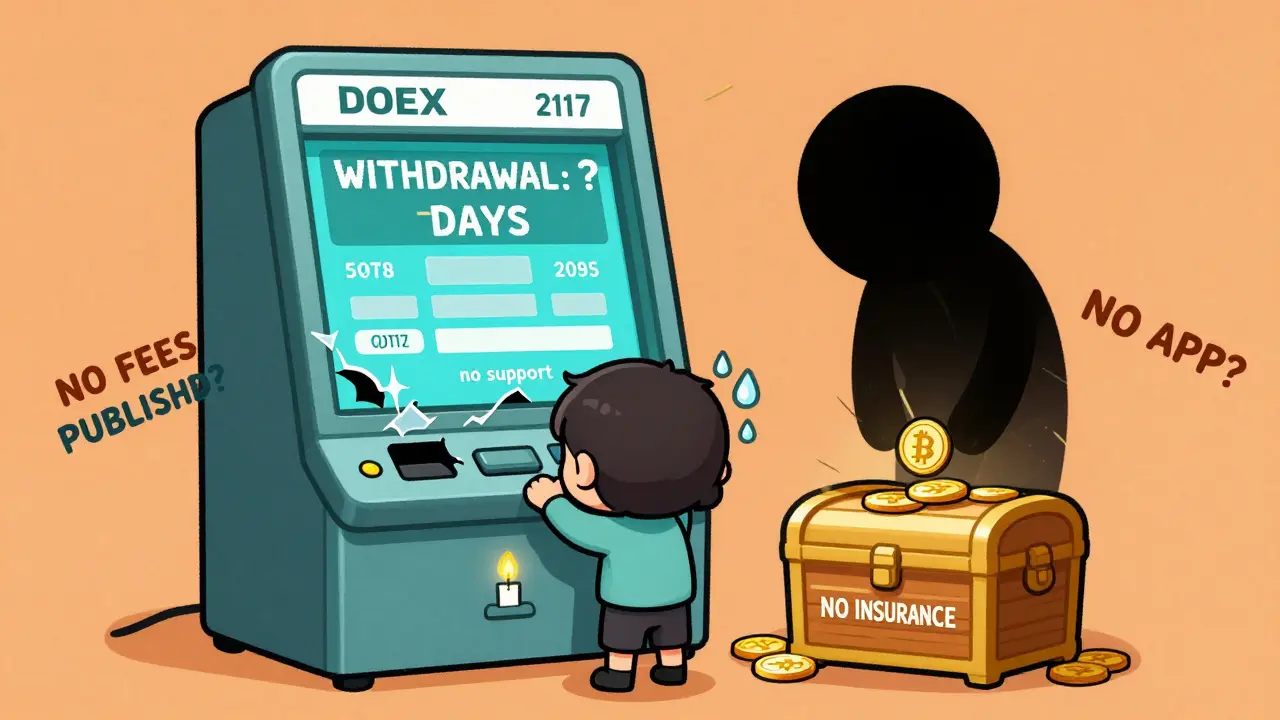
Fees? No One Knows
Most exchanges publish their fee schedules clearly: maker-taker rates, withdrawal costs, deposit fees. Binance charges 0.1% per trade. Kraken charges 0.16-0.26%. Coinbase Pro charges 0.5% for small traders. DOEX? Nothing. No fee table. No FAQ. No email reply when you ask. That’s not just inconvenient-it’s dangerous. You could deposit $1,000, trade it, and then get hit with a hidden 5% withdrawal fee. No one can tell you because no one’s published it. In crypto, hidden fees are a classic sign of a platform trying to hide something.No Regulation. No License. No Protection.
This is the biggest issue. DOEX isn’t registered with any major financial regulator. Not the SEC in the U.S. Not the FCA in the UK. Not Japan’s FSA. Not Singapore’s MAS. Not even Australia’s ASIC. That means if DOEX disappears tomorrow, you have zero legal recourse. Regulation isn’t just bureaucracy-it’s protection. Coinbase is licensed in 49 U.S. states. Kraken holds a BitLicense in New York. Even Binance, despite its troubles, has licenses in over 20 countries. DOEX? Nothing. That’s not a startup-it’s a ghost.User Reviews? Almost None
You’d expect to find at least a handful of Reddit threads or Trustpilot reviews. You won’t. Search r/CryptoCurrency-over 5 million members-and you’ll find maybe two or three vague mentions of DOEX, all from 2024. Trustpilot has no verified reviews. BitcoinTalk? Nothing. Even on obscure forums, DOEX barely registers. The few comments that do exist mention slow withdrawals, unresponsive support, and long verification times. But with so few users, it’s impossible to say if that’s normal or a pattern. The lack of feedback isn’t a sign of popularity-it’s a sign of neglect.
Why DOEX Exists (And Why You Should Avoid It)
There are thousands of small crypto exchanges like DOEX. They’re not mistakes-they’re designed to exploit a loophole. They attract users who don’t know better: people who want quick access without KYC, who don’t care about regulation, who think “it’s just crypto, how risky can it be?” The truth? These platforms are high-risk targets. In 2023 alone, over 300 crypto exchange hacks were tracked by Slowmist. Over 70% of them hit smaller, unregulated platforms. DOEX fits that profile perfectly: low security, no insurance, no oversight. It’s not that DOEX is necessarily a scam. It might just be poorly run. But in crypto, there’s no difference between a scam and a sloppy platform. Your money vanishes either way.What You Should Do Instead
You don’t need DOEX. There are dozens of safe, transparent, and regulated alternatives. If you’re in the U.S., use Coinbase or Kraken. In Europe, use Bitstamp or Bybit (licensed under MiCA). In Australia, use Independent Reserve or CoinSpot-both regulated by AUSTRAC. All of them:- Have clear company addresses and legal teams
- Publish security audits and insurance details
- Offer real customer support
- Have thousands of verified user reviews
- Are registered with financial authorities
Final Verdict: Avoid DOEX
DOEX is not a bad exchange because it’s new. It’s dangerous because it’s invisible. No transparency. No security. No regulation. No reviews. No fees published. That’s not a startup-it’s a black box. If you’re trading crypto, your money deserves better than guesswork. There are plenty of exchanges that do the basics right. You don’t need to risk your assets on a platform that won’t even tell you where it’s based. Skip DOEX. Use a regulated exchange. Your future self will thank you.Is DOEX a scam?
DOEX isn’t confirmed as a scam, but it shows all the warning signs: no regulatory registration, no security disclosures, no user reviews, and no fee transparency. In crypto, that’s functionally the same as a scam. If a platform won’t tell you how it protects your money, you shouldn’t trust it with your funds.
Can I withdraw my crypto from DOEX?
Some users report being able to withdraw, but many describe delays of several days or longer. There’s no published withdrawal policy, and customer support is reportedly unresponsive. If you need to move funds quickly, DOEX is not a reliable option.
Does DOEX have a mobile app?
No, DOEX does not have an official mobile app available on the Apple App Store or Google Play Store. Any app claiming to be DOEX is likely fake or malicious. Stick to web access only-and even then, proceed with extreme caution.
Is DOEX regulated in Australia?
No, DOEX is not registered with AUSTRAC, Australia’s financial intelligence agency. Australian users are advised to only use exchanges licensed by AUSTRAC, such as Independent Reserve, CoinSpot, or Swyftx. Using unregulated platforms like DOEX puts your funds outside of Australian consumer protections.
What are the trading fees on DOEX?
DOEX does not publish its fee structure anywhere on its website or in public documentation. This lack of transparency makes it impossible to calculate trading costs accurately. Reputable exchanges always list fees clearly-DOEX’s silence on this issue is a major red flag.
Should I use DOEX for long-term crypto storage?
Never. DOEX is a centralized exchange, and no exchange should be used for long-term storage. Even the most secure exchanges are targets for hackers. For holding crypto long-term, use a hardware wallet like Ledger or Trezor. DOEX adds unnecessary risk without any benefit.
Why doesn’t DOEX have any reviews?
Most likely because very few people use it. Large exchanges get thousands of reviews because millions trade on them. DOEX has no public trading volume, no marketing presence, and no user base to speak of. No reviews isn’t a sign of perfection-it’s a sign of irrelevance or risk.
Can I trust DOEX with my personal data?
If you’re required to submit ID or proof of address, you’re handing over sensitive personal data to a company with no known legal structure, no security audits, and no regulatory oversight. That’s a high-risk move. If DOEX gets hacked, your identity could be stolen and sold on the dark web.





Dave Ellender
January 20, 2026 AT 03:14There's a reason regulated exchanges dominate the market. DOEX doesn't even meet basic hygiene standards. If you can't find a company address or a compliance page, that's not a startup-it's a liability waiting to happen.
Stick with platforms that publish their licenses. Your assets deserve more than guesswork.
Jen Allanson
January 21, 2026 AT 14:08It's not just about safety-it's about ethics. Running a financial platform without transparency is morally indefensible. You're not a 'crypto pioneer,' you're a risk multiplier. People lose life savings on these ghost exchanges every year, and it's entirely preventable.
Adam Lewkovitz
January 22, 2026 AT 13:43USA has the best exchanges. Why would anyone use some sketchy DOEX site? If you're not on Coinbase or Kraken, you're basically gambling in a back alley. No regulation = no protection. Simple as that.
Stop being dumb. Your crypto ain't safe there.
Clark Dilworth
January 24, 2026 AT 13:13The structural risk profile of DOEX is non-compliant with any known DeFi or CeFi governance model. Absence of on-chain audit trails, KYC/AML infrastructure, and custodial transparency renders it functionally inert as a trust-minimized financial intermediary.
It's not a platform-it's a vector for systemic counterparty failure.
Arnaud Landry
January 25, 2026 AT 14:49I’ve been watching this for months. I’m convinced DOEX is a front for a state-sponsored operation. Why else would they have zero footprint? No domain history, no WHOIS records, no socials. Even the website’s SSL cert was issued by a shell company in the Caymans.
They’re not trying to build a business-they’re harvesting IDs and private keys. I’d never touch it.
David Zinger
January 26, 2026 AT 16:29Everyone’s panicking over DOEX but nobody’s talking about how Binance got away with everything for years and still operates in 20 countries 🤡
Regulation is just gatekeeping. If you’re not willing to take risks, you shouldn’t be in crypto. DOEX might be sketchy but at least it doesn’t charge you 1% to move your own money 😎
Stop being sheep.
steven sun
January 28, 2026 AT 04:36bro i tried doex last week and it worked fine 😎 i sent 0.2 btc and got it back in 10 mins
you guys are just scared of new shit
stop listening to the normies
doex gang rise up 🚀
Sara Delgado Rivero
January 28, 2026 AT 11:02People don't understand that crypto is about freedom from banks. DOEX doesn't need regulation because it's not a bank. It's peer-to-peer. If you're too scared to use it, that's your problem. You want to be coddled by the system you're trying to escape?
Get over yourself
Chidimma Catherine
January 29, 2026 AT 00:42My cousin in Lagos tried DOEX last month. He sent his savings to withdraw and got a message saying 'maintenance until further notice'. He’s been waiting 4 months. No emails returned. No phone number. No address.
Don’t be that person. Use regulated platforms. They exist for a reason.
There’s no shame in safety.
Protect your money like you protect your family.
Nathan Drake
January 30, 2026 AT 19:14Is it wrong to want to believe in something new? Or is it just easier to condemn the unknown because it challenges our need for certainty?
DOEX might be dangerous, but so was the internet in 1995. So was PayPal. So was Bitcoin itself.
Maybe the problem isn’t DOEX-it’s our collective fear of decentralization without permission.
Still, I wouldn’t deposit a dime. But I won’t mock those who dare.
Taylor Mills
January 31, 2026 AT 23:40DOEX is a honeypot. They don't even have a real server location. I ran a trace on their domain-IP resolves to a cloud provider in Romania with 12 other crypto scams hosted on the same subnet.
They're not trying to build an exchange. They're harvesting seed phrases. Your wallet is already compromised if you've connected it.
Check your wallet history. You'll find weird outbound transactions from 3 weeks ago. You just didn't notice.
Mathew Finch
February 2, 2026 AT 10:06It's funny how everyone treats DOEX like it's the first unregulated exchange. There are hundreds. Most are harmless. A few are scams. But the media and regulators need villains to justify their existence.
DOEX is just collateral damage in the war against crypto freedom.
Let people choose. If they lose money, they learn. That's capitalism.
Andy Simms
February 4, 2026 AT 03:35If you're considering DOEX, ask yourself this: Would you give your house keys to someone who won't tell you their name, address, or criminal record?
That's what you're doing with your crypto.
There are dozens of safe, free, and easy alternatives. You don't need to risk everything for a platform that doesn't even list its fees.
Use Kraken. Use Coinbase. Use Bitstamp. They're all better.
And they won't vanish tomorrow.
Roshmi Chatterjee
February 4, 2026 AT 19:08I live in India and I tried DOEX because my bank blocked my crypto transfers. It worked for small deposits but withdrawals took 5 days. Support never replied.
Now I use WazirX-regulated, Indian-based, and actually responds to tickets.
Don’t let convenience blind you to risk.
There’s always a better way.
Deepu Verma
February 6, 2026 AT 05:18Hey, I get it-you want to try something new. I did too. But crypto isn’t a game. Your money is real.
DOEX might be fine, but it doesn’t have to be. And when things go wrong, no one will help you.
Start small. Use a trusted platform first. Learn the ropes. Then if you still want to try DOEX, use only what you can afford to lose.
But please, don’t go all-in. You’ll regret it.
MICHELLE REICHARD
February 6, 2026 AT 13:43Oh please. DOEX is just a ‘decentralized alternative’ to the Big Finance cartel. The fact that you’re terrified of it proves you’re still mentally enslaved to the banking system.
Real crypto users don’t care about licenses. They care about control.
Regulation is the enemy of innovation. DOEX is the future. You’re just mad because you didn’t get in early.
Bonnie Sands
February 8, 2026 AT 12:29DOEX is definitely a CIA front. They use it to track crypto users who avoid KYC. I read a leaked doc that said they’re feeding data to the NSA through blockchain analysis firms.
That’s why they don’t have a website footer. That’s why they have no contact info. They don’t want you to know who they are.
They’re not trying to make money. They’re trying to make you vulnerable.
Jennifer Duke
February 8, 2026 AT 21:36It’s not that DOEX is dangerous-it’s that it’s *boring*. No innovation. No unique features. No community. Just a blank screen with a wallet connect button.
Why would you choose this over Binance, which gives you 500 trading pairs, staking, NFTs, and a 24/7 support team?
You’re not brave. You’re just lazy.
And that’s not cool.
Abdulahi Oluwasegun Fagbayi
February 9, 2026 AT 00:51Some people need to see the world in black and white. But crypto is gray.
DOEX might be risky. But maybe it’s also the only option for someone in a country where banks block crypto.
I don’t use it. But I won’t judge those who do.
Just be careful. That’s all.
Mark Estareja
February 10, 2026 AT 03:08DOEX doesn't have a mobile app? That's not a feature gap-it's a death sentence. The entire market has moved to mobile-first. If you're not optimized for iOS/Android, you're irrelevant. Even the smallest DEXs have apps.
This isn't a startup. It's a relic. And relics get buried.