
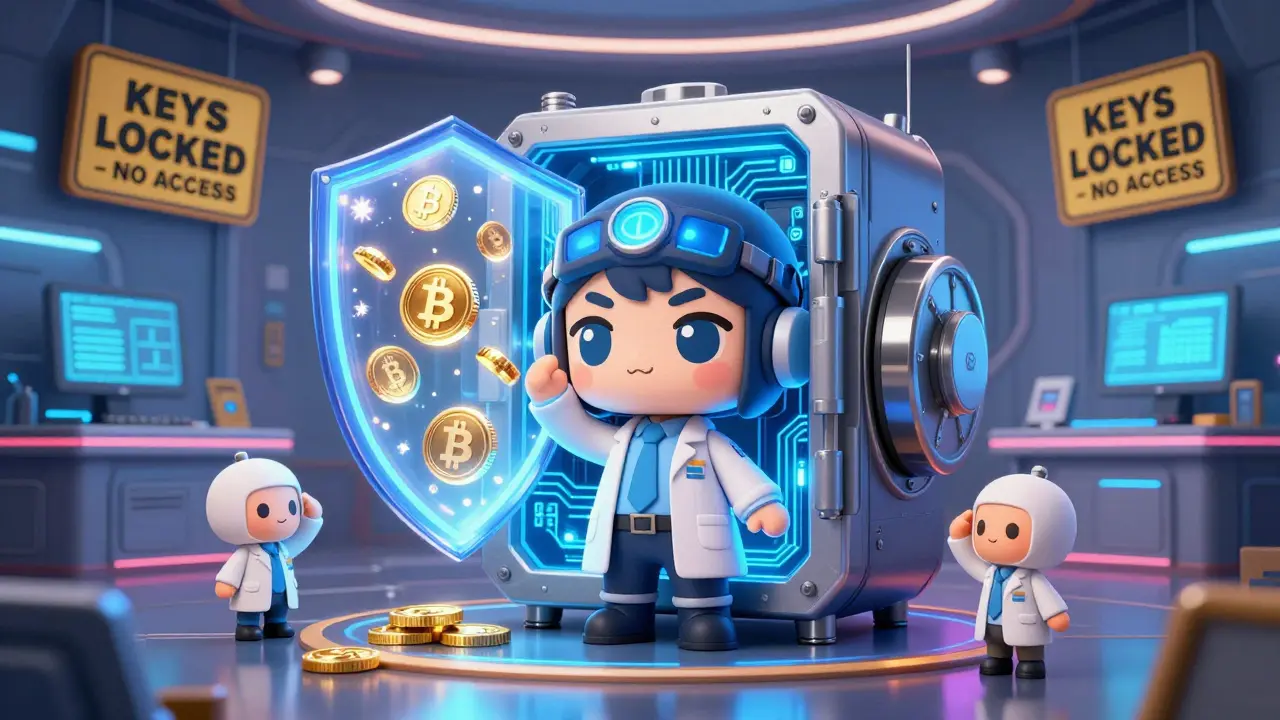
When a cryptocurrency exchange handles billions in customer funds, the biggest threat isn’t a hacker breaking through firewalls-it’s a single private key being stolen, copied, or lost. That’s where HSM key management becomes non-negotiable. Hardware Security Modules aren’t just fancy boxes; they’re the armored vaults that keep digital assets safe by ensuring private keys never leave secure hardware. Without them, exchanges are walking targets.
Why HSMs Are the Backbone of Exchange Security
Think of a private key as the master key to a bank vault. If someone gets that key, they can drain every account linked to it. Software-based key storage? Too risky. Hackers can exploit memory leaks, intercept API calls, or brute-force weak encryption. HSMs eliminate those risks by keeping keys locked inside tamper-resistant hardware. Modern HSMs, like Thales Luna HSM 7 or AWS CloudHSM, are built to FIPS 140-2 Level 3 or 4 standards. That means they physically resist tampering-cutting open the device triggers self-destruction of keys. They generate random keys using true hardware entropy, not software algorithms that can be predicted. And most importantly, keys never leave the HSM. Even the exchange’s own engineers can’t see them. After the Mt. Gox collapse in 2014, where 850,000 BTC vanished due to poor key handling, every major exchange upgraded. By 2017, HSMs became standard. Today, 97 of the top 100 exchanges use them, according to CryptoCompare’s 2023 report. Dr. Matthew D. Green from Johns Hopkins put it bluntly: any exchange without FIPS 140-2 Level 3+ HSMs is operating with unacceptable risk.How HSM Key Management Actually Works
It’s not just about storing keys. It’s about managing their entire lifecycle-generation, use, backup, rotation, and destruction.- Key generation: The HSM creates keys internally using hardware-based random number generators. No human ever sees the raw key.
- Key storage: Keys are encrypted within the HSM and never exported in plaintext. Even backups are encrypted and stored on separate, air-gapped systems.
- Key usage: When a user withdraws BTC, the exchange sends a signing request to the HSM. The HSM signs it internally and returns only the signature-never the key.
- Key rotation: Keys are changed regularly, often every 90 days, to limit exposure if one is compromised.
- Key disposal: Decommissioned keys are physically destroyed inside the HSM, not just deleted.
On-Premises vs. Cloud HSMs: Trade-Offs for Exchanges
Exchanges choose between two main models: on-premises hardware or cloud-based HSMs.| Feature | On-Premises (e.g., Thales Luna HSM) | Cloud HSM (e.g., AWS CloudHSM) |
|---|---|---|
| Performance | 20,000+ RSA signatures/sec | 10,000 RSA signatures/sec |
| Latency | 1-2 milliseconds | 5-10 milliseconds |
| Upfront Cost | $25,000+ per unit | $2.64/hour (AWS) |
| Scalability | Requires new hardware | Instant scaling |
| Disaster Recovery | Manual failover needed | Automatic geographic replication |
| Best For | High-frequency trading, hot wallets | Cold storage, regulatory compliance |

Multi-Party Authorization: The Real Game-Changer
The biggest breakthrough in HSM security isn’t the hardware-it’s how keys are used. Single-key control is a disaster waiting to happen. That’s why 78% of top exchanges now use Multi-Party Computation (MPC) with HSMs. Instead of one person having access to sign a withdrawal, MPC splits the signing process across multiple HSMs, each held by a different team in different locations. For example, Kraken uses a 3-of-5 system: any withdrawal needs approval from three of five geographically separated HSMs. Even if one HSM is compromised, the attacker can’t move funds. Fireblocks’ 2023 report showed that exchanges using MPC with HSMs reduced key compromise incidents by 94%. It’s not just security-it’s operational resilience. When QuadrigaCX collapsed in 2019, it was because the founder held the only key, and he died without handing it over. $190 million vanished. With MPC, that scenario is impossible.Implementation Challenges and Real-World Pitfalls
HSMs aren’t plug-and-play. Getting them right takes time, money, and expertise. Coinbase spent nine months integrating their HSM cluster. Thales’ own data shows 68% of exchange teams need 3+ months of dedicated engineering just to learn how to use the systems properly. The learning curve is steep: you need to understand PKCS #11, FIPS compliance, Linux CLI tools, and cryptographic protocols. And even with perfect HSMs, failures happen. The 2020 KuCoin hack didn’t breach the HSM-it stole API keys from an employee’s laptop. The HSM did its job. But the exchange didn’t enforce strict access controls on the systems that sent requests to the HSM. That’s why experts like Dr. Aggelos Kiayias warn: HSMs create a false sense of security if you ignore the rest of your stack. You need layered security: multi-factor authentication for admin access, network segmentation, zero-trust architecture, and constant monitoring. The Payment Card Industry says it best: HSMs must be part of a layered approach.
What’s Next for HSM Key Management
The future is already here. Thales released Luna HSM 7.2 in early 2023 with support for post-quantum algorithms like CRYSTALS-Dilithium. NIST is finalizing these standards, and the NSA now requires them for all new government HSMs. Exchanges that wait will be left behind. The FIDO Alliance is also working on integrating HSMs with passkey authentication for withdrawals. Google’s pilot showed this could cut phishing attacks by 92%. Imagine logging in with your phone’s biometrics to approve a withdrawal-no passwords, no SMS codes, no risk of SIM-swapping. Cloud HSM-as-a-service is growing fast. Thales’ DPoD marketplace saw a 140% year-over-year increase in 2022. Smaller exchanges that can’t afford $25,000 hardware boxes can now rent enterprise-grade security for a few hundred dollars a month.Final Reality Check
HSM key management isn’t optional. It’s the difference between surviving a crypto winter and vanishing like Terraform or Celsius. Gartner found that 100% of exchanges that made it through the 2022 market crash had mature HSM implementations. The ones that didn’t? They had software keys, single-point access, or no audit trails. If you’re running an exchange, or investing in one, ask this: Where are the private keys? Are they in a hardware vault with multi-party controls and full audit logs? Or are they sitting on a server somewhere, vulnerable to a single breach? The answer determines whether your assets are safe-or just waiting to be taken.What is an HSM in cryptocurrency exchanges?
An HSM, or Hardware Security Module, is a physical device that generates, stores, and uses cryptographic keys securely. In cryptocurrency exchanges, it ensures private keys controlling customer funds never leave the device in readable form. This prevents hackers from stealing keys through software exploits or insider threats.
Why can’t exchanges just use software to store private keys?
Software-based key storage is vulnerable to memory dumps, malware, phishing, and insider attacks. Even encrypted keys in memory can be intercepted. HSMs keep keys isolated in tamper-resistant hardware that destroys them if physically breached. This physical isolation is what makes HSMs the only trusted solution for high-value digital assets.
What’s the difference between FIPS 140-2 Level 3 and Level 4?
FIPS 140-2 Level 3 requires strong physical tamper resistance and identity-based authentication. Level 4 adds full environmental protection-meaning if someone tries to cut into the device, change temperature, or interfere with power, the HSM automatically wipes all keys. Level 4 is rare and expensive, but required for the highest-risk operations like cold storage in major exchanges.
Can HSMs be hacked?
HSMs themselves are extremely hard to hack directly. But attackers don’t need to break the HSM-they can compromise the systems that send requests to it. The KuCoin hack in 2020 was a perfect example: the HSM was secure, but an employee’s laptop was infected, and malware sent fraudulent signing requests. That’s why HSMs must be part of a full security stack, not the only defense.
Do all cryptocurrency exchanges use HSMs?
As of 2023, 97 of the top 100 exchanges by trading volume use HSMs. Regulatory bodies like the New York DFS now require FIPS 140-2 Level 3+ HSMs for licensed exchanges. Smaller or unregulated platforms may still use software keys, but they’re at high risk of theft, legal action, or collapse-like QuadrigaCX in 2019.
How much does HSM key management cost for an exchange?
On-premises HSMs like Thales Luna start at $25,000 per unit, plus 15-20% annual maintenance. Cloud HSMs like AWS charge $2.64/hour, which adds up to about $1,900/month for continuous use. But cost isn’t just hardware-it’s also engineering time. Most exchanges spend 3-9 months and $200,000+ on integration, training, and policy design before going live.
What happens if an HSM fails?
Exchanges use clustered HSMs with automatic failover. If one unit fails, another takes over instantly. Keys are encrypted and replicated across multiple units in different locations. During a 2021 European data center outage, an exchange maintained 99.95% uptime because their cloud HSMs automatically switched to backup regions. No funds were locked, and no transactions were lost.
Are HSMs future-proof against quantum computing?
Current HSMs use RSA and ECC algorithms, which quantum computers could break. But new HSMs like Thales Luna 7.2 already support post-quantum algorithms like CRYSTALS-Dilithium. The NSA and NIST are pushing for adoption by 2026. Exchanges that upgrade now will be ready. Those that wait risk being vulnerable when quantum attacks become practical.





Rishav Ranjan
December 19, 2025 AT 21:57HSMs? Cool. But why do we even need them if most exchanges get hacked through employees anyway?
Steve B
December 21, 2025 AT 19:18One cannot help but reflect on the metaphysical implications of cryptographic isolation-when a key is never seen, does it truly exist? Or is it merely a ghost in the machine, a silent guardian of digital souls?
Dusty Rogers
December 21, 2025 AT 23:17Reading this made me realize how much engineering goes into keeping crypto safe. It’s not magic-it’s years of careful design, testing, and discipline. Hats off to the teams doing this work.
Mmathapelo Ndlovu
December 22, 2025 AT 20:45This is so important 💪✨ I’ve been watching crypto for years and this is the one thing people never talk about-how the keys are actually protected. Thank you for laying it out like this. So many lives and savings depend on this stuff.
Tyler Porter
December 24, 2025 AT 19:55HSMs are essential. Essential. Essential. No excuses. No exceptions. If you’re not using them, you’re gambling with people’s money.
Earlene Dollie
December 25, 2025 AT 18:26Imagine if your grandma’s life savings vanished because someone stole a key she didn’t even know existed… and then the exchange said ‘oops’? That’s not a tech problem-it’s a moral failure.
Kevin Karpiak
December 26, 2025 AT 05:49Why are we trusting American-made HSMs? What if they’re backdoored? We need Russian or Chinese hardware for true sovereignty.
Amit Kumar
December 27, 2025 AT 12:28Bro, in India we had a guy who lost 50 BTC because he saved his seed phrase on a sticky note. HSMs aren’t luxury-they’re survival. And yeah, they cost money, but so does crying over lost crypto at 3 AM.
Helen Pieracacos
December 27, 2025 AT 21:17So you're telling me the real reason exchanges don't use HSMs is because they're too lazy to spend $25K? Cute.
Melissa Black
December 29, 2025 AT 20:34The cryptographic lifecycle management via PKCS #11 interfaces, coupled with FIPS 140-2 Level 3+ attestation, represents the de facto standard for asset integrity in decentralized finance. Non-compliance is not negligence-it’s existential risk.
Naman Modi
December 30, 2025 AT 17:59Yeah right, HSMs are perfect. Until the CEO’s dog eats the backup drive. 😢
Rebecca F
December 31, 2025 AT 09:54Everyone’s so obsessed with HSMs but nobody talks about how most of these exchanges are just glorified Ponzi schemes with fancy boxes. The real risk is the people running them.
Vijay n
December 31, 2025 AT 13:01HSMs are just a distraction from the real truth the west doesnt want you to know the NSA controls all key generation through backdoors in thales and aws systems trust no one
Alison Fenske
December 31, 2025 AT 22:26It’s wild how something so technical feels like a superhero movie-the keys are locked in a fortress, no one sees them, they vanish if you even look at them funny. I love it.
Collin Crawford
January 2, 2026 AT 12:12You mention FIPS 140-2 Level 3, but fail to acknowledge that FIPS 140-3 has been the standard since 2019. Your data is outdated. This undermines the entire credibility of your argument.
Jayakanth Kesan
January 3, 2026 AT 21:57Good read. I’m not in crypto, but I work in IT security. This stuff matters. Even if you’re just holding a little BTC, knowing it’s protected gives you peace.
Aaron Heaps
January 5, 2026 AT 06:0697/100 use HSMs? Yeah right. Most of those are just marketing fluff. Look at the real numbers-half the top 50 are still using software wallets behind the scenes.
Tristan Bertles
January 6, 2026 AT 01:59People forget that HSMs are only as good as the people managing them. But hey, at least they’re a step forward. Keep pushing for better systems.
Megan O'Brien
January 8, 2026 AT 01:37Post-quantum algorithms? More like post-hype. Nobody’s even using ECC properly yet.
Brian Martitsch
January 9, 2026 AT 05:45Only amateurs think HSMs are enough. Real security requires quantum-resistant MPC, zero-knowledge attestations, and hardware root-of-trust chains. If you’re not doing all three, you’re playing dress-up.
Rachel McDonald
January 10, 2026 AT 13:38So basically… if you’re not using HSMs, you’re just asking to get robbed? And the worst part? You’ll never even know until it’s too late. 😭
Grace Simmons
January 11, 2026 AT 11:18The reliance on U.S.-based cloud infrastructure for cryptographic security presents a systemic vulnerability for non-American jurisdictions. This is not merely a technical issue-it is a geopolitical liability.
chris yusunas
January 13, 2026 AT 04:57Man in Nigeria we got guys using USB drives to store keys. But hey at least they got internet. Progress is messy.
Sophia Wade
January 14, 2026 AT 07:10The true question isn’t whether HSMs protect keys-it’s whether society is ready to accept that absolute security requires absolute control. And who, really, should hold that control?
Dustin Bright
January 14, 2026 AT 07:44so hsm = good? i mean i get it but what if the guy who has the password to the hsm is also the guy who hacked the laptop? like… what then? 😅
Dusty Rogers
January 15, 2026 AT 14:57Good point about the laptop breach. That’s why we enforce MFA and air-gapped signing stations. The HSM does its job-it’s the humans that need better guardrails.