

Privacy Coin Regulatory Status Checker
Check Your Country's Privacy Coin Regulations
Based on current global regulatory landscape. Privacy coins include Monero and Zcash.
Select a country to see regulatory status
How This Works
Privacy coins face varying regulatory treatments worldwide. This tool shows:
- Legal status of privacy coins (Monero, Zcash)
- Exchange restrictions
- Reporting requirements
- Practical risks for users
Bitcoin was never truly anonymous. From day one, every transaction was written in stone on a public ledger. Your name? Not there. But your wallet address? Always visible. And with enough time, tools, and data, that address can be tied to you-your phone number, your IP, your exchange account. That’s the problem privacy advocates have been fighting since 2009. And the fight isn’t slowing down. It’s getting louder, faster, and more dangerous.
How Privacy Tech Got Its Start
When Bitcoin launched, people thought it was secret. It wasn’t. It was pseudonymous. Anyone could see how much you sent, when, and to whom. If you ever used that same address to buy coffee or cash out on an exchange, your whole history became public. That’s not privacy-that’s transparency with a mask. So developers built better tools. Monero came in 2014 with ring signatures, stealth addresses, and RingCT. Ring signatures hide your real input among fake ones, so no one can tell which one you used. Stealth addresses generate a new one for every transaction, so receivers can’t be tracked. RingCT hides the amount. Together, they make Monero transactions virtually untraceable. Zcash took a different route. Instead of obfuscating inputs and outputs, it used zk-SNARKs-zero-knowledge proofs that let you prove a transaction is valid without showing any details. You can send $10,000 in Zcash, and the blockchain only says, “This is legit.” Nothing else. No sender. No receiver. No amount. Just proof. These weren’t just tech demos. They were responses to real-world tracking. Researchers had already shown how to link Bitcoin addresses to real identities using timing analysis, cluster algorithms, and exchange data. If you bought Bitcoin on Coinbase and sent it to another wallet, they could trace it. Privacy coins said: “Not anymore.”The Surveillance Backlash
The crypto world didn’t stay quiet. Companies like Chainalysis, Elliptic, and CipherTrace built tools to fight back. They don’t break cryptography. They don’t need to. They use patterns. Think of it like this: If you always send money to the same five addresses every Monday, that’s a pattern. If those addresses are linked to a darknet market, you’re likely connected to it. If you send small amounts to multiple wallets before sending a large one to an exchange, that’s mixing. And mixing? That’s a red flag. These companies cluster addresses into “entities.” One entity = one person or organization. They track transaction flows across chains. They use machine learning to spot behavior that looks like laundering. And they sell this data to exchanges, banks, and governments. In 2023, the U.S. Department of Justice shut down Samourai Wallet, a privacy-focused Bitcoin app, and charged its founders with conspiracy to operate an unlicensed money service business. The government didn’t claim Samourai was used for crimes-it claimed the tool itself enabled them. That’s the shift: privacy tech is now treated as a crime. Exchanges started delisting privacy coins. Binance, Kraken, Coinbase-all dropped Monero or Zcash at some point. Why? Compliance. Regulators said: “If you list privacy coins, you’re a risk.” So exchanges chose safety over choice.Regulation Is the New Weapon
It’s not just about tracking. It’s about banning. China banned all crypto in 2021. Saudi Arabia and Qatar followed. Russia is pushing laws to outlaw anonymous transactions. The U.S. doesn’t ban privacy coins outright-but it makes them impossible to use legally. In the U.S., exchanges must collect KYC (Know Your Customer) data. If you send Monero to a wallet that’s ever been linked to an exchange, that wallet gets flagged. If you use a privacy wallet like Wasabi or Samourai, your bank might freeze your account. The Financial Crimes Enforcement Network (FinCEN) now requires all crypto transactions over $3,000 to be reported. For privacy coins? That’s a death sentence. Some countries are trying to walk a line. The EU’s MiCA regulation doesn’t ban privacy coins, but it forces exchanges to monitor them closely. That means privacy coins will only be traded on a few niche platforms. Most users won’t bother.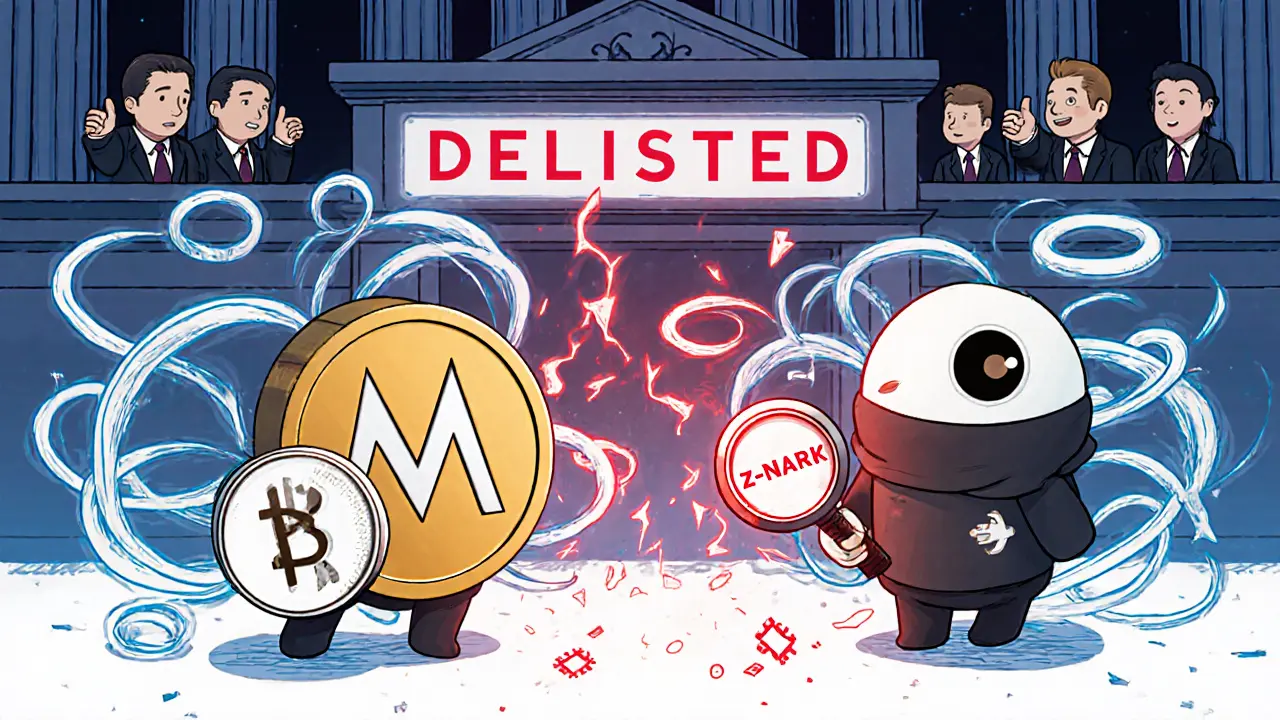
Smart Contracts and the New Frontier
It’s not just about sending coins anymore. Smart contracts are the new battleground. Imagine a company paying contractors in crypto. They want to keep salaries private-but still prove they paid taxes. Or a hospital storing patient payments on-chain without revealing diagnoses. How do you make that work? Some teams are building private smart contracts using zk-SNARKs. Projects like Aztec and Tornado Cash tried. Tornado Cash got sanctioned by the U.S. Treasury in 2022. The founder was arrested. The tool was blocked on every major wallet. The message is clear: Even if you’re not breaking the law, using privacy tech can get you labeled a criminal.The Philosophical Divide
This isn’t just about technology. It’s about belief. Edward Snowden said it best: “Privacy is not the exception. It’s the rule.” If privacy becomes something you have to fight for, then governments control it. And control means power. Privacy advocates argue: Financial privacy is a human right. Just like you don’t need to explain why you pay cash for groceries, you shouldn’t need to explain why you use Monero to send money to a friend. Regulators say: Criminals use privacy tech. Terrorists hide behind it. Sanctioned entities evade detection. We have a duty to stop them. Both sides have points. But here’s the catch: The tools that protect terrorists also protect journalists in authoritarian states. They protect victims of domestic abuse trying to escape. They protect small business owners in countries with corrupt banks. When you ban privacy tech, you don’t just ban criminals. You ban everyone who needs to hide.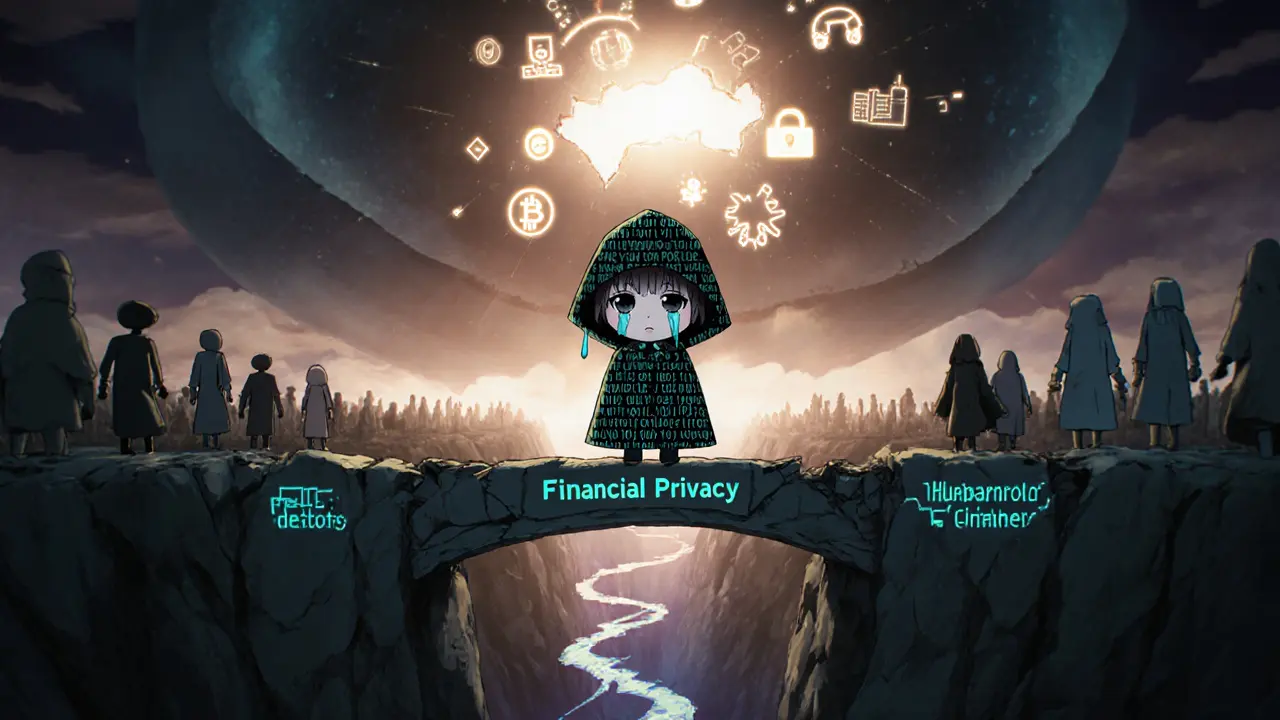
What’s Next? Quantum, AI, and the Endgame
The race isn’t slowing-it’s accelerating. Quantum computers could break today’s encryption. That means both privacy and surveillance tech are built on sand. Developers are already working on quantum-resistant cryptography. Zcash is testing post-quantum zk-SNARKs. Chainalysis is exploring quantum-enhanced clustering. AI is playing both sides. On one hand, AI detects anomalies in transaction flows. On the other, AI helps create better mixing protocols, smarter decoy transactions, and even synthetic identities on-chain. New architectures like DAGs (Directed Acyclic Graphs) are emerging. Obyte, for example, removes miners and validators entirely. No central authority. No single point of control. Just peer-to-peer, censorship-resistant transactions. But here’s the reality: Most people don’t care. Bitcoin and Ethereum still make up 90% of crypto market cap. Privacy coins? Less than 2%. The average user wants simplicity, not secrecy. That’s why the real battle isn’t on the blockchain. It’s in the courts, the exchanges, and the minds of regulators.The Hard Truth
There’s no clean winner here. If privacy wins, criminals thrive. If surveillance wins, freedom dies. The middle ground? It’s thin. And it’s being erased. Some experts suggest technical standards: Allow private transactions, but require identity verification at the point of entry (like exchanges). Let people send anonymously-but only if they’ve proven who they are to begin with. Others say: Don’t regulate the tech. Regulate the behavior. If someone uses privacy tech to launder money, punish them. Don’t punish the tool. But right now, the law doesn’t work that way. It punishes the tool. And the tool is winning fewer battles every year. The future of crypto privacy won’t be decided by coders. It’ll be decided by judges, lawmakers, and voters. And if you think your financial privacy won’t be next on the chopping block-you’re already behind.Are privacy coins illegal?
Privacy coins like Monero and Zcash aren’t illegal in most countries, but they’re heavily restricted. In the U.S., using them can trigger reporting requirements or bank freezes. Exchanges have delisted them due to regulatory pressure. Some countries like China and Saudi Arabia ban all crypto, including privacy coins. The legal risk isn’t about owning them-it’s about using them in ways regulators don’t approve of.
Can Chainalysis really track Monero?
No, Chainalysis cannot track Monero transactions. Monero’s ring signatures, stealth addresses, and RingCT make transaction tracing impossible with current technology. Chainalysis and other firms have admitted this publicly. What they *can* do is track when Monero is converted to Bitcoin or Ethereum on exchanges-and then trace those transactions. But the Monero portion itself remains hidden.
Why do exchanges delist privacy coins?
Exchanges delist privacy coins because regulators threaten them with fines or license revocation. If an exchange allows users to trade Monero, it may be labeled a money service business without proper licensing. Regulators argue privacy coins increase money laundering risk. To avoid legal exposure, exchanges remove them-even if they’re technically legal.
Is Zcash truly anonymous?
Zcash offers two types of transactions: transparent (like Bitcoin) and shielded (private). Shielded transactions use zk-SNARKs to hide sender, receiver, and amount. They’re mathematically private. But if you send Zcash to a transparent address, or convert it to Bitcoin on an exchange, that link becomes visible. Privacy only lasts as long as you stay within shielded pools.
Can AI improve privacy in crypto?
Yes. AI can help generate realistic decoy transactions, simulate user behavior to confuse tracking algorithms, and even create synthetic wallets that mimic real users. Some privacy tools now use AI to optimize mixing patterns and reduce the chance of detection. But AI also helps surveillance firms spot anomalies faster. It’s a double-edged sword.
Will quantum computing break crypto privacy?
Potentially. Current encryption like ECDSA (used in Bitcoin) and some zk-SNARKs could be broken by large-scale quantum computers. That’s why researchers are developing quantum-resistant algorithms. Privacy coins like Monero and Zcash are already exploring post-quantum cryptography. But surveillance tech will also adapt. The next arms race will be fought with quantum-powered analysis tools.





Louise Watson
November 8, 2025 AT 01:55Privacy isn't a feature. It's a right.
Liam Workman
November 9, 2025 AT 03:18I love how this whole thing feels like a sci-fi movie where the heroes use cloaking devices, and the villains just keep building better radar. 🤖📡
But here's the kicker - the people who need cloaking the most? Survivors, journalists, dissidents. Not the bad guys. The bad guys? They've got offshore accounts and lawyers. The real victims are the ones trying to disappear quietly.
Benjamin Jackson
November 9, 2025 AT 07:18Man, I remember when people thought Bitcoin was for hackers. Now it's just another stock you buy on Robinhood. And privacy coins? They're the weird cousin no one invites to family dinners. Sad, really. We built this tech to be free - not to be policed like a high school hallway.
Leo Lanham
November 10, 2025 AT 05:17Monero is just crypto crack. People use it because they're too lazy to learn real finance. And now the feds are coming for it? Good. Let 'em burn.
Brian Webb
November 10, 2025 AT 23:42I get why exchanges delist privacy coins - it’s easier than fighting regulators. But it’s also cowardly. We’re not just losing tools. We’re losing the idea that you can move money without asking permission.
And that’s the soul of crypto, isn’t it?
Whitney Fleras
November 11, 2025 AT 09:28My mom uses PayPal. She doesn’t know what zk-SNARKs are. But if her account got frozen because she sent $5 to a privacy wallet? She’d cry. And she’d never trust crypto again.
That’s the cost of this war. Not the criminals. The quiet ones.
Colin Byrne
November 12, 2025 AT 16:54Let’s be honest - the entire privacy coin movement is a libertarian fantasy wrapped in cryptographic jargon. You want privacy? Use cash. Or better yet - don’t do anything that requires hiding. The fact that you need Monero to send $20 to your cousin means you’re either paranoid or up to no good. And frankly, the latter is more common.
Regulators aren’t the enemy. The enemy is the myth that anonymity equals freedom. It doesn’t. It equals chaos. And chaos doesn’t protect anyone - it just makes it easier for predators to hide.
Why do you think every major privacy tool gets shut down? Not because they’re incompetent. Because they’re dangerous. And dangerous things get removed - like bad apps, bad drugs, bad ideas.
You say ‘privacy is a human right.’ Fine. But so is public safety. Which one gets priority when your neighbor’s kid gets kidnapped and the trail leads to a shielded Zcash transaction? You’ll be begging for surveillance then.
Stop romanticizing obscurity. It’s not liberation. It’s evasion. And evasion doesn’t build a society. It destroys it.
Sunidhi Arakere
November 12, 2025 AT 23:19Interesting read. In India, we don’t have privacy coins. But we do have cash. And people still use it. Because trust in banks is low. Maybe the real issue isn’t the tech - it’s the lack of trust in institutions.
Vivian Efthimiopoulou
November 14, 2025 AT 07:00The legal framework surrounding privacy technologies is fundamentally misaligned with their technological reality. The regulatory apparatus operates on a paradigm of visibility and control - one that assumes all financial activity must be transparent to authorities. Yet cryptographic privacy tools operate on a principle of mathematical certainty: that certain information can be rendered inherently non-revealing without compromising verifiability.
When the U.S. Treasury sanctions Tornado Cash, it is not sanctioning a tool - it is sanctioning a mathematical proof. This is not law. It is epistemological tyranny.
Furthermore, the conflation of privacy with criminality is a logical fallacy of the highest order. The existence of a tool does not imply its misuse. The existence of a hammer does not imply the commission of assault. Yet we punish hammers when someone uses them to break a window - and then wonder why no one builds houses anymore.
The future of financial sovereignty does not lie in compliance. It lies in the ability to prove without revealing. That is not a bug. It is a feature of human dignity.
Angie Martin-Schwarze
November 14, 2025 AT 15:48i just dont get why people care so much... like i use cash for groceries and no one asks me why... but if i send monero? suddenly im a criminal??
also i think the feds are just scared they cant track everyone... which is kinda funny cause they already can... mostly...
anyway im tired of this whole thing
Fred Kärblane
November 15, 2025 AT 20:23Let’s not forget the architectural shift here: We’re moving from UTXO-based transparency to ZK-optimized privacy stacks. The paradigm isn’t just about obfuscation - it’s about composability without correlation. Think of it as zero-knowledge DeFi: private lending, private swaps, private yield. The infrastructure is already being built in the shadows. And when it goes mainstream? The entire KYC/AML model collapses. Not because it’s evil - because it’s obsolete.
Regulators are fighting the last war. The next wave isn’t Monero vs Chainalysis. It’s zk-rollups with private state transitions on Ethereum L2s. That’s where the real battle is. And the banks? They’re still arguing about whether to list XMR.
Steven Lam
November 17, 2025 AT 03:10Privacy coins are just a scam for criminals and conspiracy theorists. If you're not doing anything wrong why are you hiding? You're not a spy. You're not a journalist. You're just a guy who doesn't want to pay taxes. Face it.
Noah Roelofsn
November 19, 2025 AT 02:10The real tragedy isn’t that privacy tech is being banned - it’s that most users don’t even know how to use it properly. People think downloading Wasabi Wallet makes them anonymous. Nope. You still connect to the same ISP. You still use the same device. You still log into Coinbase with your real name.
True privacy isn’t a coin. It’s a stack: Tor + hardware wallet + coinjoin + no KYC + burner email + no metadata.
Most users? They want the illusion of privacy without the effort. And that’s why they get caught.
It’s not the tech that’s failing. It’s the people.
Sierra Rustami
November 20, 2025 AT 07:24America doesn't need crypto privacy. We have the dollar. The rest of the world can have their Monero. We don't need criminals hiding behind code. This is America. We don't hide. We shine.
Ryan McCarthy
November 21, 2025 AT 13:10I think we’re all missing the point. This isn’t about criminals. It’s about control. If the government can track every dollar you move - what else can they track? Your thoughts? Your purchases? Your friendships?
Privacy isn’t about hiding bad things. It’s about keeping space for good things to grow - quietly, safely, without permission.
And if we let them take that space… what’s next?
Abelard Rocker
November 22, 2025 AT 02:40Oh wow. Another ‘crypto is freedom’ sermon. Let me guess - you also think Bitcoin will replace the dollar, and that the Fed is run by lizard people? And that if you use Zcash, you’re a digital Robin Hood?
Newsflash: Nobody cares. The average person uses Venmo. Your ‘privacy revolution’ is a niche subreddit with 12k followers and a guy who thinks he’s a hacker because he uses a VPN.
You’re not fighting tyranny. You’re fighting irrelevance.
And now the government is coming for you? Good. Let them. Maybe then you’ll finally stop pretending you’re a revolutionary when you’re just a guy who doesn’t want his mom to know he bought weed with crypto.
Stop romanticizing your paranoia. It’s not philosophy. It’s a lifestyle choice. And it’s not even a cool one.
Hope Aubrey
November 23, 2025 AT 05:44I just want to say - I lost my job because my bank froze my account after I sent $300 in Monero to a friend for rent. I didn’t do anything wrong. I just needed privacy. And now I’m the villain?
Why does it feel like the world is turning against the quiet ones?
andrew seeby
November 24, 2025 AT 10:19so like... if i use zcash and never touch an exchange... is it really traceable? 🤔
also can ai really guess my wallet from my typing style?? 😅
Pranjali Dattatraya Upadhye
November 26, 2025 AT 10:04My uncle in rural India uses cash to send money to his daughter in Dubai. No app. No ID. Just a man with a bag. Why is it so hard to accept that privacy isn’t about tech - it’s about dignity?
Maybe we need to stop calling it ‘privacy coin’ and start calling it ‘dignity protocol’.
Kyung-Ran Koh
November 26, 2025 AT 19:33There’s a quiet revolution happening - not on the blockchain, but in the minds of people who realize that financial autonomy is non-negotiable.
Privacy isn’t about hiding from the law. It’s about protecting yourself from the abuse of power. From corrupt officials. From abusive partners. From predatory lenders.
When you criminalize privacy, you criminalize vulnerability. And that’s not justice. That’s cruelty dressed in compliance.
We don’t need more surveillance. We need more trust - in people, not systems.
Missy Simpson
November 27, 2025 AT 00:49I just started using Wasabi and it felt like… finally, I could breathe. No one’s watching. No one’s judging. Just me and my money.
Thank you to the devs who keep building this. You’re doing important work.
Finn McGinty
November 27, 2025 AT 02:45While the emotional appeal of privacy is compelling, the legal and economic realities are not so easily dismissed. The argument that privacy tools protect victims is valid - but so is the argument that they enable transnational crime, tax evasion, and sanctions evasion on an unprecedented scale.
Regulators are not monolithic villains; they are institutions operating under immense pressure to maintain financial integrity. The delisting of privacy coins by major exchanges is not an act of oppression - it is risk mitigation in a hyper-regulated global system.
Moreover, the notion that ‘the tool is the crime’ is a legal mischaracterization. The tool is not the crime - its *systemic use* for illicit ends is. The law does not punish hammers; it punishes those who use them to commit violence.
The path forward is not prohibition nor idealism - it is nuanced regulation: mandatory identity verification at on-ramps, transparent reporting thresholds, and differential treatment of shielded vs. transparent transactions. Privacy need not be binary. It can be contextual. And it must be accountable.
Let us not confuse moral courage with legal recklessness. The future of finance requires both liberty and responsibility - not one at the expense of the other.