
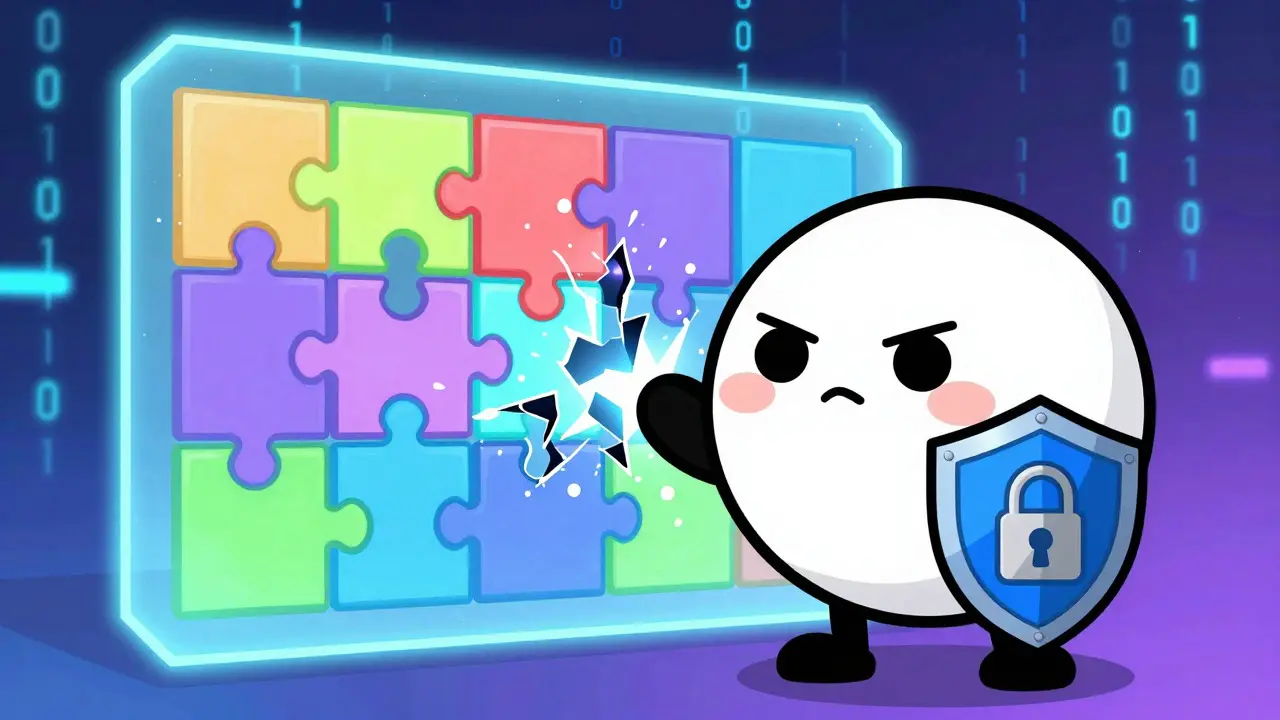
Blockchain networks face a classic problem: they can be secure and decentralized, or they can be fast and scalable, but rarely all three at once. This is known as the blockchain trilemma. To solve this, developers turned to sharding, a technique that splits a network into smaller pieces called shards. Each shard processes its own transactions independently, allowing the whole system to handle more data simultaneously. But breaking a single, unified chain into multiple independent chains introduces serious security risks. If one shard falls, does the whole network fall? How do you stop attackers from targeting weak links? These are the critical questions behind sharding security considerations.
How Sharding Changes the Security Model
In a traditional blockchain like Bitcoin or early Ethereum, every node validates every transaction. This creates a massive amount of redundancy. If an attacker wants to take over the network, they need to control more than 50% (or in some cases, 33%) of the total computing power across the entire globe. That is incredibly difficult and expensive.
When you introduce sharding, that model changes completely. Instead of everyone checking everything, nodes are assigned to specific shards. They only validate transactions within their assigned shard. According to Professor Alec Liu from the MIT Blockchain Lab, "sharding shifts the security model from network-wide to shard-level, creating a fundamentally different attack surface." This means an attacker no longer needs to overpower the entire network. They only need to overpower a single shard.
This shift brings two main technical requirements: liveness and safety. Liveness ensures that the shard can eventually agree on the order of transactions. Safety ensures that once a transaction is confirmed, it cannot be reversed. In a non-sharded network, these properties apply globally. In a sharded network, they must be maintained locally for each shard while still preserving global consistency. If a shard loses liveness, transactions get stuck. If it loses safety, users lose money. The challenge is keeping both intact when nodes are constantly moving between shards.
The Threat of Shard Takeover Attacks
The most direct threat to sharded blockchains is the shard takeover attack. Because shards have fewer validators than the main chain, they are easier to compromise. Imagine a network with 10,000 validators split into 100 shards. Each shard might only have 100 validators. An attacker who controls just 51 of those 100 validators can dictate what happens in that shard. They could double-spend coins, censor transactions, or halt progress entirely.
This risk is amplified by how validators are assigned. Many protocols use random assignment to distribute nodes evenly. However, randomness can sometimes cluster malicious nodes together. If an attacker has a large portion of the total stake, probability works in their favor during reshuffling events. Research from the NDSS Symposium in 2024 highlights that guaranteeing constant liveness and safety requires at least ⌈2(N−1)/3⌉+1 uncorrupted participants to remain active. If the number of honest nodes drops below this threshold in any given shard, security collapses.
To mitigate this, newer protocols like DynaShard (released in 2024) introduced adaptive security parameters. These systems monitor threat levels in real-time. If a shard shows signs of being targeted-such as unusual transaction patterns or consensus delays-the system automatically reconfigures. DynaShard’s testing showed that with 50 shards and 500 validators, even with 10% malicious nodes, the protocol achieved a 0% success rate for cross-shard double-spending attacks. It identified collusion attempts with 98% accuracy and recovered from disruptions in under 3.2 seconds.
Cross-Shard Transaction Vulnerabilities
While securing individual shards is hard, coordinating them is harder. Most real-world applications require interactions between different shards. For example, a user might want to send tokens from Shard A to a smart contract on Shard B. This is called a cross-shard transaction. It introduces complex coordination challenges.
The Nervos Network whitepaper warns that "cross-shard transactions represent the most complex security challenge due to coordination requirements between shards." When Shard A sends value to Shard B, both shards must agree on the state change. If they don’t communicate properly, funds can disappear or be duplicated. Early protocols like OmniLedger required all shards to validate cross-shard transactions, which created bottlenecks and reduced scalability. RapidChain improved speed by reducing communication overhead but became more vulnerable to single-shard takeovers because shards operated more independently.
A formal security analysis by Li et al. (2022) found that sharding protocols using Practical Byzantine Fault Tolerance (PBFT) maintain security only when malicious nodes stay below one-third of the total validators per shard. Cross-shard transactions add extra verification layers, increasing latency by 17-22%. Developers often write 300-400 lines of complex cryptographic code just to handle one type of cross-shard interaction. This complexity increases the chance of bugs. Auditors frequently find critical issues in the logic that handles these handoffs.
Validator Reshuffling and Epoch Transitions
Validators don’t stay in the same shard forever. To prevent long-term attacks, networks regularly reshuffle validators into new shards. This process usually happens at fixed intervals called epochs. While necessary for security, reshuffling is also a prime target for exploits.
During an epoch transition, the network must freeze current operations, calculate new assignments, and restart shards. This window of instability is dangerous. A Reddit user going by 'ChainSecurityExpert' noted in May 2024 that "most sharding vulnerabilities occur during epoch transitions when validators move between shards." Their audit found 12 critical issues in reshuffling logic across five major protocols. Common problems include race conditions where old and new states conflict, or denial-of-service attacks that delay the reshuffle to keep malicious nodes in place longer.
Maintaining security during these transitions requires precise timing and robust communication channels. The DynaShard protocol, for instance, dedicates 22 minutes per epoch specifically to validator reshuffling to ensure smooth handovers. Initial setup can take up to 4.7 hours to establish secure configurations. Teams implementing sharding typically spend 6-8 months developing production-ready security measures before launching. This isn't a plug-and-play feature; it demands deep expertise in distributed systems and cryptography.
Economic Penalties and Slashing Mechanisms
Since purely technical solutions have limits, sharded blockchains rely heavily on economic incentives to enforce honesty. If a validator acts maliciously-by signing conflicting blocks or staying offline-they should be punished. This punishment is called slashing. The validator loses part or all of their staked cryptocurrency.
Effective slashing mechanisms must detect misbehavior quickly and accurately. False positives (punishing honest nodes) can destabilize the network by reducing the pool of available validators. False negatives (missing bad actors) allow attacks to continue. DynaShard reduces malicious actor capabilities by 95% through its penalty mechanisms. By making attacks economically unviable, the network discourages participation from bad actors.
However, designing fair slashing rules is difficult. What constitutes misbehavior in a cross-shard context? If Shard A accuses Shard B of fraud, how do neutral shards decide who is right? Decentralized dispute resolution mechanisms are needed. These often involve committees of randomly selected validators reviewing evidence. The process must be transparent and resistant to bribery. Without strong economic penalties, there is little cost to attacking a small shard, making the network fragile.

Comparison of Sharding Protocol Security Features
| Protocol | Launch Year | Cross-Shard Handling | Vulnerability Focus | Recovery Time |
|---|---|---|---|---|
| OmniLedger | 2018 | All shards validate | Bottlenecks | N/A |
| RapidChain | 2018 | Reduced communication | Single-shard takeover | N/A |
| DynaShard | 2024 | Threshold signatures | Adaptive threats | 3.2 seconds |
| Ethereum Proto-Danksharding | 2024 (Planned) | Data availability sampling | Data withholding | Variable |
Regulatory and Enterprise Implications
As enterprises adopt blockchain for supply chain, finance, and healthcare, sharding becomes attractive for its throughput benefits. A Deloitte survey from late 2023 found that 63% of enterprises cite transaction throughput as the primary driver for sharding. However, regulators are watching closely. The EU’s MiCA framework requires "equivalent security guarantees for sharded and non-sharded blockchain implementations." This means companies cannot cut corners on security just because they are using shards.
The SEC has also issued guidance stating that sharding implementations must maintain auditable transaction trails across all shards. If a breach occurs, investigators need to trace funds back to their source, even if they moved across multiple shards. In 2023, 28% of sharding implementations experienced at least one security incident, with average breach costs reaching $2.4 million. Gartner predicts that by 2026, 70% of enterprise blockchain projects will use sharding, but 40% will face security incidents due to poor configuration. Proper setup is not optional; it is a business necessity.
Future Directions: ZK-Sharding and Dynamic Verification
The next generation of sharding security relies on zero-knowledge proofs (ZKPs). ZKPs allow one party to prove a statement is true without revealing the underlying data. In sharding, this means validating cross-shard transactions without sharing full transaction details between shards. Vitalik Buterin projected that by 2026, zk-sharding could reduce cross-shard verification costs by 85-90% while improving security. Ethereum researchers announced at EthCC 2024 that their implementation would use data availability sampling with a 1% security threshold. Previously, 50% of validators had to verify each shard's data. Now, only 1% is needed, drastically reducing load while maintaining integrity.
Another unresolved issue is the "nothing-at-stake" problem. During a shard reorganization, an attacker might try to create alternative histories for different shards with minimal cost. If there is no penalty for supporting multiple chains, attackers can confuse the network. Researchers are addressing this with cryptographic linking of shard states and stronger economic penalties. As these technologies mature, sharding may finally deliver on its promise of scalable, secure, and decentralized blockchains.
What is a shard takeover attack?
A shard takeover attack occurs when an adversary gains control of more than 50% of the validators in a specific shard. Since shards have fewer nodes than the main chain, they are easier to compromise. Once controlled, the attacker can manipulate transactions, censor users, or halt consensus within that shard.
Why are cross-shard transactions risky?
Cross-shard transactions require coordination between independent shards. If the communication fails or is manipulated, funds can be lost or duplicated. They add significant complexity and latency, often requiring additional verification layers that slow down processing by 17-22%.
How does validator reshuffling improve security?
Reshuffling moves validators to different shards regularly. This prevents attackers from building long-term influence in a single shard. However, the transition period itself is vulnerable, so protocols must handle the switch carefully to avoid temporary weaknesses.
What is slashing in blockchain sharding?
Slashing is an economic penalty where malicious validators lose their staked cryptocurrency. It deters bad behavior by making attacks financially costly. Effective slashing requires accurate detection of misbehavior to avoid punishing honest nodes.
Can sharding be used safely in enterprise environments?
Yes, but only with proper configuration. Regulations like the EU’s MiCA framework demand high security standards. Enterprises must invest in robust monitoring, adaptive security parameters, and thorough audits to mitigate the higher risk of shard-specific breaches.





Claudio Perrone
August 14, 2026 AT 12:41bloody hell this is heavy stuff. i mean really. who needs all this security anyway? its just crypto bro paranoia. the whole thing is a scam to begin with but sure lets worry about shards while the world burns. typical tech elite nonsense.
Melissa G
August 16, 2026 AT 10:36The philosophical underpinning of sharding reveals a profound tension between individual autonomy and collective security. When we fragment the blockchain, we are essentially asking whether trust can be distributed without being diluted. It reminds me of the social contract theories where the strength of the community relies on the integrity of its smallest units. If one shard fails, does the moral fabric of the entire network unravel?
Hicham Mounir
August 16, 2026 AT 17:58I totally get why people are worried about this. It feels like we are building a house of cards in a wind tunnel. The idea that an attacker only needs to target one small piece instead of the whole system is terrifying for anyone holding value. We need to make sure these systems are resilient because our financial futures might depend on it. It’s not just code; it’s livelihoods.
Aaron Morrissey
August 17, 2026 AT 19:33Oh, the sheer audacity of attempting to scale such a fragile construct! One must marvel at the hubris of developers who believe they can simply divide and conquer the laws of cryptography. The drama of a shard takeover is nothing short of Shakespearean tragedy in digital form. How utterly devastating it would be to watch one's assets vanish into the ether due to a mere statistical anomaly in validator assignment!
Patrick Quairoli
August 19, 2026 AT 09:58they want you to think its safe but its not. the reshuffling is just a cover up for when they move your money. look at the dates. dynashard released same time as new regulations. coincidence? i think not. they are testing us before they take everything. wake up sheeple.
Sarah Campbell
August 20, 2026 AT 08:36America built the internet and now we have to deal with this messy crypto stuff from overseas 🇺🇸💪 if we cant secure our own blocks then we dont deserve to lead. stop importing bad code and build it right here. simple as that 😡
Marco Maldonado
August 22, 2026 AT 04:19listen up losers. nobody knows more about this than me. i read the whitepapers. cross shard transactions are easy if you know what you are doing. the problem is amateurs trying to use enterprise grade tech. stop complaining and learn how to configure your nodes properly or get out of the way.
Darren Moon
August 23, 2026 AT 01:01The semantic drift in the terminology surrounding 'liveness' and 'safety' is quite exhausting to parse. One finds oneself wading through a mire of jargon that obscures rather than illuminates the fundamental vulnerabilities. It is a tedious exercise in intellectual gymnastics that yields little practical insight for the weary observer.
Quang Thai Tran
August 23, 2026 AT 02:23It is imperative to recognize that the current sharding models are merely a Trojan horse for centralized control. The so-called 'random assignment' of validators is statistically rigged to favor large stakeholders. This is not decentralization; it is a sophisticated mechanism for wealth consolidation disguised as technological progress. Beware the illusion of choice.
Dianne Ritter
August 25, 2026 AT 01:01I think there is merit in both sides of this argument. On one hand, scalability is essential for adoption. On the other, security cannot be compromised. Perhaps the solution lies in a hybrid approach that balances these competing interests. We should remain open to evolving solutions as the technology matures.
Calliope Clio
August 26, 2026 AT 18:29Ugh, another article filled with dense technicalities that only the initiated can understand 🙄✨ It is quite pretentious to assume everyone wants to dive into the weeds of Byzantine Fault Tolerance. Give me something with a bit more flair and less dry academic rigor. Boring much? 💅
Tasha Davis
August 27, 2026 AT 23:25Let’s keep the energy positive everyone! Sharding is a huge step forward for blockchain technology. Yes, there are challenges, but every great innovation faces hurdles. Let’s support the developers working hard to solve these issues. Together we can build a better, faster, and more secure decentralized future! 🚀
Teri W
August 29, 2026 AT 19:46It is morally reprehensible that companies are rushing to implement sharding without adequate testing. They are gambling with user funds for the sake of speed. Where is the accountability? If a shard fails, who pays? The little guy always gets screwed while the executives cash out. Shameful.
Stephanie Millar
August 30, 2026 AT 20:12From a cultural perspective, the fragmentation of the blockchain mirrors the fragmentation of modern society. We seek efficiency above cohesion. Yet, as any historian will tell you, empires that expand too quickly often crumble under their own weight. The EU regulations mentioned are a necessary check on this unchecked expansion. One must pause and reflect on the broader implications.
Nikki keller
August 31, 2026 AT 00:47There is a delicate balance to be struck here. While the technical details are fascinating, the human element of trust remains paramount. If users do not feel secure, the technology fails regardless of its throughput. We need transparent communication from developers about the risks involved. It is about fostering confidence in the system.
miranda gamboa
September 1, 2026 AT 06:14The implementation of zero-knowledge proofs in sharding is a game-changer for data availability sampling. By reducing the verification load to just one percent of validators, we significantly enhance scalability without compromising security. This cryptographic elegance allows for robust cross-shard interactions while maintaining privacy. It is a brilliant application of advanced math to real-world problems.
Kiran Jayaram
September 2, 2026 AT 13:59stop crying about security. if you cant handle the risk you dont deserve the rewards. the market will weed out the weak protocols. its survival of the fittest. most of you are just looking for excuses to lose money. get over it.
Patrick Pat
September 3, 2026 AT 05:39surely the reshuffling logic is foolproof right? oh wait no it isn't. classic case of 'move fast and break things' applied to finance. hilarious how they expect us to trust this black box. pass the sarcasm please.
Zothana Pachuau
September 3, 2026 AT 20:01Look, I know it sounds scary, but let's be realistic. Every new tech has growing pains. The key is education. If we understand the risks, we can mitigate them. Don't let fear paralyze you. Instead, ask questions and stay informed. You've got this!
Claudio Perrone
September 5, 2026 AT 00:12replying to the conspiracy guy below. yeah maybe they are watching us. probably reading my comments right now. creepy.