
Most people think crypto markets are wild and unpredictable. But if you look at the last 15 years, something surprising shows up: crypto market cycles repeat. Not perfectly, not always on schedule-but often enough to give you a real edge if you know what to watch for. This isn’t guesswork. It’s pattern recognition. And right now, in early 2026, we’re in the middle of a cycle that’s breaking all the old rules.
What Are Crypto Market Cycles?
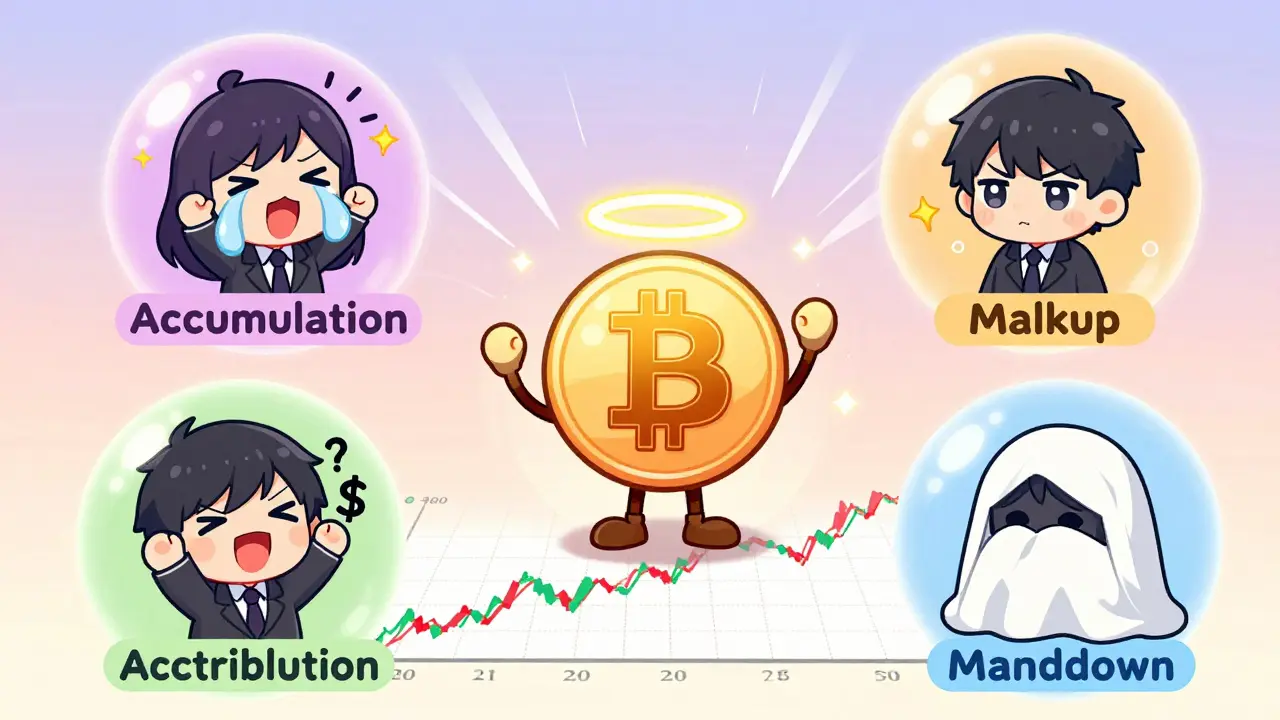
Crypto market cycles are the natural rhythm of price swings driven by human emotion and structural changes in the market. They don’t happen because of magic or algorithms alone. They happen because people buy when they’re scared of missing out, and sell when they’re scared of losing everything. That’s why cycles exist.There are four clear phases in every cycle:
- Accumulation - Prices sit tight. Most people have given up. Trading volume drops. The Fear & Greed Index hovers around 20-30. This is when smart money quietly buys.
- Markup (Uptrend) - Prices start climbing. News picks up. More people jump in. Volume surges. The Fear & Greed Index climbs to 70-90. This is where most people think they’ve found the secret.
- Distribution (Bubble) - Prices go parabolic. Everyone’s talking about crypto. Daily swings hit 8-12%. This is when early buyers start selling. The market gets overheated.
- Markdown (Crash) - The bubble pops. Prices drop 75-85% from peak. Volume spikes briefly as people panic-sell, then collapses. The Fear & Greed Index plunges below 20. This is when the cycle resets.
These phases aren’t just theory. They’ve played out exactly this way in Bitcoin’s past cycles. After the 2020 halving, Bitcoin rose from $5,000 to $69,000 in 18 months. Then it crashed to $15,000 in under a year. The pattern was textbook.
The Bitcoin Halving Myth (And Why It’s Changing)
For years, the biggest belief in crypto was this: Bitcoin’s price explodes 12-18 months after a halving. The halving cuts the new supply of Bitcoin in half. Less supply + same demand = higher price. It worked perfectly in 2012, 2016, and 2020.
After the 2024 halving, Bitcoin jumped from $42,000 to $118,000 in just two months. Then it dropped 35% to $75,000 by November 2025. That’s not a classic cycle. That’s a shockwave.
Why? Because the market isn’t the same anymore. In 2017, only 5% of Bitcoin trading came from institutions. Now, it’s 35%. Spot Bitcoin ETFs, approved in January 2024, now control 22% of all circulating Bitcoin. That’s not a small shift. It’s a structural overhaul.
When institutions buy, they don’t panic-sell. They don’t FOMO in. They buy slowly, hold long-term, and rebalance. That changes the rhythm. The halving still matters-but it’s no longer the trigger. It’s now just one factor in a much bigger machine.

How Real Traders Are Adapting
Most retail traders still chase the old cycle. They wait for the halving. They buy at the first sign of a rally. They get crushed when the market pulls back.
But the people who are winning now? They’re not waiting for signals. They’re using data.
Tools like Glassnode and CoinMetrics track on-chain metrics that show real behavior:
- MVRV Z-Score - Tells you if Bitcoin is overvalued or undervalued based on its cost basis.
- NUPL (Net Unrealized Profit/Loss) - Shows how much profit holders have locked in. When it hits 0.6, the market is often overheated.
- SOPR (Realized Profit) - Measures whether people are selling at a profit. A spike here means distribution is happening.
One trader I spoke to in Perth started using these metrics in late 2024. He didn’t care about the halving. He watched NUPL. When it hit 0.58 in May 2024, he sold half his position. When it dropped to 0.12 in October 2025, he bought back in. He didn’t catch the top. He didn’t catch the bottom. But he made 40% net profit without emotional stress.
Dollar-cost averaging (DCA) is still the safest strategy. If you buy $100 of Bitcoin every week, regardless of price, you automatically buy low during accumulation and don’t overpay during euphoria. Swan Bitcoin’s 2025 report shows DCA outperformed lump-sum investing by 22% during accumulation phases.
The New Rules of Crypto Cycles
The old 4-year cycle? It’s fading. The new cycle is faster, shallower, and more influenced by institutional flows.
Here’s what’s changed:
- Cycle duration - Used to be 48 months. Now it’s 32 months. Projections say it’ll drop to 24-30 months by 2027.
- Volatility - Daily swings are down 18% since ETFs launched. The market isn’t wilder-it’s more stable, but harder to predict.
- Phase length - Accumulation now lasts 4-6 months instead of 8-12. Markup is compressed. Distribution happens faster.
- Bitcoin dominance - Used to be 85%. Now it’s 52%. That means altcoins are getting more attention. When Bitcoin stabilizes, altcoins often surge.
That last point is critical. If you’re only watching Bitcoin, you’re missing half the story. Altseason doesn’t start with a halving. It starts when Bitcoin stops rising fast. When Bitcoin’s momentum slows, money flows into Ethereum, Solana, and other tokens. That’s when the real money is made.

What You Should Do Right Now
It’s March 2026. Bitcoin is trading around $75,000. The Fear & Greed Index is at 42 (neutral). ETF inflows have slowed. Altcoins are starting to move.
Here’s what to do:
- Don’t wait for the next halving. The next one isn’t until 2028. That’s too far away to plan around.
- Watch Bitcoin’s momentum. If it breaks $85,000 with strong volume, the next phase is likely starting. If it drops below $65,000, accumulation is still in play.
- Track altcoin volume. If Ethereum or Solana starts outperforming Bitcoin on a weekly basis, altseason is coming.
- Stick to DCA. Even if you think you know the cycle, emotional decisions cost money. Automate it.
- Keep crypto under 10% of your portfolio. No matter how confident you are. Crypto is still high-risk.
The goal isn’t to time the top. It’s not to predict the next 10x. It’s to avoid the big losses and stay in the game long enough to catch the next move.
Why This Still Matters
Even with ETFs, institutions, and algorithmic trading, crypto markets are still driven by the same thing: human psychology. People still panic. People still FOMO. The tools have changed. The players have changed. But the core emotion? Still the same.
When the Fear & Greed Index hits 15, it’s not a glitch. It’s a signal. When it hits 85, it’s not a boom. It’s a warning.
Understanding the cycle doesn’t make you rich overnight. But it stops you from making the mistakes 80% of traders make. And in crypto, avoiding mistakes is the only edge that lasts.
Are crypto market cycles still reliable after the 2024 Bitcoin halving?
The old 4-year halving cycle is less reliable now. While Bitcoin’s price still rises after halvings, the timing and magnitude have changed. The 2024 halving led to a 180% price surge in just 2 months, followed by a 35% correction-unlike past cycles that took 12-18 months to peak. Institutional involvement and spot ETFs have altered market dynamics, making cycles faster and less predictable. The psychological pattern of accumulation → markup → distribution → markdown still holds, but the triggers are now more complex.
What’s the best way to use crypto market cycles for trading?
Don’t try to time the top or bottom. Instead, use cycles to guide your strategy. Focus on phase identification: accumulation (low volume, low sentiment) is a time to accumulate; markup (rising volume, rising sentiment) is when you can add positions; distribution (parabolic rise, high volatility) is when you start taking profits; markdown (sharp drop, panic selling) is when you reassess. Combine this with on-chain metrics like NUPL and MVRV Z-Score, and use dollar-cost averaging to reduce emotional risk.
Do altcoins follow Bitcoin’s cycle?
Not exactly. Altcoins usually lag behind Bitcoin in the early stages of a cycle. But once Bitcoin’s momentum slows-usually after reaching a new high-money flows into altcoins. This is called altseason. It often starts 3-6 months after Bitcoin’s peak. Altcoins can then outperform Bitcoin by 2x to 10x during this phase. Monitoring Bitcoin dominance (BTC’s share of total crypto market cap) is key: when it drops from above 55% to below 50%, altseason is likely beginning.
Is now (March 2026) a good time to buy crypto?
It depends on your strategy. Bitcoin is trading around $75,000, which is below its June 2024 peak of $118,000 but above its 2025 low of $60,000. The Fear & Greed Index is neutral, and ETF inflows have slowed. This suggests we’re in a consolidation phase-likely accumulation or early markup. If you’re a long-term holder, now is a reasonable time to start or continue dollar-cost averaging. If you’re looking for quick gains, wait for clearer signals: rising volume on Bitcoin, or a breakout above $85,000, or a drop in Bitcoin dominance indicating altseason is starting.
How much of my portfolio should I put into crypto?
Most financial advisors recommend keeping crypto to 5-10% of your total portfolio. Crypto is volatile, unregulated in many places, and still a high-risk asset. Even if you believe in its long-term potential, overexposure can wipe out years of savings in a single crash. The goal isn’t to get rich fast-it’s to participate without risking your financial stability. Stick to this limit even during bull markets.
Markets change. Cycles evolve. But the truth remains: if you understand the rhythm, you don’t need to predict the future. You just need to react wisely.





Andrew Midwood
March 24, 2026 AT 12:33Been riding this wave since 2021 and honestly? The halving myth is dead. Institutions don’t FOMO, they deploy. ETFs are the new floor, not just another layer. I saw a 12% dip in Nov and just kept DCAing-no panic, no FOMO. Just math. And yeah, altseason’s already whispering. SOL’s volume’s been creeping up for weeks.
Ananya Sharma
March 25, 2026 AT 22:03Market cycles still exist. But now it’s less about Bitcoin and more about where the money flows. If BTC stops rising fast, altcoins wake up. Simple. No need for fancy metrics. Just watch the chart and wait.
Florence Pardo
March 27, 2026 AT 12:35I’ve been tracking NUPL religiously since last year and it’s honestly been a game-changer. I used to think the halving was the magic bullet, but now I realize it’s just one piece of a much bigger puzzle. What’s wild is how fast distribution happens now-like, one week you’re seeing all these people on Twitter saying ‘to the moon,’ and the next week they’re all silent. The emotional rhythm hasn’t changed, just the speed. And honestly? That’s scarier. Because you don’t get that long buildup to prepare. It just hits. I started automating my buys after seeing how much I lost to emotion in 2022. DCA isn’t sexy, but it’s the only thing that kept me from selling my BTC for pennies during the crash. I still hold 8% of my portfolio in crypto. Not because I think it’ll make me rich, but because I believe in the tech. And if I’m wrong? I can afford to lose it. That’s the key. Not timing. Not predicting. Just staying in the game.
Nicolette Lutzi
March 28, 2026 AT 03:12ETFs are a government trap. They’re not making crypto more stable-they’re making it a pawn in the fiat game. The Fed’s behind this. They want you to think Bitcoin is ‘safe’ now so you stop mining, stop decentralizing, and just hand over your coins to Wall Street. This isn’t evolution. It’s a slow-motion takeover. And don’t get me started on ‘altseason.’ That’s just a distraction so you forget who really controls the chain. The blockchain was supposed to free us. Now it’s just another brokerage account with more volatility.
Jeannie LaCroix
March 28, 2026 AT 07:11Y’ALL. I just sold my entire ETH position last week because I felt it in my bones. And guess what? BTC dipped 3% the next day. Coincidence? NO. This is divine timing. The universe is whispering to those who listen. I’m not a trader. I’m a channel. And right now? The energy says HOLD. But not for BTC. For the next big thing. Something’s coming. I can feel it. The stars aligned on March 14th. I’ve been meditating on blockchain since 2020. This is my calling. Trust the flow.
Domenic Dawson
March 28, 2026 AT 14:29I love how this post breaks it down. The key takeaway for me? Don’t try to be a genius. Just be consistent. I’ve been DCAing $50 a week since January 2024. No big moves. No timing. Just steady. And yeah, I missed the $118k peak. But I also didn’t get wiped out in the crash. I’m up 30% since I started. Not bad for not doing anything fancy. And altcoins? I keep 10% of my crypto in them, mostly ETH and SOL. Just in case. But BTC is my anchor. Simple. Slow. Safe.
Sam Harajly
March 29, 2026 AT 13:56The structural shift from retail to institutional participation is undeniable. The introduction of spot ETFs has fundamentally altered liquidity dynamics, reducing tail risk while compressing volatility cycles. On-chain metrics like NUPL and MVRV Z-Score are now more reliable than macro events like halvings, as they reflect actual holder behavior rather than speculative narratives. The cycle duration shortening from 48 to 32 months aligns with increased capital velocity and institutional rebalancing schedules. What remains constant is the psychological feedback loop between price action and sentiment-but the inputs have diversified. This evolution demands adaptive strategies, not rigid adherence to outdated models.
Pradip Solanki
March 29, 2026 AT 18:44Everyone’s overcomplicating this. The cycle is dead. The halving never mattered. It was always FOMO and dumb money. Now that the dumb money got smart, the whole thing’s a shell game. You think institutions care about BTC? They’re just using it to move fiat. The real play is in stablecoin flows and OTC desks. You’re all chasing ghosts. If you’re not tracking CBDC integration and Fed policy, you’re already late. And altseason? That’s just pump-and-dump with new names. Wake up.
Brad Zenner
March 31, 2026 AT 13:08One thing people miss: DCA works because it removes emotion, not because it’s smart. It’s just a tool. The real edge is knowing when to pause. I stopped DCAing in December 2025 when NUPL hit 0.61. Didn’t sell. Just paused. Came back in at 0.13. No drama. No stress. Just discipline. And yeah, BTC dominance dropping below 50%? That’s your signal. Not the halving. Not the news. Just the data.
Tony Phillips
April 1, 2026 AT 00:56Hey, I started with $200 in BTC back in 2020. I didn’t know what I was doing. But I kept buying a little every week. Now I’m not rich, but I’m not broke either. And I sleep better than most. This post? Spot on. You don’t need to predict the future. You just need to show up. And if you’re still waiting for the ‘perfect time’? You’re already behind. Start small. Stay consistent. Let time do the work.
Leona Fowler
April 2, 2026 AT 05:55I’ve been using Glassnode for over a year now. NUPL is my favorite metric. It doesn’t lie. When it’s near zero, it’s time to buy. When it’s above 0.6, it’s time to trim. I don’t even look at price anymore. Just the numbers. And altseason? I wait for ETH/BTC to break above 0.075 on the daily. That’s my trigger. Simple. Clean. No hype.
Anand Makawana
April 3, 2026 AT 20:24The concept of market cycles is fundamentally flawed. Markets are not cyclical-they are chaotic systems influenced by emergent variables. The halving is a red herring. The real driver is macroeconomic liquidity, geopolitical risk, and regulatory arbitrage. Bitcoin’s price is a symptom, not a cause. To rely on historical patterns is to mistake correlation for causation. The 2024 surge was not a cycle-it was a liquidity event driven by institutional hedging. Any trader who treats this like a repeatable pattern is setting themselves up for failure.
Mohammed Tahseen Shaikh
April 5, 2026 AT 17:10Bro, you think you’re smart with your NUPL and MVRV? Nah. Real traders don’t need charts. They smell the market. I felt altseason coming last week. SOL started whispering. I bought 500 SOL at $120. Now it’s at $150. I didn’t check a single metric. I just knew. Crypto’s not about math. It’s about vibes. And right now? The vibes are strong. You can’t quantify energy. But you can feel it. Trust your gut. That’s the real edge.
Sarah Terry
April 7, 2026 AT 16:47DCA is the only strategy that works. No exceptions. No fancy tools. Just buy every week. Even if you think it’s overpriced. Even if you’re scared. Even if everyone’s selling. Just buy. It’s boring. It’s safe. And it works.
Shayne Cokerdem
April 8, 2026 AT 15:38crypto is a scam. the fed owns it. the halving is fake. btc is just a digital dollar. you think you’re smart for using glassnode? you’re just feeding the machine. wake up. they’re watching you. they want you to think you’re in control. you’re not. you’re a data point. and your portfolio? it’s their toy.
kavya barikar
April 8, 2026 AT 17:35Understanding cycles is not about profit. It is about awareness. The market reflects human fear and hope. To trade is to engage with emotion. To understand is to step back. The tools change. The players change. But the heart of the cycle remains unchanged. We are not masters of the market. We are participants in its rhythm.
Andrea Zaszczynski
April 9, 2026 AT 14:35Wait, so you’re saying ETFs are good? That’s literally the opposite of everything I’ve read. Who’s funding these ETFs? Who’s behind the ‘experts’ pushing this narrative? I’ve been in crypto since 2017. I’ve seen this before. They always make it look safe… until it’s not. And then they disappear. Don’t trust the ‘data.’ Trust your gut. Something’s off.
Cordany Harper
April 9, 2026 AT 20:16Altseason is real, but it’s not just about BTC dominance dropping. It’s about the *rate* of change. If BTC dominance falls from 55% to 50% in 2 days? That’s a signal. If it takes 2 months? Probably noise. I track the 7-day change in BTC dominance on CoinGecko. That’s my trigger. And I only look at ETH and SOL. Everything else? Too noisy. Keep it simple.
DarShawn Owens
April 9, 2026 AT 22:33Love this breakdown. I’ve been telling my friends for months: stop chasing halving memes. The game’s changed. I started using DCA in 2023. I thought I was being boring. Turns out I was being smart. Now I’m just waiting for altseason to kick in. No rush. No stress. Just watching.
Andy Green
April 10, 2026 AT 14:12Of course the cycle changed. You think Wall Street let us keep our decentralized utopia? They co-opted it. They turned Bitcoin into a hedge fund asset. And now they’re using altcoins as casino chips. You’re not trading crypto. You’re playing their game. And you’re losing. Because you’re still believing in the myth. The truth? Crypto’s dead. It’s just a tax write-off for billionaires now.
Annette Gilbert
April 10, 2026 AT 20:21Wow. Someone actually wrote a 2000-word essay on crypto and called it ‘understanding.’ Congrats. You just described the obvious in 17 paragraphs. The halving didn’t change. You just got lazy and started calling it ‘institutional flow’ because you don’t want to admit you’re late to the party. The cycle’s still 4 years. You’re just scared to wait.
John Alde
April 11, 2026 AT 03:34One thing I’ve learned after 7 years: the best traders aren’t the ones with the most data. They’re the ones who walk away the most. I sold everything in 2022. Didn’t trade for 18 months. Came back in 2024 with $1000. DCA’d. Now I’m up 200%. Not because I’m smart. Because I didn’t touch it. Sometimes the best trade is doing nothing.
manoj kumar
April 11, 2026 AT 09:29Why are you even talking about altseason? No one cares. The only thing that matters is BTC. Everything else is garbage. And DCA? That’s for losers who can’t time the market. If you’re not going all in at the bottom, you’re wasting your time. I bought at $18k. Sold at $118k. Now I’m waiting for $50k again. That’s how you do it.