

Gas Fee Calculator
Calculate your potential savings when trading on Avalanche instead of Ethereum. Based on article data: Ethereum gas fees ($3-$15) vs Avalanche (<$0.05).
Ethereum
Estimated Fee:
Based on peak conditions ($3-$15)
Avalanche
Estimated Fee:
Typical base fee (<$0.05)
Uniswap V3 on Avalanche isn’t another copy-paste DeFi app. It’s a precision tool built for traders and liquidity providers who want Ethereum-level functionality without Ethereum’s fees and delays. If you’ve ever waited 20 seconds for a swap to confirm or paid $50 in gas to trade $200 worth of tokens, you already know why this version matters. But is it actually better? Let’s cut through the hype.
What Makes Uniswap V3 on Avalanche Different?
Uniswap V3 launched on Ethereum in 2021 with one big idea: concentrated liquidity. Instead of spreading your funds across every possible price point (like V2 did), you pick a range-say, $1.90 to $2.10 for WAVAX/USDC-and put all your capital there. That means you earn more fees per dollar invested. On Ethereum, this boosted efficiency by up to 4,000x. On Avalanche, it works just as well-but faster and cheaper. Avalanche’s C-chain handles transactions in under 1.2 seconds. Gas fees? Usually under $0.05. Compare that to Ethereum, where a simple swap can cost $3-$15 during peak times. Uniswap V3 on Avalanche didn’t just move to a new chain-it moved to a better one for daily trading.Trading on Uniswap V3 (Avalanche): How It Works
Swapping tokens is simple. Connect your wallet-MetaMask, Coinbase Wallet, or Trust Wallet-and you’ll see your balances instantly. Pick the token you want to sell, pick the one you want to buy, and click swap. The interface shows slippage tolerance and estimated output. For major pairs like WAVAX/USDC, slippage stays below 0.1% even on $50k trades. That’s tighter than most centralized exchanges. You don’t need to understand AMMs to trade. The platform handles the math. But if you’re swapping rare tokens or tokens with low liquidity, watch out. The 1% fee tier exists for a reason. If you see a pair with a 1% fee, it’s because the market is thin. Stick to the 0.3% pairs unless you know what you’re doing.Liquidity Provision: High Reward, High Complexity
This is where Uniswap V3 shines-and where most people get stuck. On Uniswap V2, you added liquidity to a pool and earned fees passively. On V3, you’re now a market maker. You choose your price range. If the price moves outside that range, your tokens get swapped out and you stop earning fees. Get it right? You earn 5-10x more than on V2. Get it wrong? You lose out on fees and might even get caught in impermanent loss. For example, if you put $10,000 into WAVAX/USDC between $1.80 and $2.20, you’ll earn most of the fees as long as the price stays in that zone. But if WAVAX drops to $1.60 or spikes to $2.50, your position becomes inactive. You’re not earning anything until the price comes back. This isn’t “set and forget.” It’s active management. Experienced users spend hours optimizing ranges. Beginners often lose money by setting ranges too narrow or too wide. CryptoAdventure estimates it takes 5-8 hours of focused learning just to understand how to position liquidity effectively. There’s no auto-rebalancing. No AI suggestions. Just you, the chart, and a lot of math.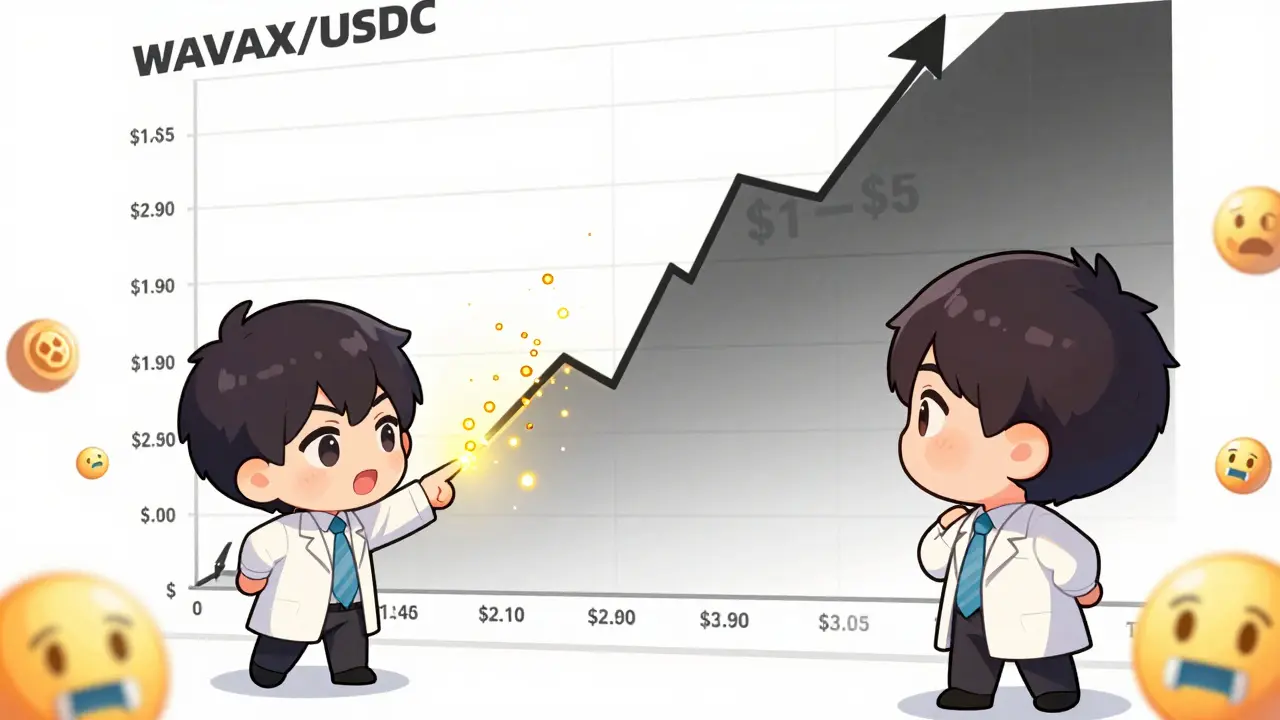
What Tokens Can You Trade?
Uniswap V3 on Avalanche supports 41 tokens across 63 trading pairs. That’s not a lot compared to Ethereum’s 100+ tokens-but it’s enough for most users. The dominant pair is WAVAX/USDC, accounting for over 80% of daily volume. That tells you everything: most activity is stablecoin trading, not speculative meme coins. You won’t find Solana tokens like BONK or Dogwifhat. No XRP, no LTC, no TON. This is strictly an Avalanche-native ecosystem. If you want to trade those, you need a different platform. But if you’re focused on AVAX, USDC, DAI, WBTC, and a few major DeFi tokens like AAVE or MKR, you’re covered.How It Compares to Trader Joe and Pangolin
Avalanche has its own native DEXes: Trader Joe and Pangolin. Both are popular, both offer more tokens, and both have simpler interfaces. So why use Uniswap V3? It comes down to liquidity depth and fee efficiency. Trader Joe has more volume overall, but Uniswap V3 has tighter spreads and better capital efficiency. For large trades, Uniswap V3 often has less slippage. Pangolin’s interface is easier, but its liquidity pools are less concentrated. That means lower returns for providers. A review from ICO Rankings put it well: “Uniswap V3 on Avalanche isn’t screaming for attention-but it doesn’t need to.” It’s quiet, reliable, and efficient. It’s the institutional choice in a sea of retail-focused apps.Gas Fees, Speed, and Network Congestion
Avalanche’s speed is its superpower. Confirmations take 1.2 seconds on average. That’s faster than Visa. But even Avalanche can get congested. During major token launches or big market moves, gas fees spike-sometimes to $0.50 or even $1.50. That’s still cheap compared to Ethereum, but it’s noticeable when you’re doing 10 swaps a day. There’s no way to predict these spikes. You just have to wait or delay your trade. Some users set alerts for gas prices and only trade when fees drop below $0.10. It’s a small price to pay for the speed and low baseline costs.
Security and Regulation
Uniswap V3 on Avalanche is non-custodial. You hold your keys. No one can freeze your funds. No KYC. No account limits. That’s the whole point. But there’s a legal gray zone. In October 2025, the SEC issued guidance suggesting that DEXs like Uniswap could be considered unregistered securities exchanges. That doesn’t mean they’re shut down-it means they’re under scrutiny. U.S. users aren’t blocked, but they’re on notice. If you’re in the U.S., you’re trading at your own risk. No warnings, no disclaimers, no help from Uniswap if something goes wrong.Who Is This For?
If you’re a beginner who just wants to swap ETH for USDC and call it a day, use PancakeSwap or a centralized exchange. Uniswap V3’s interface isn’t built for you. If you’re an experienced DeFi user who understands impermanent loss, price ranges, and fee tiers-this is your playground. You’ll earn more from your liquidity. You’ll trade with less slippage. You’ll save on fees. If you’re a liquidity provider looking to maximize returns on AVAX, this is the best tool on the chain. No other DEX offers the same level of capital efficiency.The Future: Uniswap V4 and What’s Next
Uniswap V4 is coming in Q2 2026. It will introduce “hooks”-custom smart contract modules that let developers build features like on-chain limit orders, auto-rebalancing, and dynamic fees. That could make liquidity provision way easier. Imagine setting a rule: “Put my liquidity between $1.90 and $2.10, and automatically shift it if the price moves 5%.” That’s the future. But for now, V3 is the standard. And on Avalanche, it’s working better than anywhere else.Is Uniswap V3 on Avalanche safe to use?
Yes, as long as you understand how non-custodial wallets work. Your funds are never held by Uniswap. You control your private keys. But if you send tokens to the wrong address or lose your seed phrase, there’s no recovery. Always double-check addresses and use hardware wallets for large amounts.
Can I use Uniswap V3 on my phone?
There’s no official mobile app, but you can use it through your wallet’s built-in browser. MetaMask and Trust Wallet both support connecting to Uniswap V3 on Avalanche via mobile web. It works fine, but the interface is designed for desktop. Liquidity provision is much harder on a small screen.
What’s the difference between Uniswap V3 on Ethereum and on Avalanche?
The core features-concentrated liquidity, multiple fee tiers-are identical. The difference is speed and cost. On Avalanche, swaps confirm in 1.2 seconds and cost pennies. On Ethereum, they take 15+ seconds and can cost dollars. Avalanche is better for frequent trading. Ethereum has more tokens and deeper liquidity overall.
Why is WAVAX/USDC the most traded pair?
WAVAX is the native token of Avalanche, and USDC is the most trusted stablecoin. Most traders use USDC to enter and exit positions. So, almost every trade starts or ends with WAVAX/USDC. It’s the hub of the ecosystem. Other pairs exist, but they’re mostly niche or speculative.
Do I need UNI tokens to use Uniswap V3 on Avalanche?
No. UNI is the governance token for the Uniswap protocol, but you don’t need it to swap or provide liquidity. You only need AVAX to pay gas fees and the tokens you want to trade. UNI is only relevant if you want to vote on protocol changes-which most users don’t.
Is Uniswap V3 better than PancakeSwap on Avalanche?
It depends. PancakeSwap is easier to use and has more tokens. But Uniswap V3 offers better capital efficiency for liquidity providers and tighter spreads for traders. If you’re trading under $50k, Uniswap V3 usually has less slippage. If you’re a beginner or want to farm yield on new tokens, PancakeSwap might be simpler.
What happens if I set my liquidity range too wide?
You’ll earn less in fees. Concentrated liquidity only works if your range is tight enough to capture most trades. If you set it too wide-say, $1 to $5 for WAVAX/USDC-you’re spreading your capital too thin. You’ll end up earning close to what you would on Uniswap V2, but with more complexity. The sweet spot is usually within 10-20% of the current price.