
Remember the wild days of late 2021? Everyone was talking about 'yield farming,' and new tokens popped up overnight promising massive returns. One of those projects was Liquidus (old), also known as LIQ. It was pitched as a simple way to earn interest on your crypto without doing any heavy lifting. But here is the hard truth: that project is dead. If you are looking at LIQ today because you found it in an old wallet or saw a flash of hope on a price chart, stop right there. You are looking at what experts call a 'zombie token'-a coin that still technically exists but has no life, no team, and no future.
This article breaks down exactly what Liquidus (old) was designed to be, why it failed, and why holding it today is likely a waste of time and money. We will look at the numbers, the history, and the harsh reality of the current market landscape for this specific asset.
The Original Promise: Simplifying DeFi Staking
To understand why Liquidus (old) matters-or rather, why its failure matters-you have to look back at what it tried to do. Launched on the Ethereum blockchain, LIQ was created to solve a specific problem in decentralized finance (DeFi). Back then, finding good places to park your crypto for interest was complicated. You had to hunt through different platforms, check rates, and manage multiple connections.
Liquidus (old) promised to be a 'one-stop solution.' The idea was elegant: connect your wallet, and the platform would automatically find the best yield opportunities across various DeFi protocols for you. It claimed to simplify liquidity provision and staking. For beginners who were scared of complex interfaces, this sounded like magic. The token itself was meant to be a utility tool within this ecosystem, helping users access these automated services.
However, the promise was ambitious, and the execution never matched the hype. While the concept of yield aggregation is valid (and used by successful platforms today), Liquidus (old) lacked the robust infrastructure and security audits needed to survive the competitive DeFi market.
The Crash: From $4.80 to Near Zero
If you bought LIQ near its peak, you are probably hurting. Let’s look at the cold, hard data. On November 10, 2021, the token hit an all-time high of approximately $4.80. That was during the height of the DeFi boom, when speculation ran wild.
Fast forward to mid-2025 and into 2026, and the picture is bleak. As of August 2025, data from major trackers shows the price hovering around $0.0073 USD. That is not a dip; that is a collapse. We are talking about a decline of over 99%. To put that in perspective, if you invested $1,000 at the top, it would now be worth less than seven dollars.
| Metric | Value / Date | Source Context |
|---|---|---|
| All-Time High (ATH) | $4.80 (Nov 10, 2021) | CoinMarketCap |
| Recent Price (Aug 2025) | ~$0.0073 USD | Binance/CoinGecko Data |
| Total Decline | 99.82% | Calculated from ATH |
| Market Cap (Aug 2025) | ~$56,470 USD | CoinMarketCap |
| 24-Hour Volume | $0 - $162 USD | Various DEXs |
The market capitalization tells the same story. With a max supply of 93 million tokens, a healthy project might have a market cap in the hundreds of millions. Liquidus (old) sits at roughly $56,000. That is smaller than many individual startup budgets. It represents 0% of the global crypto market. In the world of cryptocurrency, being invisible is often worse than being hated.
Why Did It Fail? The Rise of Better Alternatives
You might wonder, 'If the idea was good, why did it die?' The answer lies in competition and trust. During the 2020-2022 period, thousands of DeFi projects launched. Most were poorly coded, uneconomical, or outright scams. Liquidus (old) fell into the category of 'abandoned due to lack of viability.'
While LIQ struggled to maintain its platform, other projects stepped up. Platforms like Yearn.finance (YFI), Beefy.finance, and Harvest.finance built robust, transparent, and actively maintained yield aggregators. They offered better security, clearer governance, and actual working products. Users migrated to these safer havens.
Furthermore, the development team behind Liquidus (old) disappeared. There were no regular updates, no community engagement, and no technical improvements. By early 2022, the official website returned '404 Not Found' errors. The Telegram group, which once boasted 8,500 members, dwindled to just over 1,200 inactive users. When a project stops communicating, investors flee. Once the liquidity dried up, the token became trapped.
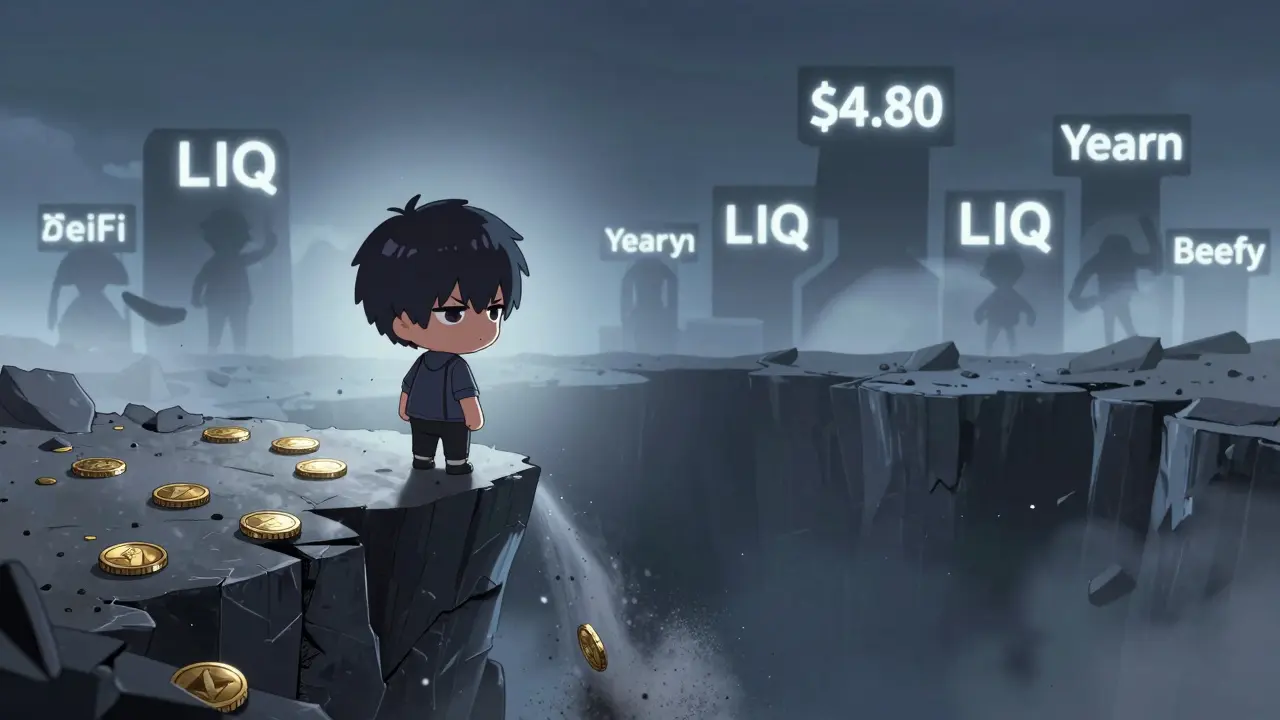
The Current State: A 'Zombie Token'
So, what is happening with LIQ right now in 2026? Technically, it still trades. Because decentralized exchanges (DEXs) like PancakeSwap, ApeSwap, and Biswap are permissionless, anyone can create a trading pair. This means LIQ pairs still exist on-chain, even though no one is managing them.
This creates a dangerous illusion. You might see a price ticker and think, 'It’s still alive!' But look closer at the volume. Daily trading volume is often reported as $0 or less than $150. This is negligible. It means if you try to sell even a small amount of tokens, you will face extreme slippage. You could lose 15% or more of your value just trying to execute a trade because there is no one else willing to buy.
Experts classify this as a 'zombie token.' It has no utility, no team, and no community. It persists only because the blockchain itself is immutable-the code hasn’t been deleted, so the tokens remain in wallets. However, they are effectively worthless digital artifacts.
Risks of Holding or Buying LIQ Today
If you hold LIQ, you might be tempted to 'wait for a comeback.' Here is why that is a bad strategy:
- No Liquidity: You may not be able to sell. Even if you find a buyer, the transaction fees on Ethereum or BSC might cost more than the tokens are worth.
- No Development: There is no roadmap. No GitHub commits. No social media activity since 2021. The project is not paused; it is dead.
- Scam Risk: Sometimes, scammers buy up cheap, abandoned tokens and launch fake 'revival' campaigns to trick new investors into buying. These are exit scams designed to drain whatever little liquidity remains.
- Opportunity Cost: Every dollar tied up in a zombie token is a dollar not working for you in a productive investment.
User feedback from forums like Reddit and Bitcointalk confirms this. Users report being unable to unstake assets, broken interfaces, and complete silence from support. One user noted, 'Avoid LIQ at all costs... Complete ghost project now.'
What Should You Do Instead?
If you are interested in yield farming or staking, do not go back to the graveyard of 2021 projects. Focus on established, audited, and active platforms. Look for projects with:
- Active Development: Check their GitHub repository. Are they pushing code regularly?
- Transparent Team: Do you know who runs the project? Are they doxxed (publicly identified)?
- Strong Community: Is the Discord or Telegram active with real discussions, not just bots?
- Security Audits: Have reputable firms reviewed their smart contracts?
Projects like Aave, Compound, or the aforementioned Yearn.finance offer similar benefits to what Liquidus (old) promised, but with actual functionality and security. They have survived multiple market cycles and continue to evolve.
Conclusion: Learn from the Past
Liquidus (old) serves as a cautionary tale for every crypto investor. It reminds us that in DeFi, promises mean nothing without execution. A cool idea does not guarantee success. Without a dedicated team, sustainable economics, and continuous improvement, even the most hyped tokens can vanish into obscurity.
If you have LIQ in your wallet, consider it a sunk cost. Trying to salvage value from it is likely futile and risky. Cut your losses, learn from the experience, and direct your attention toward vibrant, living projects that respect your capital and your time.
Is Liquidus (old) (LIQ) still a valid investment?
No. LIQ is considered a 'zombie token' with no active development, minimal liquidity, and a 99%+ drop in value. It poses significant risks including inability to sell and potential scam attempts. It is not recommended for investment.
Where can I buy or sell LIQ tokens?
LIQ is not listed on major centralized exchanges like Binance. It may be found on decentralized exchanges such as PancakeSwap, ApeSwap, or Biswap. However, due to extremely low liquidity, trading volumes are near zero, and slippage will likely result in significant losses.
Why did the Liquidus project fail?
The project failed due to intense competition from more robust platforms like Yearn.finance and Beefy.finance, lack of ongoing development, disappearance of the founding team, and loss of user trust. The official website and support channels have been inactive since 2022.
What is the contract address for Liquidus (old)?
The original Ethereum contract address starts with 0x5f69...4ddcc0. Always verify addresses on reliable block explorers like Etherscan before interacting with any token to avoid phishing scams.
Are there safe alternatives to Liquidus for yield farming?
Yes. Established platforms like Yearn.finance, Beefy.finance, Aave, and Compound offer secure and active yield aggregation and lending services. Always research a project's audit status and team transparency before investing.