
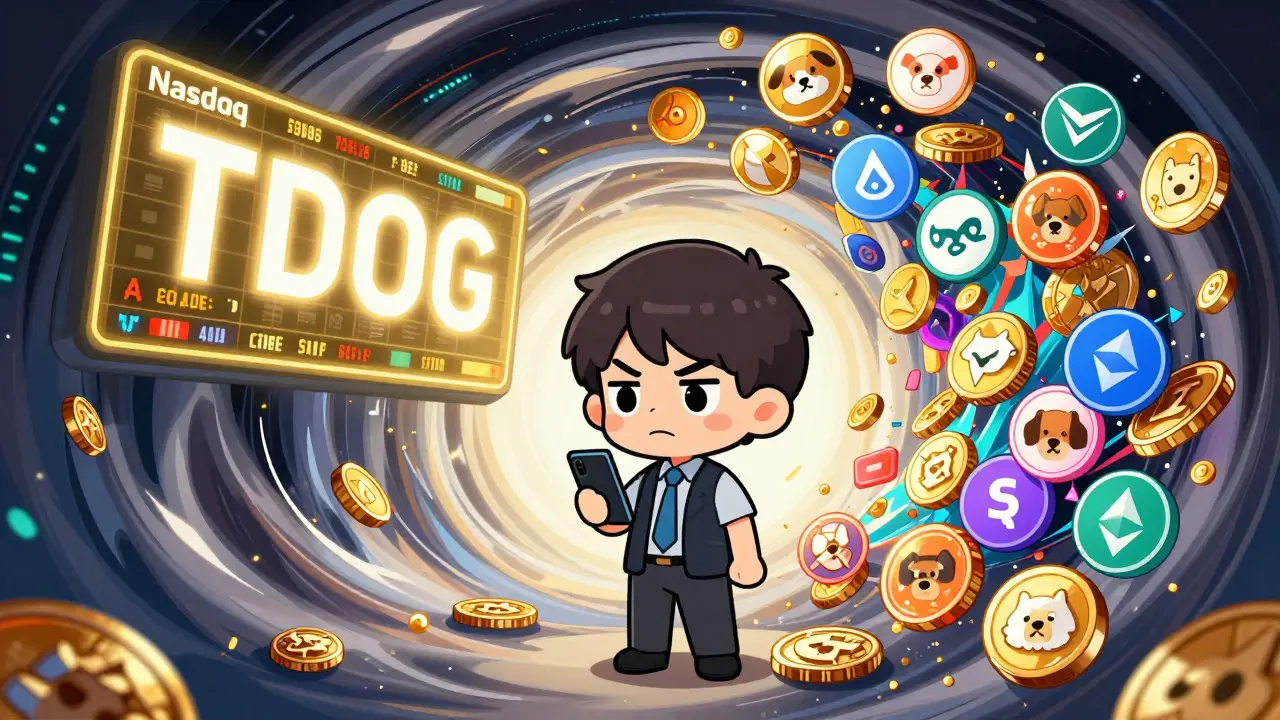
You type TDOG into your search bar or brokerage app, and suddenly you are staring at a confusing mess. There is a regulated exchange-traded fund on Nasdaq. Then there is a token with a supply of "420P". And somewhere in between, there are half a dozen meme coins on Solana, Tron, and Ethereum all fighting for attention under the same ticker symbol. If you are trying to figure out what the DOGE ETF (TDOG) is a financial instrument providing exposure to Dogecoin, but currently exists as both a regulated fund and multiple unrelated crypto tokens, you are not alone. The confusion is real, and mixing them up could cost you money.
The short answer is that "TDOG" refers to two very different things right now. First, it is the ticker for the 21Shares Dogecoin ETF is the first SEC-approved spot ETF for Dogecoin, launched on Nasdaq in January 2026. This is a legitimate, regulated financial product. Second, it is the ticker for several unregulated cryptocurrency tokens, including one ironically named "Dogecoin ETF" and various other dog-themed memes. Knowing which one you are looking at is the most important step before you click buy.
The Real Deal: 21Shares Dogecoin ETF on Nasdaq
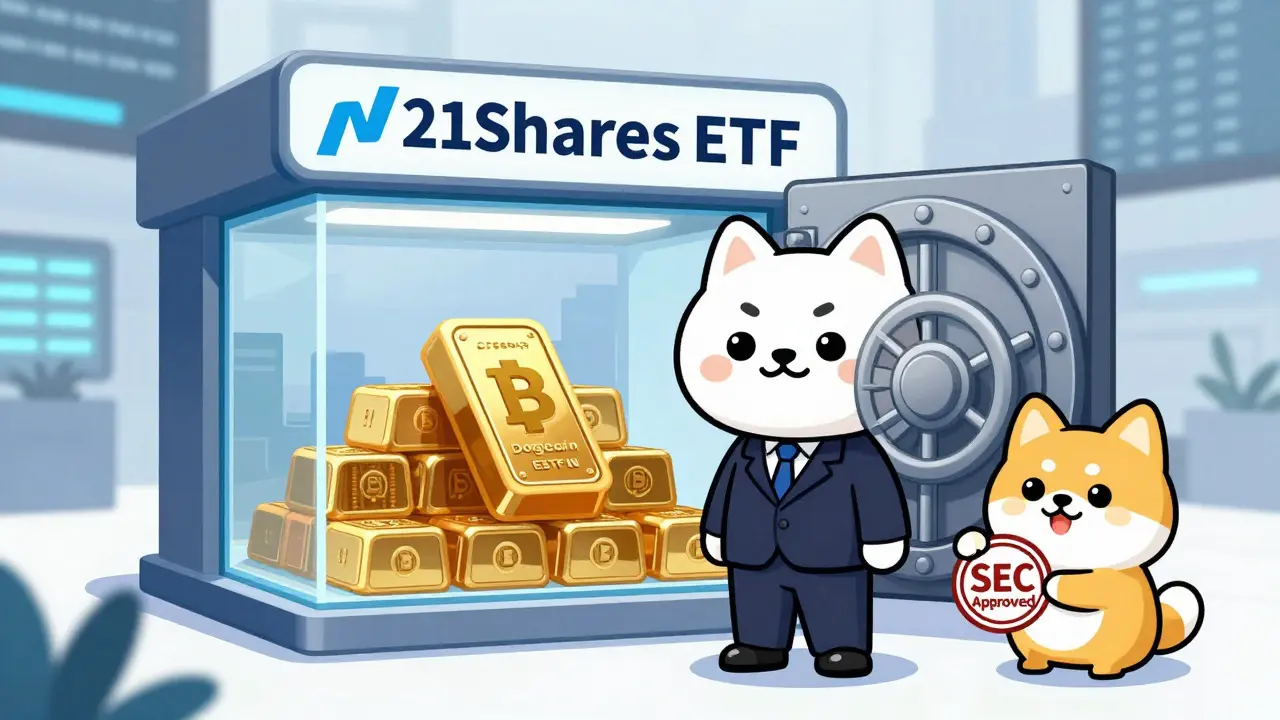
When experts talk about the DOGE ETF, they are usually referring to the fund issued by 21Shares is a Swiss-based asset management firm specializing in crypto exchange-traded products. Launched on January 22, 2026, this fund trades on the Nasdaq stock exchange under the ticker TDOG. It is not a new coin. It is not a blockchain project. It is a traditional financial vehicle that holds actual Dogecoin behind the scenes.
This structure matters because it changes how you invest. You do not need a digital wallet. You do not need to worry about private keys or seed phrases. Instead, you use your existing brokerage account-the same one you might use for stocks like Apple or Tesla-to buy shares of TDOG. The fund operates as a physically backed trust. This means for every share of the ETF in circulation, there is an equivalent amount of Dogecoin held in institutional-grade custody. The goal is simple: the price of the ETF should track the price of Dogecoin, minus the fees.
The regulatory path for this fund was significant. It received explicit approval from the U.S. Securities and Exchange Commission (SEC), making it the first spot Dogecoin ETF in the United States. Before trading started, the ticker appeared on the Depository Trust & Clearing Corporation (DTCC) list in October 2025. This is a common step for new funds, but it often causes confusion. Being on the DTCC list does not mean the fund is live; it just means the plumbing is ready. Actual trading only began after the SEC approved the S-1 registration statement and Nasdaq approved the 19b-4 rule change.
Who backs this? It is not just a random financial firm. The launch involved collaboration with the Dogecoin Foundation is the non-profit organization overseeing the Dogecoin ecosystem and brand. Specifically, House of Doge, the corporate arm of the foundation, endorsed this specific ETF. As of early 2026, it is considered the only Dogecoin spot ETF approved by the foundation itself. This endorsement adds a layer of legitimacy that other crypto products simply do not have.
How the ETF Works: Fees, Tracking, and Risks
Understanding the mechanics of the 21Shares TDOG ETF helps you decide if it fits your portfolio. The fund tracks the CF Dogecoin Dollar US Settlement Price Index. This index is designed to reflect the spot price of Dogecoin in U.S. dollars. When you buy the ETF, you are buying a claim on a fractional amount of the Dogecoin held in the trust. The net asset value (NAV) is calculated daily based on these holdings.
Nothing is free, though. The annual management fee is 0.50%. This fee is deducted from the fund’s assets, meaning your returns will always be slightly lower than the raw performance of Dogecoin. For long-term holders, this drag can add up. However, many investors accept this cost because it eliminates the operational headaches of self-custody. You avoid the risk of losing your hardware wallet, sending coins to the wrong address, or dealing with exchange hacks. Instead, you deal with familiar risks like bid-ask spreads and brokerage commissions.
Trading hours also matter. Since TDOG trades on Nasdaq, you can only buy and sell during standard market hours (typically 9:30 AM to 4:00 PM Eastern Time). Crypto markets never sleep. If Dogecoin spikes at 2:00 AM while you are sleeping, your ETF share price will not reflect that move until the market opens the next morning. This delay is a trade-off for regulation and ease of access.
The Copycats: TDOG Crypto Tokens Explained
If you look at decentralized exchanges or certain crypto data aggregators, you will see other assets labeled TDOG. These are not the Nasdaq ETF. They are separate tokens, mostly built on blockchains like TON, Tron, Solana, and Ethereum. Some are clearly memes. Others try to confuse investors by using similar branding.
One notable example is a token literally called "Dogecoin ETF" with the ticker TDOG. Its profile claims a total supply of "420P TDOG." That number is a nod to internet culture, referencing the meme number 420 and the letter P (perhaps for Petabyte or just absurdity). The project’s marketing materials sometimes claim it is listed on the DTCC, but this appears to be a conflation with the real ETF’s pre-launch status. There is no contract address or technical whitepaper widely associated with this specific token in reliable sources. It looks more like a branding stunt than a functional investment vehicle.
Then there are the pure meme coins. Here is a breakdown of some of the other TDOG tokens floating around:
- TON DOG (TDOG): Built on the TON blockchain. As of mid-2026, it has a micro-market cap (often under $40,000) and extremely low prices. It is highly speculative and driven by social media hype rather than fundamentals.
- Tron Dog (TDOG): Found on the TRON network. It features a "loyal digital dog" mascot and originated from community celebrations. Like most Tron memes, it has high volatility and low liquidity.
- Tension Dog (TDOG): A Solana-based token with a billion-token supply. Its market cap hovers around $27,000, indicating a very small, niche community.
- Trump’s Dog (TDOG): An Ethereum token launched in late 2024. It has a massive supply of 10 trillion tokens and a market cap of less than $4,000. This is classic meme-coin math: huge supply, tiny price, extreme risk.
- Turbo Dog (TDOG): A Binance Smart Chain token that shows zero volume and zero price in recent data, suggesting it may be dead or illiquid.
These tokens share nothing with the 21Shares ETF except the letters T-D-O-G. They are not backed by Dogecoin. They are not regulated by the SEC. They are not endorsed by the Dogecoin Foundation. Buying them is akin to buying lottery tickets, not investing in an asset class.
| Feature | 21Shares TDOG ETF | TDOG Meme Tokens (e.g., TON DOG) |
|---|---|---|
| Regulation | SEC Approved, Nasdaq Listed | Unregulated, Decentralized |
| Backing | 1:1 Physical Dogecoin Holdings | None (Speculative Value Only) |
| Access | Standard Brokerage Account | Crypto Wallet + DEX |
| Fees | 0.50% Annual Management Fee | Network Gas Fees + Slippage |
| Risk Profile | Moderate (Market Risk + Fee Drag) | Extreme (Rug Pull, Liquidity Loss) |
| Endorsement | Dogecoin Foundation Approved | Community/Social Media Hype |
Why the Confusion Exists
The crypto world thrives on ambiguity. Tickers are not unique across all blockchains. A ticker like BTC exists for Bitcoin on Coinbase, but also for countless fake Bitcoin tokens on Ethereum or BSC. The same applies to TDOG. The fact that the real ETF uses a ticker that sounds like a meme coin name is ironic, given Dogecoin’s origins. But it creates a hazard for retail investors who might see "TDOG" on a chart and assume it is the safe, regulated option without checking the exchange.
Another source of confusion is the DTCC listing. In October 2025, TDOG appeared on the DTCC Active and Pre-Launch list. Financial news outlets reported this as a major milestone. However, casual observers might mistake this administrative step for the start of trading. The token projects quickly latched onto this terminology, claiming their own "DTCC listings" to sound legitimate. In reality, the DTCC listing was merely a prerequisite for the Nasdaq launch, not a guarantee of quality for any asset sharing the ticker.
Which One Should You Choose?
Your choice depends entirely on your goals and your tolerance for complexity.
If you want exposure to Dogecoin’s price movement without managing wallets, verifying contract addresses, or worrying about blockchain security, the 21Shares Dogecoin ETF is the preferred choice for mainstream investors seeking regulated DOGE exposure is the clear winner. It is transparent, audited, and accessible through the financial system you already know. The 0.50% fee is a reasonable price for that convenience and safety. It is particularly suitable for retirement accounts (like IRAs) where direct crypto ownership is often restricted or complicated.
If you are a degenerate gambler who enjoys hunting for the next 100x meme coin and understands how to use MetaMask or Tonkeeper, then the TDOG meme tokens might appeal to you. But be warned: the market caps are tiny. Liquidity is thin. The risk of losing your entire investment is high. Do not confuse these bets with an investment in Dogecoin itself.
Avoid the "Dogecoin ETF" token with the 420P supply unless you are specifically interested in studying failed marketing campaigns. It offers no utility, no backing, and no regulatory protection. It is essentially noise.
Key Takeaways for Investors
Before you make a move, keep these points in mind. Always verify the exchange. If you are buying TDOG on Nasdaq, you are getting the 21Shares ETF. If you are swapping TDOG on Uniswap or Raydium, you are likely getting a meme coin. Check the ISIN code for the ETF: US90137N1063. This unique identifier confirms you are looking at the correct fund. For tokens, check the contract address. If the address does not match a verified source, assume it is a scam or a joke.
Remember that the ETF tracks Dogecoin, it does not replace it. If Dogecoin goes to zero, the ETF goes to zero. If Dogecoin doubles, the ETF doubles (minus fees). The underlying asset risk remains. The ETF only removes the custodial risk.
Finally, stay updated. The crypto ETF landscape is evolving rapidly. New products may launch, fees may change, and regulations may shift. What is true in August 2026 may not be true in 2027. Always do your own research, read the latest prospectus for the ETF, and never invest more than you can afford to lose.
Is the TDOG ETF the same as Dogecoin?
No. The TDOG ETF is a financial product that holds Dogecoin. When you buy the ETF, you own shares in a trust that owns Dogecoin. You do not own the Dogecoin directly on the blockchain. You cannot send those shares to a friend or use them to pay for coffee at a merchant that accepts DOGE. However, the price of the ETF should closely mirror the price of Dogecoin.
Can I buy the TDOG ETF in my IRA?
Yes. Because the 21Shares Dogecoin ETF trades on Nasdaq like a regular stock, you can buy it in most traditional brokerage accounts, including Traditional IRAs, Roth IRAs, and 401(k)s that allow individual stock picks. This is one of its biggest advantages over holding crypto directly, which often requires complex workarounds for tax-advantaged accounts.
What is the difference between TDOG the ETF and TDOG the token?
The TDOG ETF is a regulated, SEC-approved fund backed by real Dogecoin holdings. It trades on Nasdaq. TDOG tokens are unregulated cryptocurrencies on various blockchains (like Solana or Tron) that share the same ticker symbol. They are not backed by Dogecoin, have no regulatory oversight, and carry much higher risk. Always check the exchange and contract address to tell them apart.
Does the Dogecoin Foundation support the TDOG ETF?
Yes. The 21Shares Dogecoin ETF (TDOG) is endorsed by the Dogecoin Foundation, specifically through its corporate arm, House of Doge. It is recognized as the only Dogecoin spot ETF approved by the foundation as of its launch in January 2026. This endorsement adds credibility compared to other crypto products.
What fees do I pay for the TDOG ETF?
The 21Shares Dogecoin ETF charges an annual management fee of 0.50%. This fee is deducted from the fund's assets daily, so you don't receive a separate bill. Additionally, you may pay brokerage commissions or bid-ask spreads when buying or selling the shares, depending on your broker.
Is TDOG available outside the United States?
The specific Nasdaq-listed TDOG ETF is primarily for U.S. investors. However, 21Shares offers similar crypto ETPs (Exchange-Traded Products) on European exchanges. International investors should check if a local version of the Dogecoin ETF is available in their region, as cross-border trading rules vary.
Why are there so many fake TDOG tokens?
Crypto tickers are not globally unique. Anyone can create a token with the ticker TDOG on any blockchain. Scammers and meme creators often copy popular tickers to trick investors into buying worthless tokens. The rise of the legitimate TDOG ETF has unfortunately led to a surge in copycat tokens hoping to ride the coattails of the fund's publicity.




Rodmun Tarnowski
August 10, 2026 AT 19:56It is truly encouraging to see such clarity in a space that has been so murky for far too long! The distinction between the regulated ETF and the chaotic meme tokens is absolutely vital for retail investors who are just trying to navigate this new financial landscape. I believe that education is the key to empowerment, and articles like this serve as a beacon of hope for those of us who want to participate without falling victim to scams. The fact that 21Shares has secured SEC approval is a monumental step forward for institutional adoption of Dogecoin. It legitimizes the asset class in a way that pure speculation never could. We should all be grateful for these regulatory milestones because they protect the little guy from the worst excesses of the crypto wild west. Keep up the excellent work in demystifying these complex instruments!
Matthew Smith
August 11, 2026 AT 11:26the moral decay of society is evident when we allow gambling to masquerade as investing. the etf is merely a sanitized version of the same vice. it does not change the underlying absurdity of valuing a joke currency. yet here we are building financial infrastructure around it. one must ask if this is progress or just a more efficient way to lose money. the foundation endorsing it adds a layer of complicity that is hard to swallow. but perhaps i am being too harsh on the inevitable march of capitalism.
Prudence Flemming
August 12, 2026 AT 12:35look at the epistemological crisis inherent in ticker symbols. tdog is a signifier detached from any stable signified. the etf points to an index which points to doge which points to nothing but collective belief. meanwhile the meme coins point to liquidity traps. it is a hall of mirrors. the jargon of finance tries to impose order on chaos but the ontology of the asset remains fundamentally unstable. we are trading representations of representations. interesting how the dtcc listing became a vector for confusion rather than clarity. semiotics in action.
Carl Michaud
August 12, 2026 AT 15:48let us not forget that the sec is not some benevolent guardian of truth but a bureaucratic apparatus designed to manage decline. the approval of this etf is simply them co-opting the narrative to maintain relevance. the real power lies with the shadowy entities controlling the custody solutions. 21shares is just the face of a deeper manipulation. the endorsement by the dogecoin foundation is likely coerced or bought. trust no one. the dtcc listing was a signal to the whales to position themselves before the retail herd arrived. typical market rigging tactics employed by the globalist elite to siphon wealth from the unsuspecting masses.
Matt Kay
August 13, 2026 AT 09:16too much text. just buy the dip.
Dave Kjendal
August 15, 2026 AT 02:06most people dont read past the headline anyway. they see doge and click buy. whether its the etf or the meme token matters less than their willingness to lose it all. the guru in me says stay away from both. the lazy critic in me says good luck figuring it out. simple really. you either know what you are doing or you are prey. no middle ground here. just pick your poison.
Kat Bennett
August 15, 2026 AT 07:33i have been following the development of these products for quite some time now and it is fascinating to observe how the lines are blurring between traditional finance and decentralized assets. the convenience of using a standard brokerage account to gain exposure to cryptocurrency is something that many people overlook until they actually try to set up a self-custody wallet and realize how cumbersome the process can be. while the fees associated with the etf are certainly a consideration for long-term holders the peace of mind that comes with knowing your assets are held in institutional-grade custody is invaluable for those of us who are not tech-savvy enough to manage private keys securely. it is also interesting to note the specific endorsement by the house of doge which seems to lend a certain level of credibility that other similar products lack. i wonder how this will play out over the next few years as more funds enter the market.
Candice Cornett
August 15, 2026 AT 23:57everyone is so excited about regulation but they forget that regulation just means more red tape and higher costs for the consumer. the etf is a trap for the lazy investor who wants to pretend they are sophisticated while paying fees to intermediaries. the real freedom is in the unregulated tokens even if they are risky. why let the government tell you what is legitimate? the 420p supply token is clearly art not fraud. stop listening to the suits and start thinking for yourself. the etf is just a way to tax your gains more efficiently.
Lance Jantz
August 16, 2026 AT 10:04oh darling do come closer and let me whisper the secrets of the abyss into your ear. the ticker symbol tdog is merely a mask worn by the hydra of modern finance. one head bites with the precision of a swiss banker while the others snap with the rabid enthusiasm of internet trolls. to choose one is to deny the existence of the other. it is a philosophical dilemma wrapped in a financial instrument dipped in meme culture. shall we dance on the edge of the volcano together? the view is exquisite from here especially when the floor gives way.
Don Fizy
August 17, 2026 AT 23:00hey there! great article :) i think a lot of folks get confused by the tickers so this breakdown is super helpful. if you are new to this stick with the etf for safety. check that isin code always! happy trading :)
Phil Babb
August 18, 2026 AT 23:50LISTEN UP EVERYONE!!! THIS IS HUGE NEWS FOR THE CULTURE OF INVESTING!!! THE ETF IS NOT JUST A PRODUCT IT IS A MOVEMENT!!! WE ARE BRIDGING THE GAP BETWEEN WALL STREET AND THE PEOPLE!!! DO NOT LET THE MEME COINS DISTRACT YOU FROM THE MAIN EVENT!!! BUY THE DIP HOLD THE LINE AND SHOW THE WORLD THAT DOGE IS HERE TO STAY!!! WHO IS WITH ME?!?!?
Dominic Greco
August 20, 2026 AT 22:04they want you to believe the etf is safe 🛡️ but look at the dates. october 2025 dtcc listing then january 2026 launch. classic pump setup. the foundation endorsement is fake news planted by the deep state to make you feel secure 🚩🚩🚩. the real money is in the solana rug pulls where you can still escape before the doors lock. wake up sheeple 👁️👄👁️
Sean Rowland
August 21, 2026 AT 17:18it appears that the gentleman in question has failed to grasp the fundamental dichotomy between speculative assets and regulated securities. the notion that one might interchangeably use the term tdog for both is an affront to basic financial literacy. furthermore the intrusion of meme culture into serious discourse is tiresome. the contract address verification is paramount yet ignored by the masses. this is a systemic failure of communication protocols within the digital age. one wonders if the author understands the gravity of the implications involved in misidentifying these instruments. it is quite frankly embarrassing.
Sus Sawyer
August 23, 2026 AT 15:56yo guys big ups for writing this up. its crazy how many scammers are out there copying the ticker. always double check that contract address if u are buying on dexs. the etf is legit tho if u want the easy route. dont sleep on the potential but keep yer eyes peeled. lets gooo 🔥