

When Pakistan banned cryptocurrency transactions in 2018, no one expected it to become one of the world’s top three adopters just seven years later. But by 2025, the country had climbed from zero to crypto adoption leader - not because of flashy trading or speculative hype, but because millions of ordinary Pakistanis turned to digital assets out of necessity. Today, an estimated 20 million people - nearly 9% of the population - hold crypto worth $20-25 billion. That’s more than double the global average ownership rate of 6.9%. And according to Chainalysis’ 2025 Global Adoption Index, Pakistan sits at 3rd place globally, right behind India and the United States.
From Ban to Breakthrough: How Pakistan Changed Course
In 2018, the State Bank of Pakistan issued a blanket ban on all cryptocurrency-related activities. Exchange platforms were shut down. Banks froze accounts linked to crypto wallets. The message was clear: digital assets were illegal, dangerous, and not welcome. Yet people kept using them anyway. Remittance workers in the Gulf sent money home through peer-to-peer trades. Small business owners bypassed slow, expensive banking systems by accepting Bitcoin and USDT. Farmers in Sindh used stablecoins to protect savings from inflation that hit 38% in 2023. By 2024, the government realized it couldn’t stop what the people had already embraced. Instead of fighting it, they restructured. In July 2025, the Pakistan Virtual Assets Regulatory Authority (PVARA) was created - the first dedicated federal agency for digital assets in South Asia. Around the same time, the Pakistan Crypto Council was formed, led by CEO Bin Saqib, with direct access to ministers and even the army chief. This wasn’t just policy change. It was a full institutional pivot.Why Stablecoins, Not Bitcoin, Are the Real Story
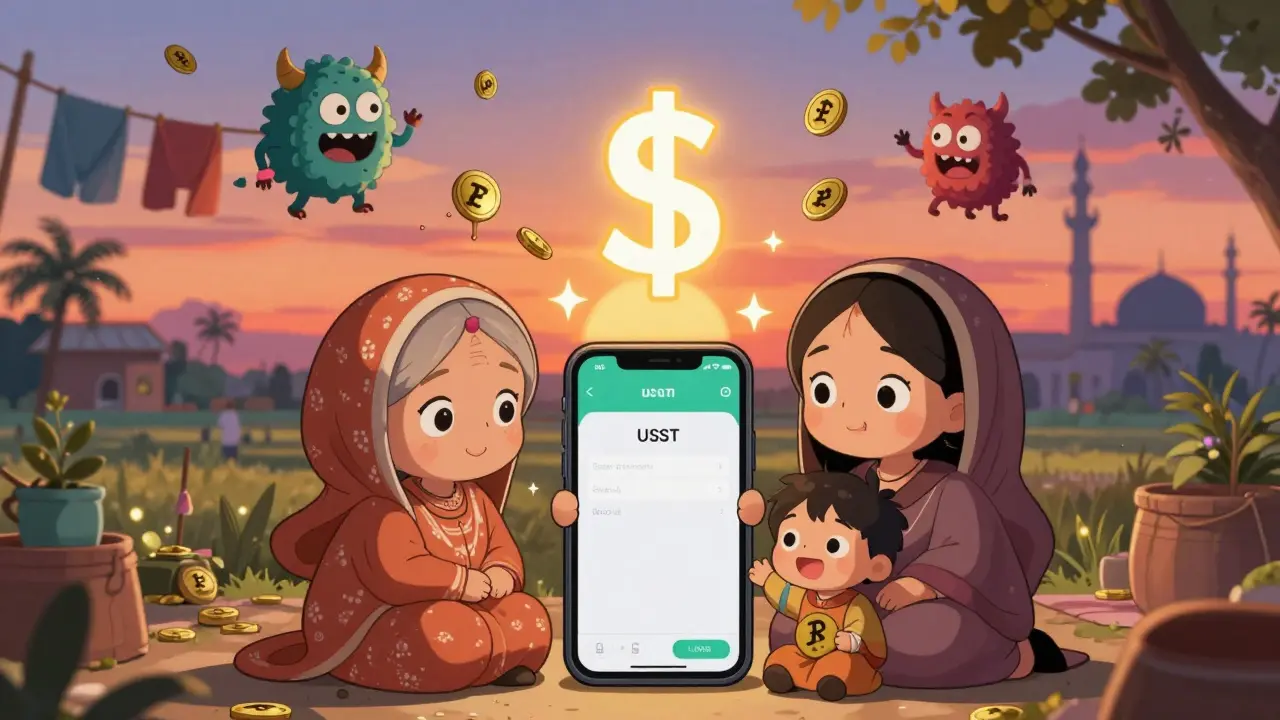
Most people assume Pakistan’s rise is due to Bitcoin speculation. It’s not. Bitcoin trading accounts for less than 15% of total crypto volume in the country. The real driver? Stablecoins - especially USDT (Tether). Why? Because they’re not about getting rich. They’re about staying afloat. Pakistan’s currency, the rupee, has lost over 60% of its value against the dollar since 2020. Inflation eats away at savings. Bank transfers take days. International remittances cost up to 12% in fees. Stablecoins solve all three problems. A worker in Saudi Arabia sends $500 in USDT directly to a family member’s wallet. It arrives in minutes. The recipient converts it to rupees at a local exchange with 1% fees. No middlemen. No delays. No hidden charges. Chainalysis economist Kim Grauer put it plainly: “Crypto adoption is mostly accelerating in emerging markets where stablecoins are transforming how people manage money.” In Pakistan, that’s not theory - it’s daily life. A 2025 survey of 5,000 users in Lahore and Karachi found 73% used crypto primarily for remittances and savings, not trading.How Pakistan Compares to Other Top Adopters
The top five countries in crypto adoption in 2025 look very different:- India (1st): 120 million users. Dominates due to massive population, low-cost exchanges, and widespread use of crypto for micro-payments and gig economy jobs.
- United States (2nd): 58 million users. Driven by ETF approvals, institutional adoption, and tax-friendly frameworks for holding crypto.
- Pakistan (3rd): 20 million users. Surging because of practical utility - remittances, inflation hedging, and decentralized commerce.
- Vietnam (5th): 15 million users. Strong in peer-to-peer trading and NFT-based freelancing.
- Nigeria (6th): 18 million users. Once a top contender, but regulatory backtracking and currency instability have slowed momentum.
The Hidden Players: Who’s Behind the Scenes?
Behind Pakistan’s crypto boom are not just everyday users - there are powerful partnerships shaping the future. In August 2025, the Pakistan Crypto Council signed a cooperation deal with World Liberty Financial, a firm linked to the Trump family. The agreement focuses on building blockchain infrastructure for public services, including land registries and payroll systems. This isn’t charity. World Liberty Financial’s co-founder, Zach Witkoff, secured meetings with top Pakistani officials - including Prime Minister Shehbaz Sharif and Army Chief Asim Munir - in April 2025. Critics call it a political play. Supporters say it brings much-needed tech investment. Meanwhile, MicroStrategy’s Michael Saylor has been quietly advising Pakistani officials on Bitcoin treasury reserves. His firm holds over $62 billion in Bitcoin. While Pakistan hasn’t bought any yet, the conversations are real. The goal? Use crypto to reduce dependence on the U.S. dollar for foreign reserves.Is This Sustainable? Or Just a Temporary Surge?
Some experts warn Pakistan’s ranking could slip if political instability grows. Others argue the foundation is solid. Unlike speculative booms in Venezuela or Argentina, Pakistan’s adoption is rooted in real economic pain - and real solutions. The creation of PVARA means crypto businesses now operate under clear rules. Licensing is required. KYC is enforced. Tax reporting is mandatory. This isn’t wild west anymore. It’s regulated utility. Also, Pakistan’s population is young - over 60% under 30. They’re digitally native, distrustful of traditional banks, and already fluent in mobile apps. Crypto isn’t foreign to them. It’s the next step. Projections show global crypto users will hit 1.1 billion by 2030. Pakistan, with its 230 million people and growing digital infrastructure, is positioned to capture a huge share. The real question isn’t whether it will stay in the top 5 - it’s whether it can become the first country to build its financial future on crypto-native systems.
What Comes Next for Pakistan’s Crypto Scene?
By 2026, expect to see:- Government payroll systems using USDT for civil servants in high-inflation regions.
- Local banks partnering with licensed crypto exchanges to offer hybrid accounts (fiat + crypto in one app).
- Mobile network operators (like Jazz and Telenor) launching crypto top-up services for airtime and data.
- Regulatory sandboxes allowing startups to test blockchain-based land title systems.
Why This Matters Beyond Pakistan
Pakistan’s story is a blueprint for other developing nations. It proves that even when governments try to ban crypto, people will find a way - and eventually, the state will have to adapt. The lesson isn’t about Bitcoin prices. It’s about what happens when innovation outpaces regulation. Countries like Egypt, Bangladesh, and Indonesia are watching closely. If Pakistan can make crypto work for its people - not just investors - it could redefine how the global South interacts with digital money.What’s Next for Global Crypto Adoption?
The Asia-Pacific region led global growth in 2024-2025, with Pakistan and India driving over 40% of new users. But the real shift is happening in places where people have no choice but to use crypto - not because they want to, but because they have to. The next frontier isn’t Wall Street. It’s Karachi. It’s Lahore. It’s the village in Balochistan where a grandmother sends her grandson’s school fees via USDT because the bank is closed for the third time this month. Crypto adoption isn’t about tech. It’s about survival.Why did Pakistan ban crypto in 2018, and why did it change its mind?
In 2018, the State Bank of Pakistan banned cryptocurrency, calling it illegal and risky. The move was meant to protect the financial system and prevent capital flight. But by 2023, over 15 million Pakistanis were already using crypto daily - mostly for remittances and inflation protection. With the rupee losing value and traditional banking failing, the government realized enforcement was impossible. Instead of continuing a losing battle, it shifted to regulation. By 2025, it created the Pakistan Virtual Assets Regulatory Authority to bring crypto into the legal economy.
Is crypto legal in Pakistan today?
Yes, but it’s regulated, not free. Since July 2025, all crypto exchanges, wallet providers, and trading platforms must be licensed by the Pakistan Virtual Assets Regulatory Authority (PVARA). Users must complete KYC, and businesses must report transactions over PKR 500,000. Crypto isn’t legal tender, but it’s a recognized digital asset under law. Taxes apply. Fraud is punishable. It’s now a controlled, monitored system.
Why are stablecoins like USDT more popular than Bitcoin in Pakistan?
Bitcoin is too volatile for everyday use. Its price swings make it unreliable for paying bills or sending money. USDT, on the other hand, stays pegged to the U.S. dollar. That means a Pakistani worker can send $500 in USDT to family, and the recipient knows exactly how much rupees they’ll get. It’s stable, fast, and cheap - perfect for remittances and saving money during inflation. Bitcoin is seen as a long-term store of value by a small group. USDT is what keeps households running.
How many people in Pakistan use cryptocurrency?
As of 2025, an estimated 20 million Pakistanis - about 9% of the population - actively hold or use cryptocurrency. Most are between ages 18 and 35. Over 70% use it for remittances or protecting savings from inflation. This is far above the global average of 6.9% ownership. Some estimates suggest the real number could be higher due to unregistered peer-to-peer activity.
Does Pakistan’s crypto adoption threaten the national currency?
Not directly - and that’s intentional. The government doesn’t want to replace the rupee. It wants to give people tools to protect themselves from its instability. Crypto is used as a supplement, not a substitute. People still earn and pay in rupees. But when inflation spikes or banks freeze accounts, they turn to USDT. This reduces pressure on the central bank by lowering demand for dollars in the black market. The goal is financial resilience, not currency replacement.
Could Pakistan become a crypto hub like Singapore or Switzerland?
It’s possible, but unlikely in the same way. Singapore attracts global firms with tax breaks and tech talent. Pakistan’s advantage is scale and need. With 230 million people and high financial exclusion, its crypto ecosystem is built from the ground up - not from corporate headquarters. It’s more likely to become a model for emerging markets: a place where crypto solves real problems for ordinary people, not just a haven for investors. The focus is on utility, not prestige.





Will Lum
February 11, 2026 AT 13:13Santosh kumar
February 12, 2026 AT 04:49Benjamin Andrew
February 12, 2026 AT 17:32Kaz Selbie
February 14, 2026 AT 08:37Robbi Hess
February 14, 2026 AT 20:40monique mannino
February 16, 2026 AT 13:07Holly Perkins
February 17, 2026 AT 16:39Desiree Foo
February 18, 2026 AT 07:14Keturah Hudson
February 19, 2026 AT 09:24Ace Crystal
February 20, 2026 AT 22:31Brittany Meadows
February 22, 2026 AT 18:15SAKTHIVEL A
February 23, 2026 AT 10:11krista muzer
February 24, 2026 AT 06:48Tammy Chew
February 24, 2026 AT 22:45Lindsey Elliott
February 25, 2026 AT 11:28Claire Sannen
February 25, 2026 AT 19:50blake blackner
February 26, 2026 AT 03:19Andrea Atzori
February 26, 2026 AT 07:58Joe Osowski
February 27, 2026 AT 10:44Gaurav Mathur
February 27, 2026 AT 15:05Jeremy Lim
March 1, 2026 AT 02:02kelvin joseph-kanyin
March 1, 2026 AT 09:05Elizabeth Choe
March 2, 2026 AT 02:58John Doyle
March 2, 2026 AT 05:54Benjamin Andrew
March 3, 2026 AT 05:51