

If you’ve heard about the Aperture Finance APTR airdrop and are wondering whether you missed it or how to claim your tokens, you’re not alone. The airdrop happened in May 2024, but many users still don’t know if they qualified, how to claim, or what the APTR token is even for. This isn’t just another crypto giveaway - it’s tied to a real innovation in DeFi. Let’s cut through the noise and give you the straight facts: who got it, how to claim it, and why it matters.
What Is Aperture Finance?
Aperture Finance isn’t another DeFi app that just moves money around. It’s built around something called Intents a system that lets users describe what they want to do in plain language - like "I want to earn the highest yield on my ETH without managing positions" - and then automatically finds the best way to make that happen. Think of it like a smart assistant for DeFi. Instead of manually setting up liquidity pools, adjusting ranges, or chasing yield across dozens of protocols, you tell Aperture what you want, and its network of solvers handles the rest.
This is a big deal because most DeFi platforms still require users to understand complex mechanics like impermanent loss, range orders, and fee tiers. Aperture removes that barrier. It’s not replacing Uniswap - it’s layering on top of it to make it easier to use. And that’s why it’s gaining traction.
APTR Token Airdrop: The Basics
On May 31, 2024, Aperture Finance distributed 7% of its total token supply - APTR the native token of the Aperture Finance protocol - to users who engaged with the platform. Unlike many airdrops that lock tokens for months or years, APTR airdrop recipients got 100% of their tokens unlocked immediately. No vesting. No waiting. You claimed it, you owned it.
Eligibility wasn’t random. You had to earn points by doing specific things:
- Connecting your wallet to the Aperture platform
- Using Aperture’s tools to manage liquidity on Uniswap V3
- Participating in the UniV3 Private Beta program
- Referring others who qualified
- Creating educational content about Aperture or DeFi liquidity strategies
Points were tracked automatically. If you didn’t see a balance on the claim page, you didn’t qualify. No exceptions.
How to Claim Your APTR Tokens
Claiming your APTR tokens is straightforward - if you’re eligible. Here’s how to do it:
- Go to the official Aperture Finance airdrop claim page (always double-check the URL - scams are common).
- Connect your cryptocurrency wallet. MetaMask, Rabby, or any wallet compatible with Arbitrum works.
- Make sure your wallet is switched to the Arbitrum a Layer 2 scaling network for Ethereum that reduces fees and speeds up transactions network. APTR tokens exist only on Arbitrum.
- Click the "Sign" button to authenticate your identity.
- Once signed, the system will show you how many APTR tokens you’re eligible for.
- Click "Claim" and confirm the transaction in your wallet.
That’s it. The tokens should appear in your wallet within minutes. If you don’t see them, check your wallet’s token list - you might need to manually add the APTR contract address.
Who Qualified for the Airdrop?
Aperture didn’t give tokens to everyone. They rewarded active users. Here’s who got paid:
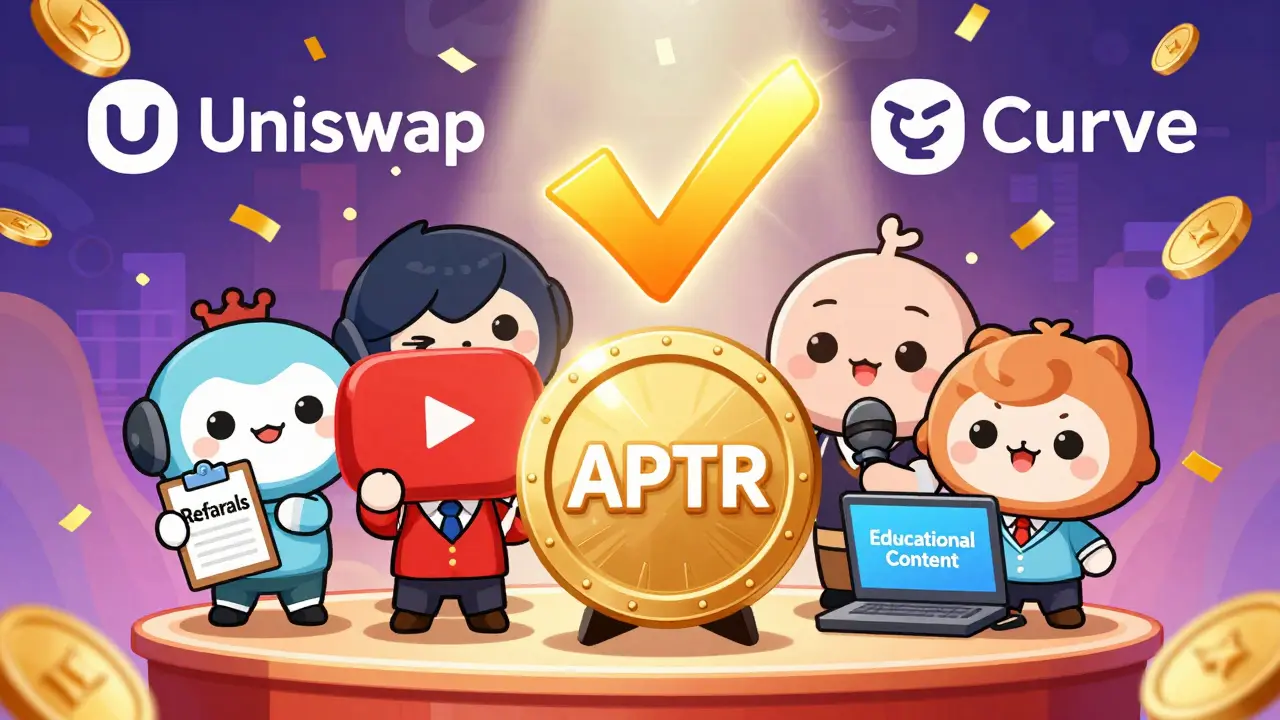
- Uniswap V3 liquidity providers - If you provided liquidity on Uniswap V3 and used Aperture’s tools to manage your positions, you earned points. The more you used it, the more you got.
- Referrers - You got 25% of the airdrop amount earned by each person you referred, capped at 16,666 APTR (around $2,500 at the time).
- Content creators - If you wrote guides, made YouTube videos, or posted on Twitter/X explaining how to use Aperture, you could earn 3,333 APTR (about $500) for high-quality material.
- Beta testers - Those in the UniV3 Private Beta program got priority access and higher point multipliers.
It wasn’t about how long you held tokens or how much you staked. It was about usage. Aperture wanted users who would stick around, not just cash out.
Tokenomics: How APTR Is Structured
Understanding APTR’s supply helps explain why the airdrop mattered. Here’s how the tokens were allocated:
| Allocation | Percentage | Vesting | Unlock Status |
|---|---|---|---|
| Airdrop | 7% | None | 100% unlocked |
| Seed Round | 10% | 5% at TGE, 6-month cliff, 24-month vesting | Partially unlocked |
| Strategic Round | 15% | 5% at TGE, 3-month cliff, 18-month vesting | Partially unlocked |
| Public Sale | 1.3% | None | 100% unlocked |
| Team & Advisors | 20% | 24-month vesting | Locked |
| Protocol Growth & Ecosystem | 46.7% | Varies | Partially unlocked |
The airdrop was the only part of the supply that was fully unlocked from day one. That means early users had immediate trading power - unlike investors who had to wait months or years. This was intentional. Aperture wanted to align incentives with users who were already helping build the protocol.
Why APTR Could Go Up - And Why It Might Not
Some price trackers predict APTR could hit $0.0720 by 2025. That’s a 33,000% increase from its initial value. Sounds crazy? Maybe. But here’s why it’s plausible:
- Aperture’s Intents model solves a real problem: DeFi is too complicated.
- It’s built on Uniswap V3, which already has billions in liquidity.
- It’s not competing - it’s enhancing. That makes adoption easier.
- 100% unlocked airdrop tokens created immediate market activity.
But here’s the flip side: no one knows if users will keep using it. If the interface doesn’t improve, if the solvers don’t deliver better prices, or if competitors catch up, APTR could stagnate. The token’s value isn’t just about speculation - it’s about utility. The more people use Aperture to manage their liquidity, the more APTR becomes necessary.

What’s Next for Aperture Finance?
The team has a clear roadmap:
- Expand beyond Uniswap V3 to other DEXs like SushiSwap and Curve.
- Improve the natural language engine to handle more complex commands - like "I want to hedge my USDC against ETH volatility."
- Add more solver types - not just for yield, but for arbitrage, debt management, and cross-chain swaps.
- Integrate with wallet providers to make the whole experience seamless.
If they pull this off, Aperture could become the default layer for DeFi users who don’t want to be traders - just people who want their crypto to work for them.
Frequently Asked Questions
Can I still claim the Aperture Finance APTR airdrop?
No. The official claim period ended on June 15, 2024. If you didn’t claim by then, you lost your eligibility. There are no extensions, no exceptions, and no second chances. Always check the official website for future airdrops.
Why was the airdrop on Arbitrum and not Ethereum?
Aperture chose Arbitrum because it’s faster and cheaper. Ethereum mainnet fees can be $50+ for a single transaction. On Arbitrum, it’s under $1. Since Aperture’s users are constantly managing liquidity positions, lower fees mean more people can use the platform without getting priced out.
Do I need to stake APTR to earn rewards?
Not yet. The airdrop was a one-time distribution. As of now, there are no staking or yield programs for APTR. Future features may change this, but nothing has been announced. Don’t trust any site asking you to stake APTR - it’s likely a scam.
How do I know if I was eligible for the airdrop?
Aperture automatically checked your wallet activity between January 1 and May 31, 2024. If you connected your wallet to Aperture, used its tools, or referred others, you would have seen a balance on the claim page. If you didn’t see anything, you didn’t qualify. There’s no appeal process.
Is APTR a good investment?
It depends. If Aperture becomes the standard way people manage DeFi liquidity, APTR could grow. But if the platform doesn’t attract more users or if competitors release better tools, the token could lose value. Don’t invest based on price predictions. Only hold it if you believe in the product - not the hype.
Next Steps
If you claimed your APTR tokens, consider using them. Trade them, hold them, or use them if Aperture ever launches governance. If you didn’t qualify, don’t chase old airdrops. Instead, keep an eye on Aperture’s official channels - they’re likely running new engagement programs. The next one might be even better.
Remember: in DeFi, the real value isn’t in the tokens you get - it’s in the tools you use. Aperture isn’t selling a coin. It’s selling a better way to do DeFi. That’s worth paying attention to.




Ken Kemp
March 8, 2026 AT 19:24Julie Potter
March 10, 2026 AT 03:14nalini jeyapalan
March 11, 2026 AT 17:49Christina Young
March 11, 2026 AT 18:08Drago Fila
March 11, 2026 AT 20:10Steven Lefebvre
March 12, 2026 AT 15:25Leah Dallaire
March 12, 2026 AT 16:15prasanna tripathy
March 14, 2026 AT 05:48James Burke
March 14, 2026 AT 22:39Jonathan Chretien
March 15, 2026 AT 12:07Bill Pommier
March 17, 2026 AT 00:31Olivia Parsons
March 17, 2026 AT 13:28Nick Greening
March 18, 2026 AT 06:20Jesse VanDerPol
March 19, 2026 AT 21:35jonathan swift
March 21, 2026 AT 14:08Datta Yadav
March 21, 2026 AT 19:50Lydia Meier
March 22, 2026 AT 01:46jay baravkar
March 23, 2026 AT 11:02Ian Thomas
March 23, 2026 AT 17:13