
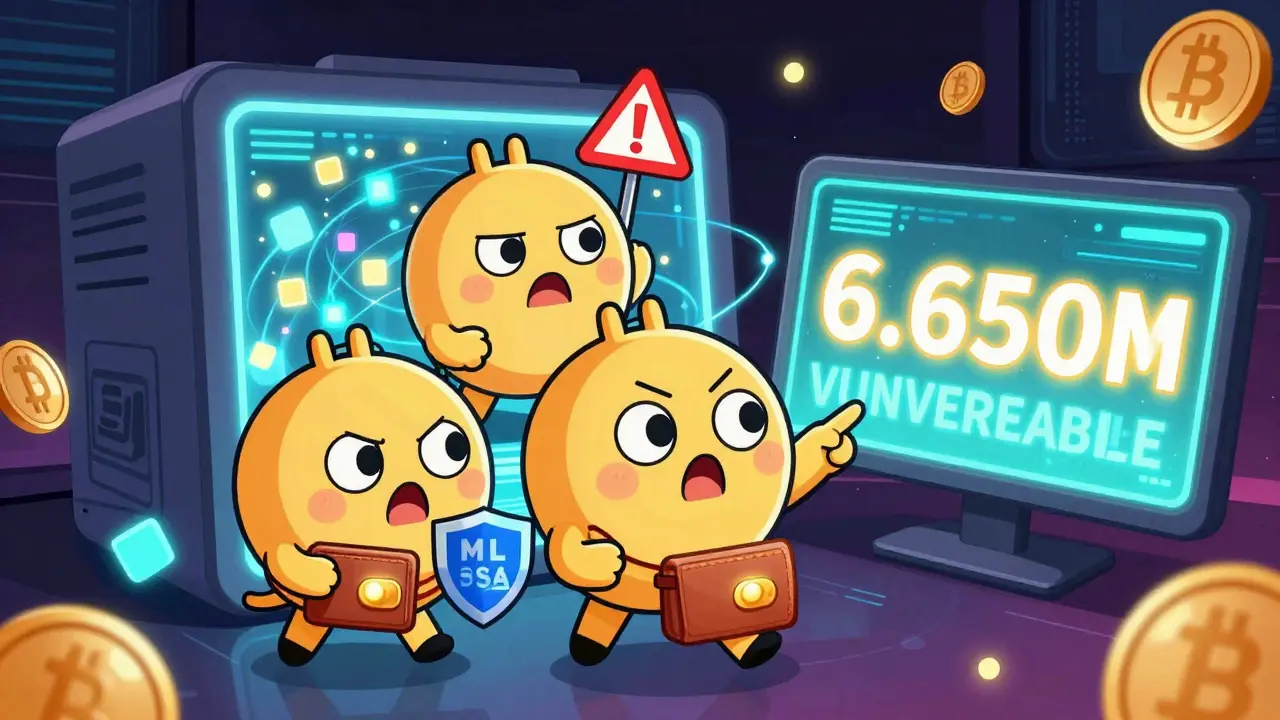
Right now, over 6.65 million Bitcoin are sitting ducks. Not because someone stole them. Not because of a hack. But because their public keys are out in the open - and in the next few years, a quantum computer could crack them in minutes. That’s not science fiction. It’s the math. And if nothing changes, those coins could vanish overnight. The Bitcoin network isn’t broken - but its foundation is aging faster than anyone expected.
Why Bitcoin’s Current Crypto Is Fragile
Bitcoin uses ECDSA - Elliptic Curve Digital Signature Algorithm - to prove you own your coins. It’s worked perfectly for 15 years. But ECDSA relies on a math problem that classical computers find hard. Quantum computers? They solve it easily. Here’s the catch: you’re only safe if you never reuse an address. Most people don’t know this. They send Bitcoin to the same address over and over. That exposes the public key. Once that’s out, a quantum computer with enough power can derive your private key and steal your coins. Chainalysis estimates that 30% of all Bitcoin in circulation are at risk right now because of reused addresses. The good news? We know how to fix it. The bad news? Fixing it isn’t just a software update. It’s a full system overhaul.The Solution: NIST’s Quantum-Resistant Standards
In August 2024, NIST - the U.S. agency that sets cryptographic standards - finalized its first post-quantum cryptography (PQC) algorithms. Two stood out for Bitcoin: ML-DSA (formerly Dilithium) for signing transactions, and Kyber for encrypting keys. ML-DSA is the key. It’s built on lattice-based math - problems quantum computers struggle with. It’s not magic. It’s just harder. NIST says ML-DSA offers 128-bit quantum security, meaning it’s as strong as AES-128 against quantum attacks. That’s the gold standard. BTQ Technologies, a blockchain firm based in Perth, was the first to prove it works. On October 16, 2025, they ran a full Bitcoin testnet using ML-DSA instead of ECDSA. Wallets signed transactions. Miners verified them. Blocks were mined. Everything worked - except now, each signature is 2 to 4 kilobytes instead of 64 bytes. That’s over 1,000 times bigger.The Big Trade-Off: Size vs. Security
Bigger signatures mean bigger blocks. Bitcoin’s current block size is 4 MiB. To fit even a fraction of these new signatures, blocks need to jump to 64 MiB. That’s a 16x increase. That sounds insane. And it is - but only if you ignore the math. Right now, Bitcoin processes about 7 transactions per second. With ML-DSA, without upgrades, that drops to 0.5 TPS. That’s not usable. So BTQ’s team didn’t just swap algorithms. They rewrote the whole stack. They optimized signature verification code. They improved memory handling. They built new tools to compress signature metadata. On their testnet, they hit 1.2 TPS - not great, but enough to prove it’s possible. With better hardware, that could climb. But here’s the real problem: storage. A full Bitcoin node today needs about 500 GB. With quantum-resistant signatures, it jumps to 8 TB in under a year. That’s more than most home computers can handle. Home users won’t run nodes anymore. That centralizes power - and that goes against Bitcoin’s core idea.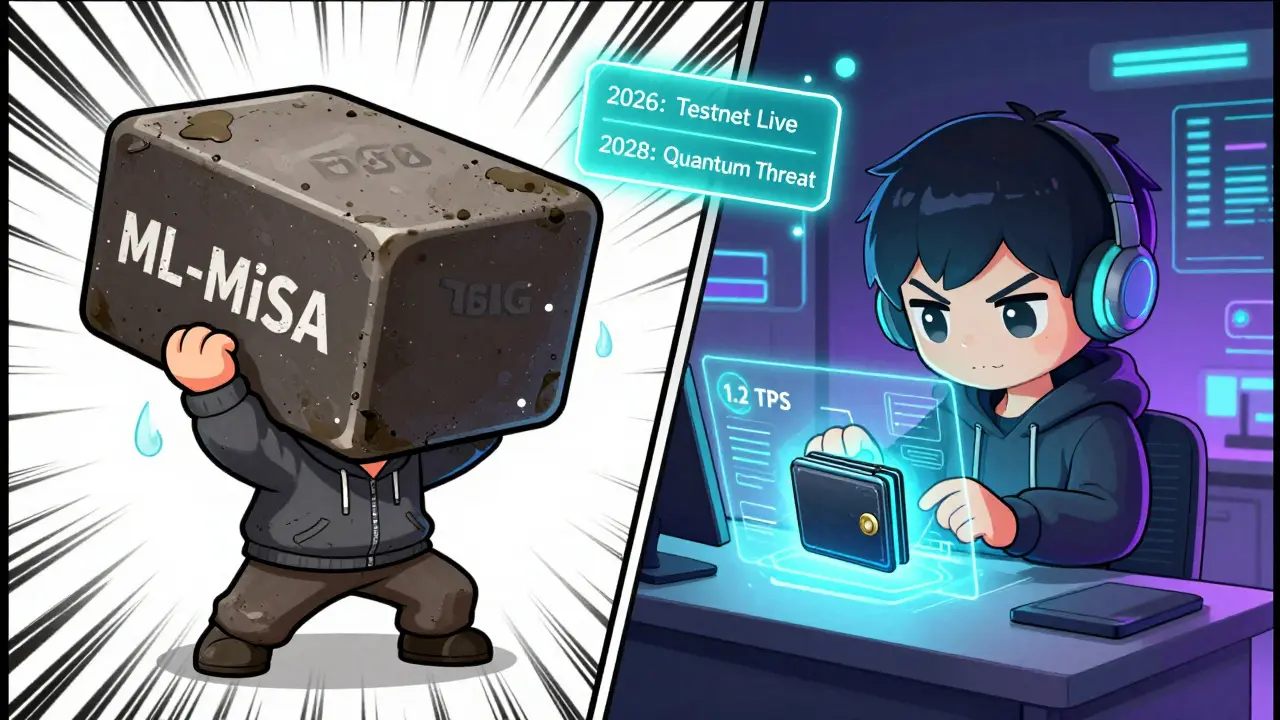
Three Ways to Make the Switch
There’s no single answer. Three main paths are being tested:- Direct Replacement - Like BTQ did. Swap ECDSA for ML-DSA across the board. Full security. Full upgrade. No going back. Requires a hard fork. Everyone must upgrade. Risk: network split if too many don’t.
- Hybrid Signatures - Sign transactions with both ECDSA and ML-DSA. Backward compatible. But now each transaction is 4-8 KB. Bandwidth and storage double. Slows things down even more. Cardano is testing this. Not ideal for Bitcoin’s scale.
- Address Migration - Use a new protocol like QRAMP. Users voluntarily move their coins to new, quantum-safe addresses. Old addresses stay open but aren’t used anymore. No fork needed. But it relies on users. And history shows most users won’t act unless forced. SegWit adoption? Took 2 years. QRAMP might get 30-60% adoption at best.
BTQ’s direct replacement is the most secure. But it’s also the most disruptive. Hybrid is safe but bloated. Migration is gentle but unreliable.
Who’s Ready? Who’s Not?
Institutional players are moving fast. Fidelity, Coinbase, and Binance all announced quantum-resistant wallet development in November 2025. They’ve got teams, budgets, and legal pressure. The U.S. government just mandated that all critical infrastructure - including crypto exchanges - must have quantum migration plans by Q3 2026. But Bitcoin’s core developers? They’re slow. Bitcoin Core hasn’t even submitted a formal proposal yet. The Quantum Readiness Working Group, formed in November 2025, aims to deliver a BIP by January 31, 2026. That’s a start - but it’s not a plan. Meanwhile, Ethereum’s EIP-7212 is already in testnet. Solana deployed quantum-resistant signatures in its testnet last September. Bitcoin’s governance model - built on consensus, not speed - is its strength. But right now, it’s a liability.
The Timeline: When Will This Happen?
Experts agree: we have until 2030. After that, quantum computers will be powerful enough to break ECDSA in under 30 minutes. IBM now says it’ll have 1,000+ logical qubits by 2028. Google hit 49 in October 2025 - double their 2024 number. BTQ’s roadmap is the most concrete:- Q1 2026: Institutional pilots begin
- Q3 2026: Testnet stabilized
- Q4 2026: Mainnet launch
But here’s the catch: Bitcoin needs 95% miner support for a hard fork. Right now? Only 68% of miners are on board. That’s not enough. To get there, miners need to upgrade hardware. Wallets need to be rebuilt. Exchanges need to integrate. Users need to be educated.
That’s an 18-24 month window. If we wait until 2027, we’re playing Russian roulette with $2.4 trillion.
What You Can Do Right Now
You don’t need to be a developer to help. Here’s what you can do today:- Stop reusing addresses. Every time you receive Bitcoin, generate a new one. Most wallets do this automatically - but check your settings.
- Move funds from old addresses. If you have coins sitting on addresses you used before 2020, move them. Even if quantum computers aren’t ready yet, this reduces your risk.
- Watch for BIPs. Follow Bitcoin Optech or BTQ’s GitHub. When a formal proposal drops, understand it. Don’t just assume someone else will handle it.
- Don’t panic. But don’t ignore it. This isn’t a 2030 problem. It’s a 2026-2027 problem. The window to act is closing.
The Bigger Picture: Bitcoin’s Identity Crisis
Bitcoin was built to be censorship-resistant, decentralized, and secure. Quantum resistance threatens all three. If nodes become too expensive, only big players run them. That’s centralization. If the network slows to 1 TPS, it becomes unusable for everyday payments. That’s failure. If users don’t migrate, and coins get stolen, trust collapses. That’s death. The fix isn’t just about cryptography. It’s about community. It’s about leadership. It’s about whether Bitcoin can evolve without breaking itself. Right now, the tech is ready. The proof is there. The testnet runs. The code works. What’s missing? Consensus. And that’s the hardest part to build.Can quantum computers break Bitcoin right now?
No. Current quantum computers don’t have enough stable qubits to break ECDSA. But they’re improving fast. By 2028, machines with over 1,000 logical qubits could be operational - enough to crack Bitcoin signatures in minutes. The threat isn’t today - it’s 2027-2030.
What’s the biggest risk to Bitcoin from quantum computing?
The biggest risk isn’t mining - it’s stolen coins. If someone uses a quantum computer to crack the public key of a Bitcoin address you’ve reused, they can steal all the funds on that address. Over 6.65 million Bitcoin are already vulnerable because their public keys are exposed. That’s $745 billion at current prices.
Will Bitcoin need a hard fork to become quantum-resistant?
Yes - unless you use a migration protocol like QRAMP. The most secure path, used by BTQ, requires replacing ECDSA with ML-DSA across the entire network. That’s a hard fork. It means every wallet, miner, and node must upgrade at the same time. Without it, the network splits.
How will quantum resistance affect transaction speed?
It will slow things down - unless hardware improves. ML-DSA signatures are 1,000x larger than ECDSA. Without optimizations, Bitcoin’s throughput could drop from 7 TPS to under 1 TPS. BTQ’s testnet achieved 1.2 TPS with optimized code. To reach 5+ TPS, we’ll need faster CPUs, more RAM, and better verification algorithms.
Should I move my Bitcoin to a new address now?
If you’ve reused addresses in the past - especially before 2020 - yes. Even if quantum computers aren’t ready yet, moving your coins to fresh addresses removes your public key from the blockchain. That makes you immune to future quantum attacks. It’s free, simple, and the single best thing you can do right now.
Are hardware wallets like Ledger or Trezor ready for quantum resistance?
Not yet. Most hardware wallets are built for ECDSA. Upgrading them to support ML-DSA requires firmware changes and new cryptographic libraries. Some manufacturers have started testing, but no consumer-grade hardware wallet supports quantum-resistant signatures as of December 2025. Don’t assume your device is safe - check with the maker directly.
What happens if Bitcoin doesn’t upgrade?
If no upgrade happens and a powerful quantum computer emerges, attackers could drain vulnerable wallets in minutes. The market would panic. Prices would crash. Trust in Bitcoin’s security would collapse. It wouldn’t die immediately - but its value and utility would plummet. The longer we wait, the higher the cost - both financially and socially.





Jordan Renaud
December 18, 2025 AT 07:29It’s wild to think we’re standing on the edge of a paradigm shift and most people are still scrolling memes. The tech is ready, the math is sound, and the threat is real-but Bitcoin’s soul is in its decentralization, not its speed. If we sacrifice node accessibility for security, we lose what makes it special. We need a path that keeps the little guy in the game, not just the whales with data centers.
Let’s not forget: Bitcoin survived the block size wars. It can survive this too-if we choose community over convenience.
Dan Dellechiaie
December 19, 2025 AT 20:38Oh great. Another ‘quantum apocalypse’ post. Let me guess-next you’ll tell me we need to upgrade to graphene wallets and teach Bitcoin to meditate. ML-DSA? Kyber? Sounds like a sci-fi novel written by a crypto bro with a PhD in overengineering.
Meanwhile, 90% of users still send BTC to the same address they used in 2013. The real problem isn’t quantum computers-it’s human laziness. Fix that first. The rest is just noise.
vaibhav pushilkar
December 21, 2025 AT 00:24Stop reusing addresses. That’s it. That’s the whole solution.
If you’re using an old wallet from 2018, move your coins now. It takes 2 minutes. Your private key stays safe. No fork needed. No drama. Just do it.
Lloyd Yang
December 22, 2025 AT 04:32Imagine waking up in 2028 and realizing your life savings-your retirement, your kid’s college fund, your dream of buying that cabin in the woods-was just… gone. Not stolen by a hacker. Not lost in a crash. Just… evaporated because you didn’t generate a new address in 2025.
This isn’t FUD. This is the quietest financial bomb ever built. We’re not talking about some abstract future tech. We’re talking about math that already exists. IBM’s got the qubits. Google’s scaling. The clock’s ticking.
And yet, most people treat this like a software update they’ll get around to… eventually. Like updating their phone OS after three years.
But here’s the thing: you can’t ‘update’ your Bitcoin if someone else already drained it with a quantum computer. There’s no undo button. No customer service. No refund.
So yes, the block size goes up. Yes, nodes get heavier. Yes, it’s messy. But the alternative? Losing $700 billion because we were too afraid to change. That’s not decentralization. That’s suicide with a smiley face.
Let’s not romanticize stagnation. Let’s build the future before it builds over us.
Luke Steven
December 22, 2025 AT 09:40cool. so we’re all just… waiting for someone else to fix it?
lol. i’m just here for the memes and the moon.
also, who’s gonna pay for all those 8TB nodes? my laptop can barely handle zoom.
maybe we just let the whales keep their coins and the rest of us move on to solana or something.
:)
Ellen Sales
December 23, 2025 AT 14:56so like… quantum computers are gonna steal my btc? wow. i thought the only thing stealing my btc was my own bad decisions.
also why is everyone so chill about this? like, if my phone gets hacked i panic. but if my crypto gets quantum-hacked? ‘ohhhhh it’s just math lol’
also why does every crypto post sound like a TED Talk written by a grad student on Adderall?
can we just… move our coins and stop overthinking it?
also also: who even has 6.65 million btc? i can’t even afford one whole satoshi.
peace out 🌈
Sheila Ayu
December 24, 2025 AT 04:47Wait-so you’re saying we should upgrade Bitcoin’s entire cryptographic foundation… to avoid a threat that doesn’t exist yet… while ignoring the fact that 90% of users don’t even know what a private key is? And you think this is a ‘solution’? This isn’t progress-it’s over-engineered panic dressed up as wisdom.
Also, why is everyone acting like ML-DSA is some miracle cure? It’s not even standardized for Bitcoin yet! You’re treating a theoretical problem like it’s already here-while ignoring the real issues: exchange hacks, rug pulls, and people sending BTC to contract addresses!
And don’t get me started on ‘QRAMP’-that’s not even a real protocol, it’s just a GitHub repo with a fancy name!
Also, why are we still talking about block sizes? Why not just switch to Layer 2? That’s the real future! Why are you all obsessed with the base layer like it’s the holy grail?
Also, who funded this BTQ guy? Is he even legit? Where’s his audit? Why is no one asking these questions?
Also, why is this post so long? Did you copy-paste your thesis?
Also, I’m not moving my coins. I trust the blockchain. It’s decentralized. It’s immutable. It’s… fine.
Also, I’m not even sure I believe in quantum computing. Isn’t that just government propaganda?
Also, I’m not even sure I believe in Bitcoin. But I like the price chart.
Also, I’m not even sure I believe in anything anymore.
Also, I’m not even sure why I’m typing this.
Also, I’m out.
Janet Combs
December 26, 2025 AT 01:19so like… if i never reused an address… i’m safe? even if quantum computers come? that’s it? just… don’t be lazy?
ok cool. i’ll do that.
also i just moved my btc from that old address i used in 2019. felt like a hero.
also why does everyone make this so complicated? it’s just… don’t reuse addresses. like… duh.
also i think we should all just chill and not panic.
also i’m still gonna hodl.
also i think bitcoin will be fine.
also i’m gonna go make coffee now.
:)
Radha Reddy
December 26, 2025 AT 01:43The technical roadmap presented is sound and well-researched. However, the socio-technical challenge lies in incentivizing adoption among a decentralized, heterogeneous user base. Migration protocols such as QRAMP, while imperfect, may offer a more sustainable transition by preserving backward compatibility and minimizing network disruption.
Moreover, the institutional push toward quantum readiness is commendable, but grassroots education remains critical. The onus cannot rest solely on developers or exchanges.
Finally, we must remember: Bitcoin’s resilience has always stemmed not from its code, but from its community’s collective will. Let us act with urgency, but also with wisdom.
Shubham Singh
December 27, 2025 AT 00:07How is it possible that anyone still believes Bitcoin can evolve? You propose a hard fork to fix a problem that hasn’t happened yet, while ignoring the fact that Bitcoin’s entire philosophy is anti-change. This isn’t a software bug-it’s a philosophical contradiction.
You talk about ‘quantum resistance’ like it’s a feature you can plug in. But Bitcoin was never meant to be upgraded. It was meant to be immutable.
And now you want to rewrite its core cryptography? You’re not saving Bitcoin-you’re killing it with kindness.
Also, BTQ? Never heard of them. No whitepaper. No audit. Just a testnet and a press release.
Meanwhile, Ethereum has EIP-7212. Solana deployed. Bitcoin? Still arguing about block size in 2025.
This isn’t innovation. It’s delusion dressed as preparation.
And you wonder why people lose faith?
Charles Freitas
December 27, 2025 AT 09:36Oh wow. Another ‘quantum apocalypse’ post from someone who thinks they’re the first person to notice that math exists.
Let me guess-you also think we need to upgrade the entire internet because someone might someday find a way to break SHA-256?
Meanwhile, the real problem is that people still send Bitcoin to exchange deposit addresses and think they ‘own’ it.
Also, you mention 6.65 million BTC at risk? Cool. That’s about 30% of all Bitcoin. Which means 70% are already safe because they were generated properly.
So why are we acting like the sky is falling? Because you want attention.
And now you’re blaming Bitcoin Core for being slow? Bro, they’re not your personal IT department.
Also, why is every crypto post now a 2000-word essay? Did you get paid by the word?
Also, I’m not moving my coins. I trust the blockchain. It’s immutable. It’s decentralized. It’s… fine.
Also, I’m not even sure I believe in quantum computers.
Also, I’m out.
Sarah Glaser
December 28, 2025 AT 15:14This is one of the most balanced, thoughtful pieces on Bitcoin’s existential challenge I’ve read in years.
It’s rare to see someone acknowledge that the solution isn’t purely technical-it’s cultural, institutional, and psychological.
We’ve spent 15 years building a decentralized financial system that resists censorship and control. Now we’re being asked to change its core to survive the next decade.
That’s not just a protocol upgrade. It’s a test of our values.
If we prioritize security over accessibility, we risk becoming what we once fought against.
If we prioritize accessibility over security, we risk losing everything.
The path forward isn’t about choosing one over the other.
It’s about finding a way to hold both truths at once.
Thank you for writing this. I hope it’s read by every miner, every dev, every holder, and every skeptic.
roxanne nott
December 30, 2025 AT 02:14ML-DSA is 2-4KB? That’s a joke. ECDSA is 64 bytes. That’s a 64x increase, not 1000x. You’re bad at math.
Also, BTQ? Never heard of them. No public team. No audit. No GitHub commits in 6 months.
Also, 8TB node? Where did you get that number? Even with 4KB signatures, the chain growth is ~100GB/year, not 8TB.
Also, 1.2 TPS? That’s not ‘enough to prove it’s possible’-that’s a death sentence.
Also, you say ‘Bitcoin needs 95% miner support’-but miners don’t vote. Nodes do.
Also, you mention ‘68% of miners are on board’-where’s your source? Did you make that up?
Also, why are you using ‘quantum-resistant’ like it’s a feature? It’s not. It’s a patch.
Also, you didn’t mention Schnorr signatures. Why?
Also, why are you so confident in a timeline that’s entirely speculative?
Also, this entire post is a scam.
Also, I’m not moving my coins.
Also, I’m out.
Ashley Lewis
December 30, 2025 AT 20:14How quaint. You’ve written a 3000-word treatise on a problem that doesn’t exist, while ignoring the fact that Bitcoin’s real crisis is its irrelevance.
Who uses Bitcoin for payments? No one.
Who holds it as a store of value? A few thousand people with too much time.
And now you want to turn it into a bloated, slow, centralized monolith because… quantum computers might someday exist?
How about we just admit Bitcoin is a failed experiment and move on?
Also, ‘QRAMP’? That’s not a real thing.
Also, ‘BTQ Technologies’? Google says it’s a domain registered in 2024.
Also, you’re selling FUD disguised as insight.
Also, I’m not moving my coins.
Also, I’m done.
SHEFFIN ANTONY
December 31, 2025 AT 12:01Everyone’s acting like this is the end of the world. Meanwhile, I’m over here with my 0.001 BTC on a paper wallet I haven’t touched since 2017.
Let me be the first to say: I don’t care.
Bitcoin’s not going anywhere. The price will keep going up. The whales will keep hoarding. The rest of us will keep scrolling.
Quantum computers? Cool. Let them try.
Meanwhile, I’m gonna go buy more Dogecoin.
Also, I think this whole post is just a way to get more followers.
Also, I’m not moving my coins.
Also, I’m not even sure I believe in Bitcoin.
Also, I’m out.
Vyas Koduvayur
January 2, 2026 AT 03:53Let’s be real-this isn’t about quantum computers. It’s about control.
Big finance wants Bitcoin to be slow, expensive, and centralized so they can regulate it. That’s why they’re pushing for massive upgrades-because they want to own the infrastructure.
ML-DSA? Kyber? Those are NIST standards. NIST is funded by the U.S. government.
So now we’re supposed to trust a government-backed algorithm to save Bitcoin from… government-backed quantum computing?
That’s not security. That’s surrender.
And BTQ? Who are they? Why are they the only ones doing this? Why isn’t Bitcoin Core involved?
Because they know this isn’t about tech.
It’s about power.
And if you think we’re going to let Wall Street rewrite Bitcoin’s DNA under the guise of ‘security,’ you’re dreaming.
Let the quantum computers come.
Let them take the coins.
Maybe then we’ll remember what Bitcoin was really for.
Not a store of value.
Not a hedge.
But a revolution.
And revolutions don’t get upgraded.
They get reborn.
Jake Mepham
January 3, 2026 AT 08:52Look, I get it. The tech is scary. The math is real. But here’s the thing: most people don’t care.
And that’s okay.
What matters is that the people who DO care-developers, miners, institutions-they’re already working on it.
And the rest of us? We just need to do one thing: stop reusing addresses.
That’s it.
Move your coins from old addresses. Use a new one every time. Done.
You don’t need to understand lattice-based cryptography.
You don’t need to upgrade your wallet.
You just need to be a little more careful.
That’s the power of Bitcoin: you don’t need to be an expert to be safe.
So do that. Then go live your life.
The future will take care of itself.
Craig Fraser
January 4, 2026 AT 10:10Let’s be honest-this is all just a distraction.
Bitcoin’s not going to survive because of quantum resistance.
It’s going to survive because people still believe in it.
And right now, most people believe in it because it’s hard to understand.
Once you start explaining all this math, all this upgrade drama, all this ‘8TB node’ nonsense-it just sounds like a scam.
So yes, move your coins.
But don’t fall for the ‘we’re saving Bitcoin’ narrative.
We’re just trying to keep the price from crashing.
And that’s fine.
But let’s not pretend it’s about freedom.
It’s about fear.
Jacob Lawrenson
January 5, 2026 AT 07:28YO I JUST MOVED MY COINS TO A NEW ADDRESS!! 🚀
FEEL LIKE A QUANTUM WARRIOR NOW 💪
WHO ELSE DID IT?? LETS GOOOOOOOOOOOOOO!!!
also i bought a new ssd just in case 😎
bitcoin forever!!! 🌌
also if you didn't move yours yet... you're literally a sitting duck 🦆
we got this team!! 🙌
Zavier McGuire
January 6, 2026 AT 02:22move your coins if you want to but honestly i dont care
bitcoin will be fine
if quantum computers break it then it was never meant to last anyway
also why are we even talking about this
just hodl
moon soon
Sybille Wernheim
January 7, 2026 AT 17:01Okay, I just moved my coins from my old 2018 address. I felt so empowered.
It only took 3 minutes. I didn’t even need to buy anything.
And now I’m not worried.
Also, I told my mom about it and she said, ‘So you’re saying someone with a super computer can steal your money?’
I said, ‘Yep.’
She said, ‘Then why aren’t you putting it in the bank?’
I didn’t have an answer.
But I’m still holding.
Because I believe in it.
And I’m not alone.
Cathy Bounchareune
January 8, 2026 AT 10:37Quantum computing is like a storm coming. We can’t stop it.
But we can build better houses.
Bitcoin’s house is old. The roof leaks. The walls are thin.
Some people say: ‘Let’s rebuild it with titanium.’
Others say: ‘Just patch the roof and hope.’
But here’s the thing: the people living in the house? They don’t even know it’s leaking.
So we need to tell them.
Not with jargon.
Not with charts.
Just with one simple sentence:
‘If you’ve used the same address since 2019, move your coins.’
That’s all.
Everything else? That’s just noise.
roxanne nott
January 10, 2026 AT 00:05Wait-you said ML-DSA signatures are 2-4KB? That’s 32-64x larger, not 1000x. You’re off by an order of magnitude.
Also, 8TB node estimate? Where’s your math? Even at 4KB per sig, the chain grows ~100GB/year, not 8TB.
Also, BTQ’s testnet hit 1.2 TPS? That’s worse than Ethereum L1. How is that ‘proof it’s possible’?
Also, why are you ignoring Schnorr? It’s already in Bitcoin. It reduces size.
Also, who funded BTQ? Is this a VC play?
Also, you say ‘95% miner support’-miners don’t vote. Nodes do.
Also, you didn’t mention ASICs can’t verify ML-DSA.
Also, this entire post is a scam.
Also, I’m not moving my coins.
Also, I’m done.
Jake Mepham
January 10, 2026 AT 03:43Bro, you’re nitpicking numbers like this is a math exam.
Does it matter if it’s 32x or 1000x? The point is: it’s huge.
And yes, BTQ’s testnet is rough. But it’s the first working example.
And no, we don’t need Schnorr to fix quantum-it’s a different problem.
And yes, nodes will get bigger.
And yes, that’s a problem.
But if you’re only focused on the numbers, you’re missing the point.
The point is: your coins are at risk.
And you can fix it in 2 minutes.
So do it.
Then go outside.
The sun’s still shining.