
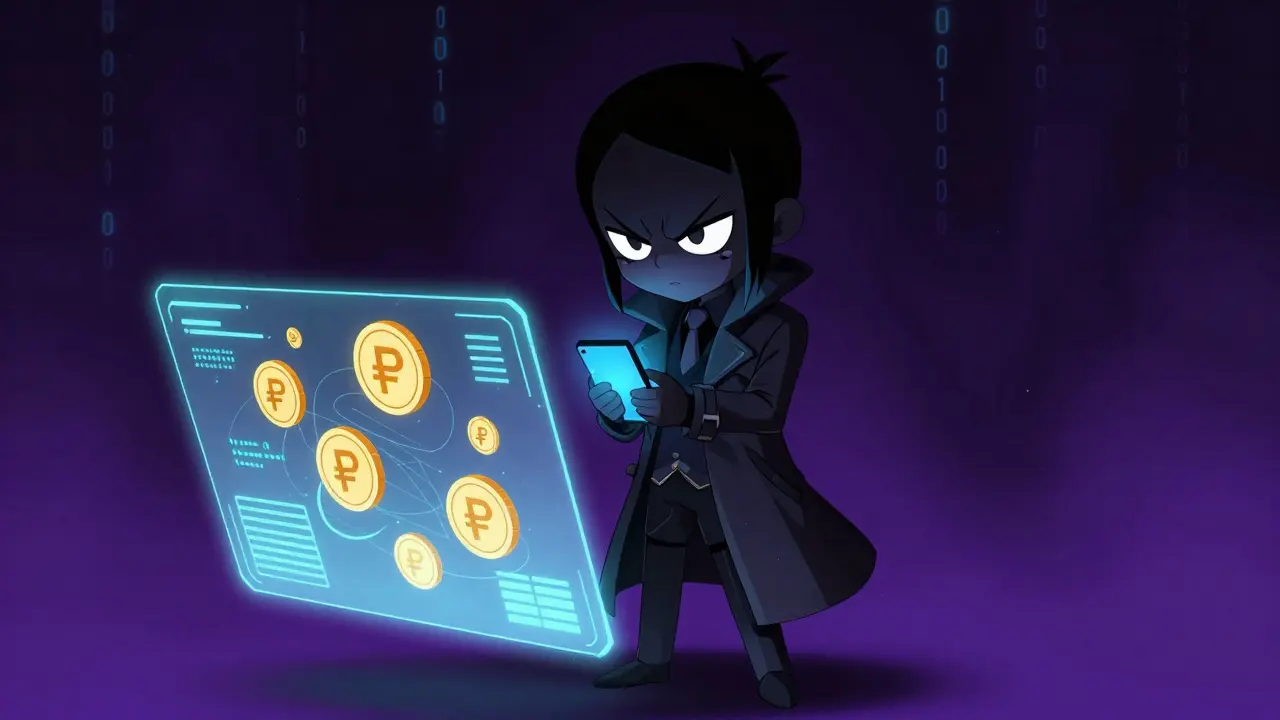
When the West slammed the financial doors shut on Russia in 2022, everyone assumed it would choke off the funding for its war machine. They were wrong. Instead of collapsing, the Russian financial system didn't just adapt-it evolved into a sophisticated digital shadow economy. By June 2026, billions of dollars are flowing through opaque cryptocurrency networks, custom tokens, and shell banks in Central Asia. This isn't just about buying Bitcoin on an anonymous site anymore; it is a state-level engineering project designed to break the global banking system.
You might think blockchain transparency makes money laundering impossible. In theory, yes. Every transaction is public. But in practice, criminals have built layers of complexity that even experts struggle to peel back. Russia has mastered this art. They use a mix of sanctioned exchanges, new replacement platforms, and purpose-built tokens like A7A5 to move money from rubles to hard currency without touching traditional SWIFT banks.
The A7A5 Token: A Ruble-Backed Loophole
Let's start with the most critical piece of this puzzle: the A7A5 token. This isn't a speculative asset like Dogecoin or a store of value like Bitcoin. It is a utility token created for one specific job: evading sanctions. Launched in early 2025, A7A5 is backed by the Russian ruble but operates on international blockchains like TRON and Ethereum.
Why does this matter? Because direct transfers of rubles are blocked or heavily monitored. But if you convert your rubles into A7A5 tokens, they become just another digital asset moving across a decentralized ledger. Since its creation, this single token has processed over $9.3 billion in transactions in just four months. That is a staggering volume for a niche instrument. It acts as a bridge, allowing sanctioned Russian entities to hold liquidity that can be moved globally before being converted into stablecoins or fiat elsewhere.
The token is issued by a firm based in Kyrgyzstan, a country that has become a crucial hub for these operations. By issuing the token outside of Russia but linking it to the ruble, the creators create a layer of legal ambiguity. Regulators in Europe or the US see a crypto transaction on the Ethereum network, not a direct transfer of Russian state funds. This separation is key to the scheme's success.
From Garantex to Grinex: The Phoenix Strategy
If you followed crypto news in 2024, you likely heard about Garantex. It was the go-to exchange for Russian users to cash out crypto because it ignored KYC (Know Your Customer) rules. The U.S. Secret Service took it down in March 2025. Or so we thought.
This is where the "Phoenix Strategy" comes in. Immediately after Garantex was seized, its operators launched a new platform called Grinex. It wasn't a coincidence. Grinex’s promotional materials openly admitted it was formed in response to the sanctions on Garantex. They even helped transfer customer deposits from the old site to the new one. It was a seamless handoff.
Grinex quickly became the new face of sanctions evasion. By mid-2025, it was facilitating billions in transactions. The U.S. Treasury’s Office of Foreign Assets Control (OFAC) eventually caught up, sanctioning Grinex for being controlled by the same people behind Garantex. But by then, the infrastructure was already deep-rooted. This pattern-shut down one entity, launch another with the same backend-is now standard operating procedure for these networks.
Kyrgyzstan: The Financial Gateway
You cannot understand this network without looking at Kyrgyzstan. This small Central Asian nation has become the operational heart of Russia's crypto evasion efforts. Why? Because it offers a blend of lax regulation, geographic proximity, and political willingness to look the other way.
The central player here is Capital Bank, led by director Kantemir Chalbayev. This bank doesn't just process normal deposits. It serves as the gateway between the traditional banking world and the crypto underworld. Russian clients send money to Capital Bank, which then converts it into cryptocurrency or facilitates purchases of military goods using crypto proceeds.
It’s a classic funnel. Money enters through informal channels, gets laundered through local businesses or shell companies, hits Capital Bank, and then jumps onto the blockchain via exchanges like Grinex or through the A7A5 token. This integration of conventional banking with crypto infrastructure is what makes the system so robust. You don't need to trust a random online exchange when you have a physical bank handling the heavy lifting.

The Ilan Shor Connection and Moldovan Networks
The scope of this operation extends far beyond Russia's borders. A major leak in September 2025 exposed the involvement of Ilan Shor, a fugitive politician from Moldova who is also a close ally of Vladimir Putin. Shor was previously convicted for stealing $1 billion from Moldovan banks in 2014 and was sanctioned by the U.S. in 2022 for undermining elections in Moldova.
Data analysis by blockchain intelligence firm Elliptic revealed that wallets linked to Shor’s associates received $8 billion in stablecoin transactions over 18 months. Where did this money go? Part of it funded political activism in Moldova, but much of it flowed back into the broader sanctions evasion network. This shows how Russia uses proxy figures in neighboring countries to add another layer of distance between the source of the funds and their final destination.
Shor’s network demonstrates that this isn't just about buying weapons. It’s about maintaining political influence and financial power across Eastern Europe while remaining untouchable by Western courts. The crypto payments allowed them to move money instantly across borders without triggering alerts in traditional banking systems.
Regulatory Crackdowns: The EU and UK Response
For years, regulators struggled to keep up. Crypto moves faster than legislation. But in 2025, the tide began to turn. The European Union adopted its 19th package of sanctions, marking a historic shift. For the first time, the EU directly targeted "dirty Russian crypto schemes." This meant banning transactions on specific platforms known to facilitate sanctions evasion.
Similarly, the UK government announced coordinated actions in October 2025, targeting Grinex, Meer exchange, and the A7A5 infrastructure. These weren't just symbolic gestures. They involved freezing assets and cutting off access to the global financial system for anyone interacting with these platforms. The goal was clear: make it too risky and difficult for intermediaries to help Russia.
However, enforcement remains a cat-and-mouse game. While the EU and UK ban these platforms, users simply migrate to new ones or use peer-to-peer methods. The regulatory pressure forces the networks to become more hidden, but it doesn't necessarily stop the flow of money entirely.

How Compliance Tech Is Fighting Back
On the technology side, the industry is adapting fast. Companies like Elliptic, which provides blockchain analytics to banks and regulators, added support for screening A7A5 tokens on both TRON and Ethereum. This means compliance teams can now flag transactions involving this specific token as high-risk.
This is crucial. Without tools to identify these custom tokens, they would remain invisible noise in the blockchain data. By tagging A7A5 and linking it to sanctioned entities, compliance software helps legitimate exchanges avoid processing illicit funds. It raises the cost of doing business for evaders because fewer reputable platforms will touch these assets.
Yet, the threat landscape is broadening. The Financial Action Task Force (FATF) warned in August 2025 that terrorist groups like ISIL-K are also exploiting virtual assets. This convergence of state-sponsored sanctions evasion and terrorist financing creates a perfect storm for regulators. They have to protect national security while preserving the integrity of the entire crypto ecosystem.
| Entity | Type | Role in Network | Status (as of 2026) |
|---|---|---|---|
| A7A5 Token | Cryptocurrency | Ruble-backed bridge asset | Sanctioned / Monitored |
| Grinex | Crypto Exchange | Replacement for Garantex | Sanctioned by OFAC |
| Garantex | Crypto Exchange | Original evasion hub | Seized by U.S. Authorities |
| Capital Bank | Traditional Bank | Fiat-to-crypto gateway in Kyrgyzstan | Under Investigation |
| Ilan Shor Network | Political/Financial Group | Proxy for fund movement in Moldova | Sanctioned |
The Future of Sanctions Evasion
Will this work forever? Probably not. Oxford Analytica predicted in September 2025 that while Russia gains short-term benefits from crypto expansion, increasing regulatory pressure will squeeze these networks. As tracking tools improve and more countries join the coalition against sanctions evasion, the cost of using these channels will rise.
But expect innovation. If A7A5 gets blocked, there will be A7B6. If Grinex falls, another exchange will pop up in a different jurisdiction. The underlying demand-to move money freely despite geopolitical restrictions-is powerful. Until the global financial system offers a viable alternative for sanctioned nations, the crypto shadow economy will continue to grow.
For regular users, the lesson is clear: transparency is not guaranteed by technology alone. You need active monitoring, international cooperation, and constant adaptation. The battle for financial sovereignty is being fought on the blockchain, and it’s far from over.
What is the A7A5 token used for?
The A7A5 token is a ruble-backed cryptocurrency designed specifically to help Russian entities bypass Western sanctions. It allows users to convert sanctioned rubles into a digital asset that can be traded on international blockchains like TRON and Ethereum, effectively masking the origin of the funds.
Is Grinex safe to use?
No. Grinex is a sanctioned entity designated by the U.S. Treasury's OFAC. It was created as a direct replacement for the seized Garantex exchange to facilitate sanctions evasion. Using it poses significant legal and financial risks, including potential asset freezes.
Why is Kyrgyzstan important in this network?
Kyrgyzstan serves as a critical financial hub because institutions like Capital Bank provide a bridge between traditional banking and cryptocurrency. This allows sanctioned Russian funds to enter the global crypto economy through less regulated channels.
How do regulators track these crypto transactions?
Regulators use blockchain analytics firms like Elliptic to monitor wallet addresses and token movements. By identifying patterns and linking specific tokens (like A7A5) to sanctioned entities, they can flag suspicious activity and enforce bans on compliant exchanges.
Did the seizure of Garantex stop Russian crypto flows?
No. While Garantex was seized in 2025, its operators immediately launched Grinex to continue operations. This demonstrates the resilience of these networks, which quickly adapt by launching new platforms when existing ones are shut down.



Hadleigh Edwards
June 3, 2026 AT 09:33I have to say that reading through all of this intricate detail about the A7A5 token and the Grinex network really opens your eyes to just how resilient and adaptable these financial systems can be when they are under such immense pressure from international sanctions. It is truly fascinating to observe how technology, which was originally designed for transparency and decentralization, can be repurposed in such clever ways to circumvent traditional banking restrictions, and I think it speaks volumes about the ingenuity of those involved in creating these shadow economies. The fact that billions of dollars are flowing through these opaque channels without collapsing the entire system shows us that we cannot simply assume that cutting off access to SWIFT will stop everything because people will always find a way to move value if there is a strong enough demand for it. We should probably look at this as a learning opportunity for our own financial infrastructure because if we want to maintain control over global finance, we need to understand these mechanisms better rather than just trying to ban them outright, which seems to only push them further underground where they become even harder to track. It is quite optimistic to think that eventually, regulatory frameworks will catch up with the technology, but until then, we are witnessing a historic experiment in state-level crypto engineering that will likely influence how money moves around the world for decades to come.
mark valmart
June 4, 2026 AT 02:27man i get why ppl use this stuff its kinda crazy how hard it is to send money normally now
Crystal Davis
June 5, 2026 AT 22:53You clearly don't understand the fundamental mechanics of blockchain analytics or the sheer scale of resources required to launder billions through custom tokens like A7A5 without leaving a trace. The idea that this is 'just' people sending money normally is absurdly naive; this is a coordinated state-sponsored effort involving shell banks in Kyrgyzstan and sophisticated mixing protocols that bypass KYC checks entirely. You are conflating peer-to-peer transactions with industrial-scale sanctions evasion, which requires a level of technical expertise and organizational structure that your average user does not possess. The article explicitly states that this is a 'state-level engineering project,' so please do yourself a favor and read the source material before commenting on something you clearly have no grasp of.
Rosie Morris
June 7, 2026 AT 18:43i mean its kinda scary tho right? like who knows whats happening with all that money and its not like we can just stop it easily
lorna erni
June 9, 2026 AT 05:31Stop acting like victims! This is exactly what happens when you rely on centralized banking systems that can be turned off by politicians. If you had your own sovereign wealth and understood crypto properly, you wouldn't be worried about some distant government's ability to freeze assets. Get educated instead of whining about it!
stalin brian
June 9, 2026 AT 12:51hey guys im stalin brian and i think its cool how kyrgyzstan is helping out here its like a whole new world opening up for trade between countries that dont talk to each other anymore
kamal ifrani
June 10, 2026 AT 12:05This entire narrative is a Western propaganda piece designed to demonize legitimate financial innovation while ignoring the hypocrisy of US sanctions regimes. The 'Phoenix Strategy' isn't criminal behavior; it's survival against an empire that uses its currency as a weapon of war. You call it evasion, I call it resistance against financial imperialism. Your moral high ground is crumbling along with your dollar hegemony. :)
saradee dee
June 10, 2026 AT 23:59Oh my goodness, this is such a dramatic situation! I feel so sad for everyone caught in the middle of all this political fighting. It’s just terrible how money becomes such a dangerous thing to handle. I hope things calm down soon because all this tension is really overwhelming.
Craig Swanson
June 11, 2026 AT 22:13Listen to me closely because I am going to say this once: You need to take responsibility for your financial education. Blaming the system doesn't help you navigate it. These networks exist because there is demand, and if you want to stay safe, you learn the rules of the game instead of complaining about them. Stop being passive and start understanding how power works.
Larry Port
June 13, 2026 AT 04:00It makes you wonder if the current model of global finance is actually sustainable or if we are just delaying the inevitable shift towards decentralized alternatives. The cat-and-mouse game described here feels like a symptom of a larger structural issue in how nations interact economically. Maybe the solution isn't more sanctions but a complete rethink of cross-border payment systems.
Jocelyn Garcia
June 14, 2026 AT 10:15The liquidity pools for A7A5 are heavily concentrated in specific TRON addresses linked to known mixers. Compliance tech like Elliptic is flagging these clusters, but the signal-to-noise ratio remains problematic for smaller exchanges. It's a classic adversarial ML problem.
Amit Varpe
June 15, 2026 AT 00:14USA should focus on its own problems instead of policing the world :) India doesn't care about your sanctions games.
Bronwen Butler
June 16, 2026 AT 12:51everyone thinks blockchain is transparent but its actually just a ledger of lies wrapped in code. the real story is how much capital flows through moldova and kyrgyzstan without anyone blinking. typical western ignorance.
Pauline Larocco71
June 17, 2026 AT 07:38I cant beleive how complex this has gotten. Its like a movie script but its real life. I hope people realize the risks involed in using these platforms. My cousin tried trading on Garantex before it shut down and he lost evrything. Please be careful out there!
beti macedo
June 17, 2026 AT 23:33It is imperative that we recognize the sophisticated nature of these financial instruments. The A7A5 token represents a significant evolution in sanction evasion tactics. We must remain vigilant and support robust regulatory frameworks to counteract such developments effectively.
Michelle Bonahoom
June 18, 2026 AT 09:36typical russian trickery. they always find a way to cheat the system. its disgusting how they exploit loopholes while ordinary citizens suffer. shame on them.
Matt Davis
June 19, 2026 AT 19:45Oh, brilliant analysis! Truly groundbreaking journalism. I suppose none of you noticed that the EU's sanctions are largely performative theater designed to placate domestic audiences while allowing key allies to continue doing business. The 'crackdown' is a myth perpetuated by compliance vendors selling software to banks who already know how to whitewash dirty money. Pathetic.
Albert Lee
June 20, 2026 AT 11:29I am so deeply moved by the resilience shown in this article. It is heartbreaking to see how far nations will go to survive, yet inspiring to see the human spirit adapt in the face of adversity. We must show compassion to all those affected by these geopolitical struggles.
Ankush Pokarana
June 21, 2026 AT 09:15the cycle of creation and destruction in financial systems mirrors the natural order of things. when one path is blocked another emerges. it is not good or bad it simply is. we must accept the flow of change rather than resist it with rigid laws that fail to account for human ingenuity
Bill Gunn
June 21, 2026 AT 22:52Hey folks! 🚀 Just wanted to drop some knowledge here. The A7A5 token is basically a digital bridge 🌉 that lets rubles sneak out of Russia without getting caught by the big bad SWIFT police 👮♂️. It's wild how they use Kyrgyzstan as a hub 🇰🇬. Stay sharp and keep your wallets secure! 🔐💸
Dana Rapoport
June 23, 2026 AT 10:58We must consider the philosophical implications of sovereignty in a digital age. Does a nation have the right to protect its economic independence through any means necessary? This raises profound questions about the nature of power and freedom in a interconnected world.
Christina Pearce
June 23, 2026 AT 15:06I'm curious about the role of Capital Bank in Kyrgyzstan. How do they manage to operate with such little scrutiny? It seems like there's a lot more to uncover about the local regulatory environment there.
Barclay Chantel
June 23, 2026 AT 17:12How utterly tedious. Another long-winded exposition on what is essentially basic money laundering dressed up in tech jargon. The elites in London and Washington pretend to be shocked by this, yet they built the system that necessitates such evasion. Your outrage is misplaced and your understanding of geopolitics is embarrassingly shallow.