
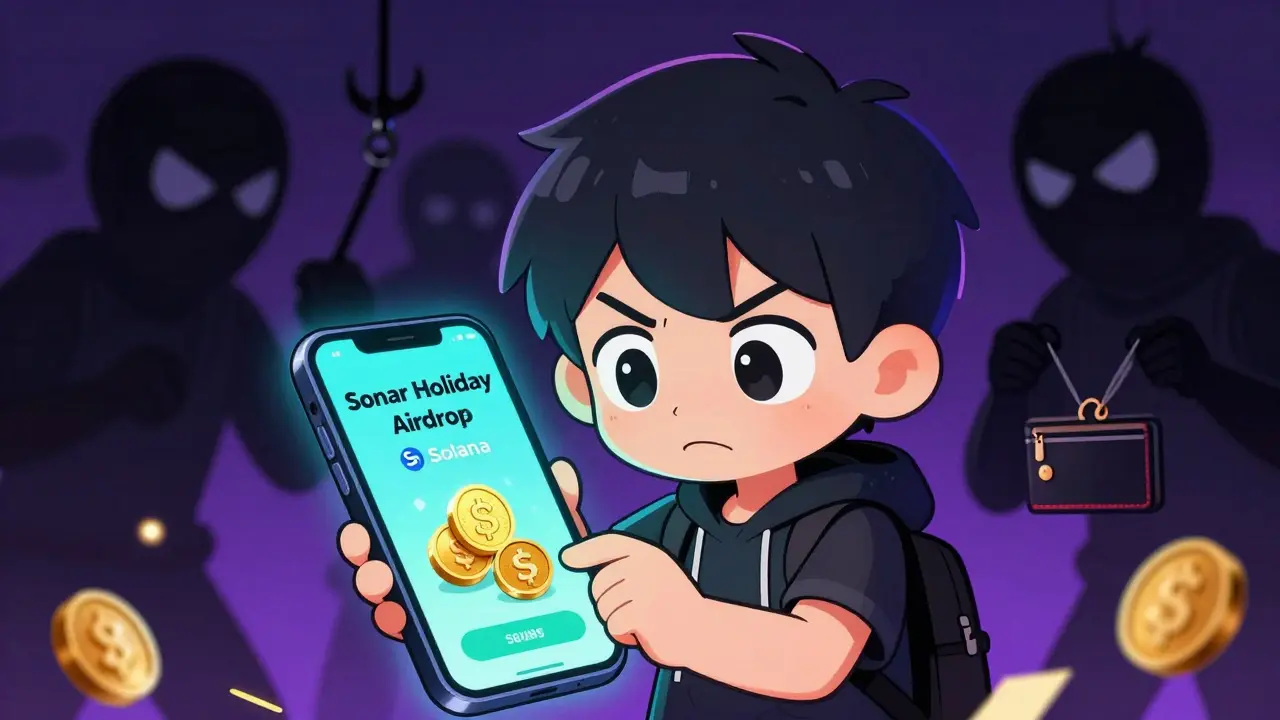
There’s no such thing as a Sonar Holiday airdrop - at least, not one that’s real, verified, or officially announced. If you’ve seen posts, tweets, or Discord messages claiming there’s a hidden crypto reward called "Sonar Holiday," you’re likely looking at a scam or a rumor. And in crypto, rumors like this can cost you real money.
Back in late 2024, Solana was buzzing with airdrops. Magic Eden dropped ME tokens. Pudgy Penguins rolled out PENGU. Doodles followed with DOOD in May 2025. These weren’t guesses. They were public, documented events with official websites, Twitter accounts, and wallet claim instructions. None of them were called "Sonar Holiday."
So where did "Sonar Holiday" come from? It’s not on any major crypto news site - CoinDesk, CoinTelegraph, The Block, or even Solana’s own blog. No GitHub repo. No whitepaper. No team members listed. No contract address you can verify on Solana Explorer. That’s not how legitimate airdrops work. Real projects don’t hide in the shadows. They announce early, build trust, and give you clear steps to claim.
Here’s what actually happened in 2025: Solana became the go-to chain for airdrops. Why? Because it’s cheap, fast, and user-friendly. You didn’t need to pay $50 in gas fees just to qualify. Just using a DEX like Jupiter or swapping on Raydium could get you on the list. Projects like Sanctum, Drift, Kamino, and Grass all gave away tokens to active users. But again - none of them were "Sonar Holiday."
If someone’s DMing you with a link to "claim your Sonar Holiday tokens," don’t click it. That link could be a phishing site designed to steal your private key. Or worse - it could be a fake wallet that drains your SOL the second you connect it. There are hundreds of these fake airdrop scams every month. And they’re getting smarter. Some even use fake logos that look like Solana’s, or copy-paste real project websites with one changed word.
Here’s how to spot a fake airdrop:
- No official website? Legit projects have a .com or .io domain with clear docs, team bios, and contact info.
- Asks for your seed phrase? Never, ever give this out. No real airdrop will ask for it.
- Urgency? "Claim now or lose it!" is a classic scam tactic.
- Only on Telegram or Discord? Real projects use Twitter, Medium, and their own websites.
- No token contract address? If they can’t show you the Solana address where tokens will be sent, walk away.
Some people claim they "heard about Sonar Holiday from a friend." But in crypto, trust doesn’t come from word-of-mouth. It comes from verification. Check the Solana blockchain yourself. Go to Solscan.io, search for the project name, and see if any token has been deployed. If you find nothing, it doesn’t exist.
There’s also a chance "Sonar Holiday" is a made-up name meant to sound like "Sonar" (a real Solana DeFi project) and "Holiday" (to trick people into thinking it’s a seasonal bonus). That’s a common scam trick - borrowing a real name and twisting it. Sonar, the actual project, is a Solana-based liquidity protocol. It has no holiday airdrop planned. Their last token distribution was in October 2024, and it was fully documented.
If you’re looking for real airdrops in 2025, focus on the confirmed ones: SonicSVM, Drift, Kamino Season 3, and Grass. These have active communities, public claim portals, and verified token contracts. You can check their official Twitter accounts or Discord servers for updates. But don’t waste time chasing ghosts like Sonar Holiday.
Bottom line: If it sounds too good to be true - especially if it’s "free money" with no effort - it probably is. Crypto airdrops are real, but they don’t come from unknown sources. They come from projects that want to build long-term users, not one-time scammers. Stay skeptical. Stay informed. And never connect your wallet to a site you didn’t find on the official project page.
There’s no Sonar Holiday airdrop. And if someone tells you otherwise, they’re either lying - or trying to take your crypto.



Elijah Young
February 9, 2026 AT 18:04Christopher Wardle
February 11, 2026 AT 14:17John Doyle
February 12, 2026 AT 06:54kelvin joseph-kanyin
February 14, 2026 AT 02:14Grace Mugambi
February 15, 2026 AT 19:30Crystal McCoun
February 16, 2026 AT 19:30Beth Trittschuh
February 18, 2026 AT 12:03Benjamin Andrew
February 19, 2026 AT 11:07Michelle Cochran
February 20, 2026 AT 04:20monique mannino
February 22, 2026 AT 02:15Peggi shabaaz
February 23, 2026 AT 11:19Sakshi Arora
February 25, 2026 AT 01:42Desiree Foo
February 25, 2026 AT 14:21Robbi Hess
February 27, 2026 AT 06:24Keturah Hudson
February 27, 2026 AT 19:52Ace Crystal
February 28, 2026 AT 01:36SAKTHIVEL A
February 28, 2026 AT 12:09krista muzer
March 1, 2026 AT 04:46Tammy Chew
March 1, 2026 AT 09:14