

When you hear about blockchain networks securing transactions, two names come up again and again: staking and mining. They both keep decentralized networks running, but they do it in completely different ways. One uses electricity like crazy. The other barely uses any. One needs expensive hardware you can’t afford unless you’re serious. The other? You can start with just a smartphone. If you’re trying to understand which one makes sense for you - whether you’re looking to earn rewards, invest, or just get smarter about crypto - this is the breakdown you need.
How Mining Works (Proof of Work)
Mining is the original way blockchains like Bitcoin stay secure. It’s based on something called proof of work (PoW). Here’s how it works: miners compete to solve a super hard math puzzle. The first one to solve it gets to add the next block of transactions to the blockchain and earns a reward - new coins plus transaction fees.
But solving these puzzles isn’t easy. It takes serious computing power. That’s why miners use specialized machines called ASICs. The Bitmain Antminer S19 XP Hyd, for example, can crunch 255 trillion hashes per second. It costs around $4,500 and pulls 3,060 watts of power. That’s more than a whole room full of gaming PCs. And it’s not just about buying the hardware - you need to keep it cool, plug it into cheap electricity, and deal with constant upgrades because hardware becomes obsolete in 18-24 months.
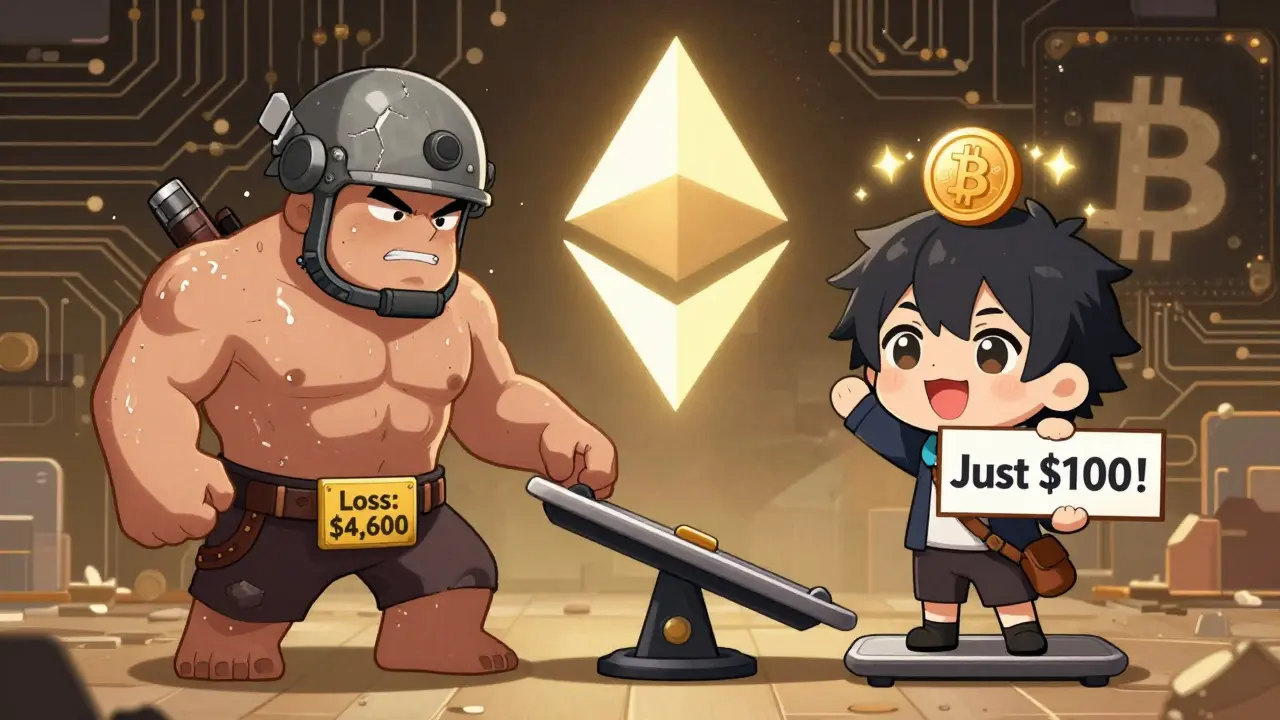
Bitcoin’s network difficulty adjusts every two weeks to keep block times steady. In March 2023, that difficulty hit 63.2 trillion - meaning it’s harder than ever to mine Bitcoin. As a result, most home miners don’t make money anymore. A Reddit user with a 6-GPU rig spent $9,200 on gear and $1,800 on electricity over 18 months… and ended up with a $4,600 net loss after accounting for depreciation. Profitability now depends on location. If you live in Iceland or Texas - where renewable energy is cheap - you might break even. Everywhere else? You’re probably just funding the mining giants.
How Staking Works (Proof of Stake)
Staking is the newer, cleaner alternative. Instead of using brute-force computing, it uses proof of stake (PoS). The idea is simple: the more cryptocurrency you lock up (or “stake”) in the network, the more likely you are to be chosen to validate transactions. No puzzles. No energy-hungry machines. Just your coins doing the work.
Ethereum switched to staking in September 2022 during something called “The Merge.” Before that, Ethereum used mining. After? Energy use dropped by 99.95%. That’s not a typo. Ethereum went from using as much power as Norway to using less than a single household.
To run a solo validator on Ethereum, you need 32 ETH. At $1,840 per ETH in late 2023, that’s about $59,000. Sounds steep - until you realize you don’t need to do it alone. Platforms like Lido, Coinbase, and Rocket Pool let you stake as little as $1. They pool your ETH with others and let you earn a share of the rewards. These are called liquid staking services because you get a token (like stETH) in return that you can trade or use in other DeFi apps.
Staking rewards vary. Ethereum offers roughly 3-4.2% APY. Solana? 6-8%. Some DeFi protocols like Marinade on Solana have hit 10-12% APY. That’s not guaranteed forever - it depends on how many people are staking and how much the network is rewarding validators. But compared to mining? The setup is dirt simple. You log into Coinbase, click “Stake ETH,” and you’re done. No cooling fans. No electricity bills. No hardware to replace.
Energy Use: The Stark Difference
This is where mining and staking can’t be more different.
Bitcoin mining alone consumed over 120 terawatt-hours (TWh) of electricity in 2023. That’s more than Argentina or Norway. The Cambridge Bitcoin Electricity Consumption Index confirms this. It’s not just about emissions - it’s about resource use. Every time a Bitcoin block is mined, it’s powered by real-world energy, often from fossil fuels.
Ethereum, after switching to staking, dropped its annual energy use from 78.9 TWh to just 0.0026 TWh. That’s 99.95% less. The difference isn’t marginal - it’s revolutionary. For every 1,000 Bitcoin transactions, you’d need roughly 1,700 kWh. For 1,000 Ethereum transactions? Less than 1 kWh.
Even Bitcoin’s mining industry claims it’s “going green.” A 2023 Cambridge study found 57% of Bitcoin mining now uses renewable energy - up from 39% in 2020. But that still means 43% isn’t. And even with renewables, the scale of energy used is massive. Staking doesn’t need to make that trade-off. It’s inherently efficient.

Hardware and Setup
Mining requires serious investment. You’re not just buying a $4,500 ASIC - you’re buying a whole system. Power supply, cooling fans, noise dampening, a dedicated circuit, and possibly even a warehouse space. Setup takes 40-60 hours for a beginner. You have to join a mining pool (because solo mining is nearly impossible now), configure software, monitor temperatures, and constantly tweak settings.
Staking? You can do it on a Raspberry Pi 4 ($50) or even a $200 laptop. The official Ethereum guide says setting up a solo validator takes 5-10 hours - mostly learning how to run the software and secure your keys. If you use Coinbase or Kraken? It takes 3 minutes. You don’t need to know what a “consensus client” is. You just need to understand that your coins are locked for a while.
And here’s the kicker: mining hardware loses 50-70% of its value in the first year. ASICs get outdated fast. Staking hardware? It doesn’t wear out. Your laptop stays the same. Your phone stays the same. The only thing that changes is how much ETH you hold.
Risk and Rewards
Both methods have risks - but they’re totally different.
Mining risks:
- Hardware depreciation - your $4,500 machine might be worth $1,000 in 18 months.
- Electricity price spikes - if your utility company hikes rates, your profit vanishes.
- Regulation - China banned mining in 2021. New York banned PoW mining in 2022. Kazakhstan restricted it during energy shortages. You could be forced to shut down.
Staking risks:
- Slashing - if your validator goes offline too often or tries to cheat, you lose a portion of your staked ETH. In Q1 2023, Ethereum slashed over 1,700 ETH from 1,832 validators - mostly because of downtime, not malice.
- Lockup periods - you can’t withdraw staked ETH immediately. In July 2023, the exit queue had over 16,000 validators waiting. Processing took 15+ days.
- Centralization - 31.2% of Ethereum’s staked ETH is held by just three entities: Lido, Coinbase, and Kraken. That’s a single point of failure.
And then there’s reward volatility. Mining rewards depend on Bitcoin’s price. Staking rewards depend on network demand. Both can change overnight.
Who Should Do What?
If you’re asking yourself: “Should I mine or stake?” - here’s who each path is for.
Choose mining if:
- You’re technically skilled and enjoy tinkering with hardware.
- You have access to cheap, renewable electricity (under $0.08/kWh).
- You’re okay with high upfront costs and no guarantee of ROI.
- You believe in Bitcoin’s long-term security model and want to contribute to it.
Choose staking if:
- You already hold ETH, SOL, ADA, or other PoS coins.
- You want passive income with minimal effort.
- You care about environmental impact.
- You’re not comfortable managing hardware or paying high electricity bills.
Most people - especially beginners - should start with staking through a trusted exchange. Coinbase, Kraken, and Binance offer simple interfaces. You can start with $100. No hardware. No noise. No heat. Just steady rewards.
What’s Next?
The future of blockchain validation is clearly leaning toward staking. Gartner predicts 80% of enterprise blockchains will use PoS by 2025. The EU’s MiCA regulation treats staking rewards as taxable income - a sign it’s being taken seriously. Ethereum’s upcoming “The Surge” upgrade will allow up to 1 million validators, making the network even more decentralized.
Meanwhile, Bitcoin mining is evolving too - but not because it’s better. It’s because it’s stuck. Companies like Riot Blockchain and Iris Energy are building massive mining farms powered by excess wind and hydroelectric power. They’re trying to justify the energy use. But the math doesn’t lie: staking does more with less.
By 2026, mining will still exist - mostly for Bitcoin. But for everything else? Staking is the default. It’s cheaper. It’s cleaner. It’s easier. And for most people, that’s all that matters.
Is staking safer than mining?
Staking and mining have different risks. Mining risks hardware failure, electricity costs, and regulatory shutdowns. Staking risks slashing penalties for downtime and centralization of staking pools. Neither is inherently “safer.” But staking has lower barriers to entry and doesn’t require physical infrastructure, making it more accessible and less volatile for most users.
Can I mine Ethereum in 2026?
No. Ethereum switched from mining to staking in September 2022. The mining process was permanently shut down during “The Merge.” Any service claiming to offer Ethereum mining is either outdated or fraudulent. If you want to participate in Ethereum’s network, you must stake.
How much money do I need to start staking?
To run a solo Ethereum validator, you need 32 ETH - about $59,000 as of early 2026. But you don’t need that much. Platforms like Lido, Coinbase, and Kraken let you stake any amount, even $10. They pool your ETH with others and give you a share of the rewards. Liquid staking tokens (like stETH) let you trade or use your staked assets in other DeFi apps.
Is staking profitable?
Yes, but not guaranteed. Ethereum staking yields around 3-4.2% APY. Solana offers 6-8%, and some DeFi protocols go as high as 10-12%. Profitability depends on network demand, token price, and platform fees. Unlike mining, you don’t pay electricity bills or replace hardware. That makes staking more consistently profitable for most users.
Why did Ethereum stop mining?
Ethereum stopped mining to solve three major problems: energy waste, scalability limits, and centralization pressure. Mining consumed as much power as a small country. It also limited how fast transactions could be processed. Staking reduced energy use by 99.95%, improved scalability, and made participation easier for everyday users - not just those with mining rigs.
Do I need to be tech-savvy to stake?
Not at all. If you use a centralized exchange like Coinbase or Kraken, staking takes less than five minutes. You just click a button. If you want to run your own validator, you’ll need to learn how to use command-line tools and secure your keys - which takes a few hours. But for 95% of users, exchange staking is the easiest and safest option.



Ruby Ababio-Fernandez
February 16, 2026 AT 19:15Jenn Estes
February 17, 2026 AT 05:04James Breithaupt
February 18, 2026 AT 14:41Scott McCrossan
February 19, 2026 AT 20:51Jeremy Fisher
February 21, 2026 AT 09:02AJITH AERO
February 22, 2026 AT 04:35Angela Henderson
February 22, 2026 AT 20:23sruthi magesh
February 23, 2026 AT 21:22Aileen Rothstein
February 24, 2026 AT 18:02Jennifer Riddalls
February 26, 2026 AT 08:44Kyle Tully
February 26, 2026 AT 14:50Ian Plunkett
February 27, 2026 AT 23:53yogesh negi
March 1, 2026 AT 06:32Nikki Howard
March 3, 2026 AT 02:38Sasha Wynnters
March 4, 2026 AT 12:34george chehwane
March 5, 2026 AT 00:46Charrie VanVleet
March 5, 2026 AT 15:20Rajib Hossaim
March 5, 2026 AT 23:40Beth Erickson
March 7, 2026 AT 07:18Anandaraj Br
March 8, 2026 AT 14:54Geet Kulkarni
March 8, 2026 AT 18:23Paul David Rillorta
March 8, 2026 AT 19:57