

Imagine you’re checking a receipt from a store with 1,000 items. You don’t want to verify every single item one by one. You just want to know if your item is really there. That’s exactly what Merkle trees do in blockchain - they let you verify a single transaction without downloading the whole block.
What Exactly Is a Merkle Tree?
A Merkle tree, also called a hash tree, is a clever way to organize data using cryptography. It’s not some mysterious tech - it’s just a tree made of hashes. Each leaf node holds the hash of a single transaction. Every node above it combines the hashes of its two children into one new hash. Keep doing this until you reach the top - that’s the Merkle root. This root is a single, unique fingerprint of every transaction in the block.In Bitcoin, for example, each block can hold over 1,000 transactions. Without Merkle trees, every node on the network would need to store and check every single one. That’s a huge waste of space and bandwidth. With Merkle trees, only the Merkle root gets written into the block header. The rest of the transaction data can be stored separately.
How Does It Work Step by Step?
Let’s say you have four transactions: T1, T2, T3, T4.- Each transaction is hashed using SHA-256: H(T1), H(T2), H(T3), H(T4).
- Then, H(T1) and H(T2) are combined and hashed together: H(H(T1) + H(T2)).
- Same for H(T3) and H(T4): H(H(T3) + H(T4)).
- Now you combine those two results: H(H(H(T1)+H(T2)) + H(H(T3)+H(T4))). That’s your Merkle root.
If you’re a lightweight wallet - like on your phone - and you want to check if your transaction (say, T3) is in the block, you don’t need all the data. You just need the Merkle root and a few hashes along the path. This small set of hashes is called a Merkle proof. With just four extra hashes, you can prove T3 is part of the block. No need to download 1,000 transactions.
Why Does This Matter for Blockchain?
Blockchain scales because of Merkle trees. Without them, every full node would have to store every transaction forever. That’s not feasible. With Merkle trees, full nodes can store transaction data in fast local databases (like LevelDB) and still verify everything cryptographically. The Merkle root is the anchor - if even one byte changes in one transaction, the entire root changes. That’s how Bitcoin guarantees integrity.It also makes syncing faster. When your node joins the network, it doesn’t need to download every transaction to validate the chain. It just checks that the Merkle root in each block header matches the actual transactions it has. This cuts down bandwidth by 90% or more.

What Happens If There’s an Odd Number of Transactions?
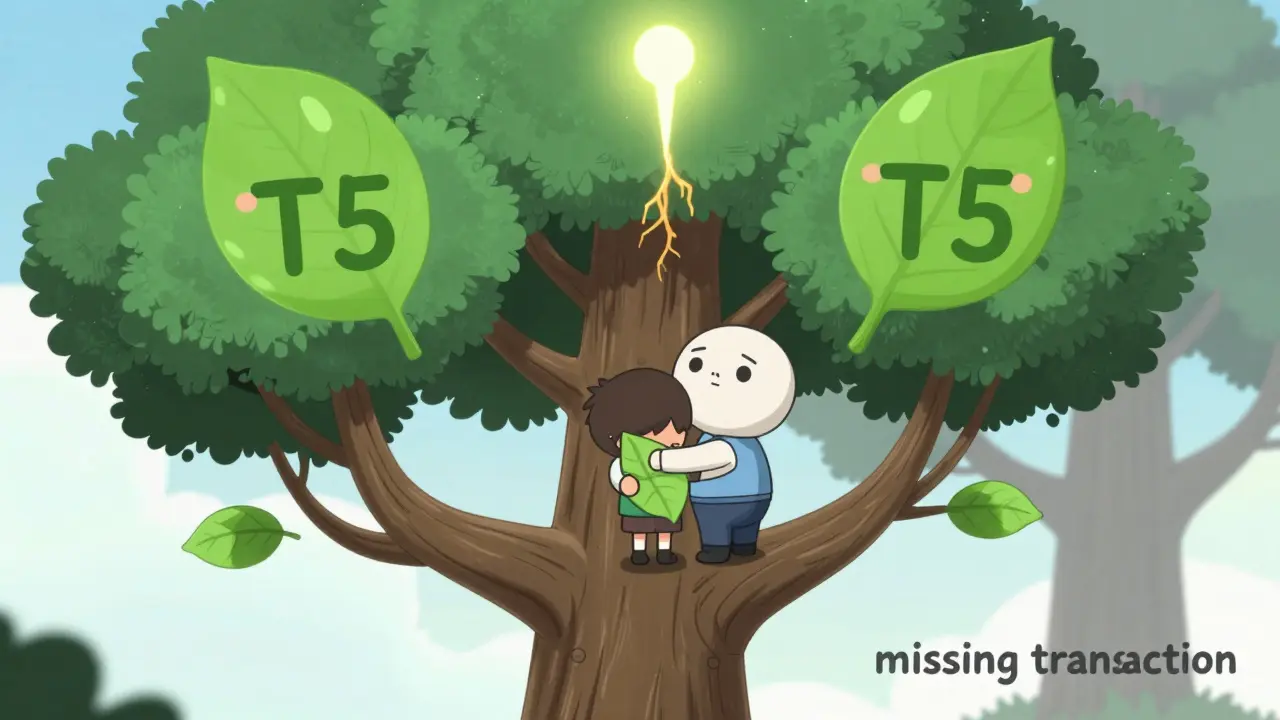
Merkle trees are binary - each parent node must have two children. If you have five transactions, the system duplicates the last one to make six. So T5 gets hashed twice. This isn’t a security flaw - it’s just a structural fix. The duplicate doesn’t change the meaning of the data. It just keeps the tree balanced.Some newer blockchains use different structures, like Merkle Patricia trees (used in Ethereum), which handle state data better. But the core idea stays the same: compress a lot of data into one hash.
Limitations and What It Can’t Do
Merkle trees are great, but they’re not magic. They can’t prove something is not in the block. If you want to know if a transaction was excluded, you’re out of luck. You’d need to check the entire chain - or use a different system like sparse Merkle trees, which are still experimental.Also, if a new transaction gets added, you have to rebuild the whole tree from the bottom up. That’s fine for blocks that are finalized - but not for real-time updates. That’s why Ethereum uses Merkle Patricia trees for its state, which allow partial updates.
Real-World Impact
Every time you send Bitcoin or Ethereum, Merkle trees are silently working behind the scenes. Bitcoin handles over 400,000 transactions per day. Ethereum handles millions. None of this would be possible without Merkle trees. They’re the reason your phone wallet can verify a transaction in under a second.Even Layer 2 solutions like Lightning Network and zk-Rollups rely on Merkle proofs to validate off-chain activity. They bundle thousands of transactions into one Merkle root and submit it to the main chain. That’s how Bitcoin and Ethereum scale without becoming bloated.
Security and Proven Track Record
Ralph Merkle invented this in 1979. It’s been around for over 45 years. Bitcoin adopted it in 2009. Ethereum did too. No major blockchain has ever been broken because of a Merkle tree flaw. The math is rock solid. SHA-256 has never been cracked. The tree structure hasn’t been exploited.Even if quantum computers become a threat someday, researchers are already working on quantum-resistant hash functions to replace SHA-256. The Merkle tree structure itself will stay - it’s the hash function that might change.
Who Uses Merkle Trees?
- Bitcoin: Uses Merkle trees to verify transaction inclusion in blocks. Every full node relies on it. - Ethereum: Uses Merkle Patricia trees to track account balances and smart contract states. - Litecoin, Dogecoin, Monero: All use Merkle trees in some form. - Blockchain explorers: Use Merkle proofs to let you verify any transaction without downloading the whole chain. - Lightweight wallets: Like Trust Wallet or Electrum - they use Merkle proofs to verify your balance without running a full node.You don’t need to understand the math to use it. But knowing how it works makes you less likely to fall for scams. If someone says they can prove a transaction without a Merkle proof - walk away.





Colin Lethem
February 24, 2026 AT 20:22kati simpson
February 25, 2026 AT 15:11Michelle Xu
February 26, 2026 AT 21:22Ryan Burk
February 27, 2026 AT 09:45lori sims
February 28, 2026 AT 16:14Tabitha Davis
March 1, 2026 AT 09:49Deborah Robinson
March 3, 2026 AT 08:59Michelle Mitchell
March 3, 2026 AT 10:43Cory Derby
March 4, 2026 AT 08:29Amanda Markwick
March 4, 2026 AT 23:05Sriharsha Majety
March 5, 2026 AT 04:10Reggie Fifty
March 6, 2026 AT 02:30Shannon Holliday
March 7, 2026 AT 13:17Don B.
March 7, 2026 AT 21:39Vishakha Singh
March 8, 2026 AT 20:09Jeremy buttoncollector
March 10, 2026 AT 14:02Kaitlyn Clark
March 12, 2026 AT 05:52Mary Scott
March 13, 2026 AT 20:53Maggie House
March 15, 2026 AT 13:19Colin Lethem
March 17, 2026 AT 05:09Amanda Markwick
March 17, 2026 AT 09:31