

Cross-Shard Transaction Impact Calculator
How Cross-Shard Transactions Slow You Down
Based on the article's findings, cross-shard transactions can be 3-5 times slower than single-shard transactions. The calculator below shows the real-world impact of your sharding configuration.
Performance Analysis
Warning: Your average transaction latency exceeds your target threshold by 0 ms. With 30% of transactions crossing shards, you'll experience significant performance degradation.
Recommendations
Based on your configuration, you should reduce cross-shard transactions to 20% to stay within your target latency threshold.
- Optimize your shard key selection to minimize cross-shard operations
- Implement query routing to keep transactions within a single shard
- Consider using a hybrid approach for transaction-heavy workloads
- Use the Saga pattern instead of distributed transactions
When you hear the term data sharding, you might think it’s just another buzzword in blockchain tech. But if you’ve also heard "transaction sharding" thrown around like it’s a separate, equally important technique, you’re not alone-most people are confused. The truth? Data sharding is a proven, decades-old method for scaling databases. "Transaction sharding"? That’s not a real thing. At least, not in any technical sense.
What Data Sharding Actually Is
Data sharding means splitting a massive database into smaller, manageable pieces called shards. Each shard holds a subset of the data and runs on its own server. Think of it like dividing a huge library into smaller rooms-each room has only a section of books, and you go to the right room based on what you’re looking for.
This isn’t theory. It’s how Twitter handles 500,000+ queries per second. They shard user timelines by user ID. If you’re user #12345, your feed lives on Shard A. User #67890? Shard B. No single server gets overwhelmed. Netflix uses it to manage over 100TB of data with sub-100ms response times. MongoDB, Cassandra, and Vitess all rely on it.
There are four main ways to shard data:
- Range-based: Split data by value ranges-like customer IDs 1-1000 on one shard, 1001-2000 on another. Used in MySQL Cluster.
- Hash-based: Take a key (like a user ID), run it through a hash function (MurmurHash3 or SHA-256), and assign it to a shard based on the result. Cassandra uses this to get 98.7% even data distribution.
- Directory-based: A lookup table tells you which shard holds which data. Vitess uses consistent hashing for this.
- Geo-sharding: Store data near users. Amazon DynamoDB Global Tables keep EU data in Europe, US data in the US-cutting latency from 800ms to under 300ms.
Each shard needs at least a 4-core CPU, 16GB RAM, and 1Gbps network. But here’s the kicker: scaling works almost linearly. Citus Data tested up to 1,024 shards and kept 95% efficiency. Beyond that, coordination overhead starts eating into gains.
Why "Transaction Sharding" Doesn’t Exist
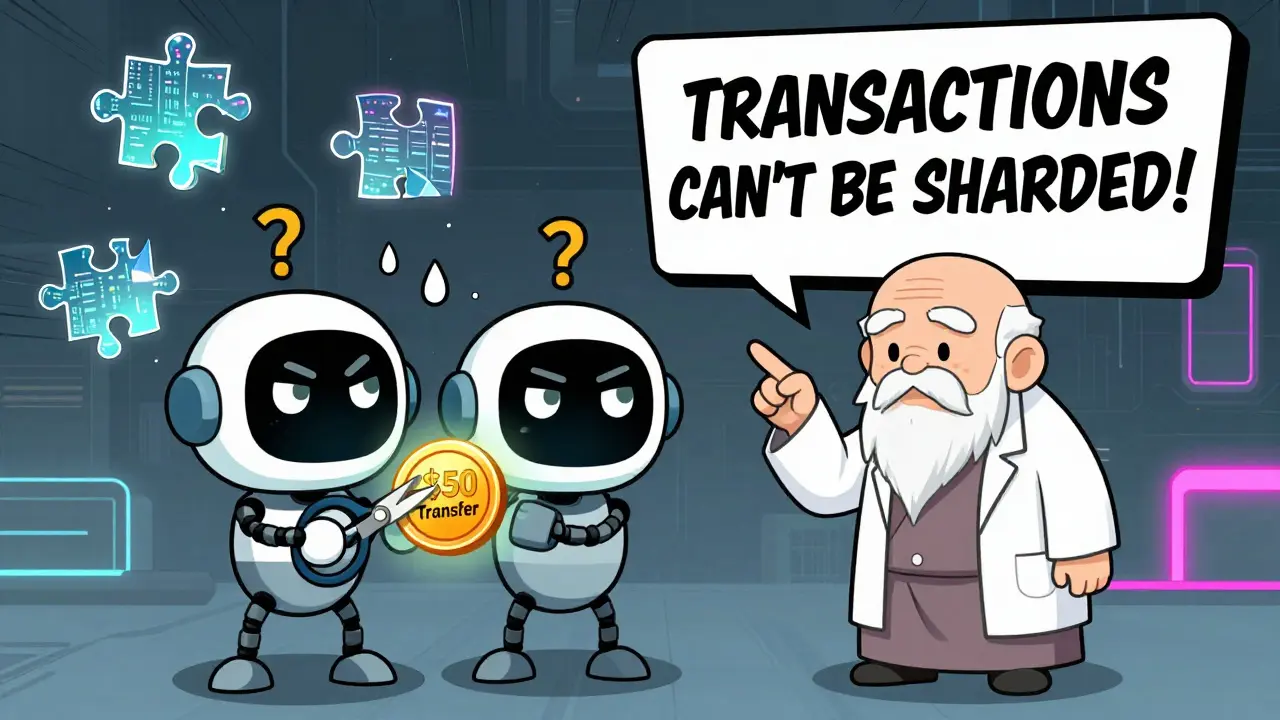
Here’s where things go off the rails. You’ll see blogs, YouTube videos, and even vendor marketing materials talk about "transaction sharding"-as if you can split transactions themselves across shards like data.
That’s not how it works.
Transactions are operations-like transferring $50 from Account A to Account B. They’re not data. You can’t slice them up. What people mean when they say "transaction sharding" is: "How do I handle transactions that touch multiple shards?"
That’s a distributed transaction problem. Not a sharding problem.
As Martin Kleppmann wrote in Designing Data-Intensive Applications: "There is no such thing as transaction sharding-sharding always refers to data partitioning, while transactions may span multiple shards creating coordination challenges."
Experts agree. Dr. Andy Pavlo from Carnegie Mellon called it a "misnomer" in his 2022 SIGMOD keynote. Baron Schwartz from Percona said he’s reviewed over 200 production systems-and never seen one that shards transactions. He called it a myth.
Even IEEE Spectrum confirmed: Google Spanner, CockroachDB, YugabyteDB-they all shard data. They don’t shard transactions. They use protocols like two-phase commit or the Saga pattern to handle cross-shard operations.
The Real Problem: Cross-Shard Transactions
Sharding makes writes fast. But when a transaction needs to update data on two different shards? That’s where things slow down.
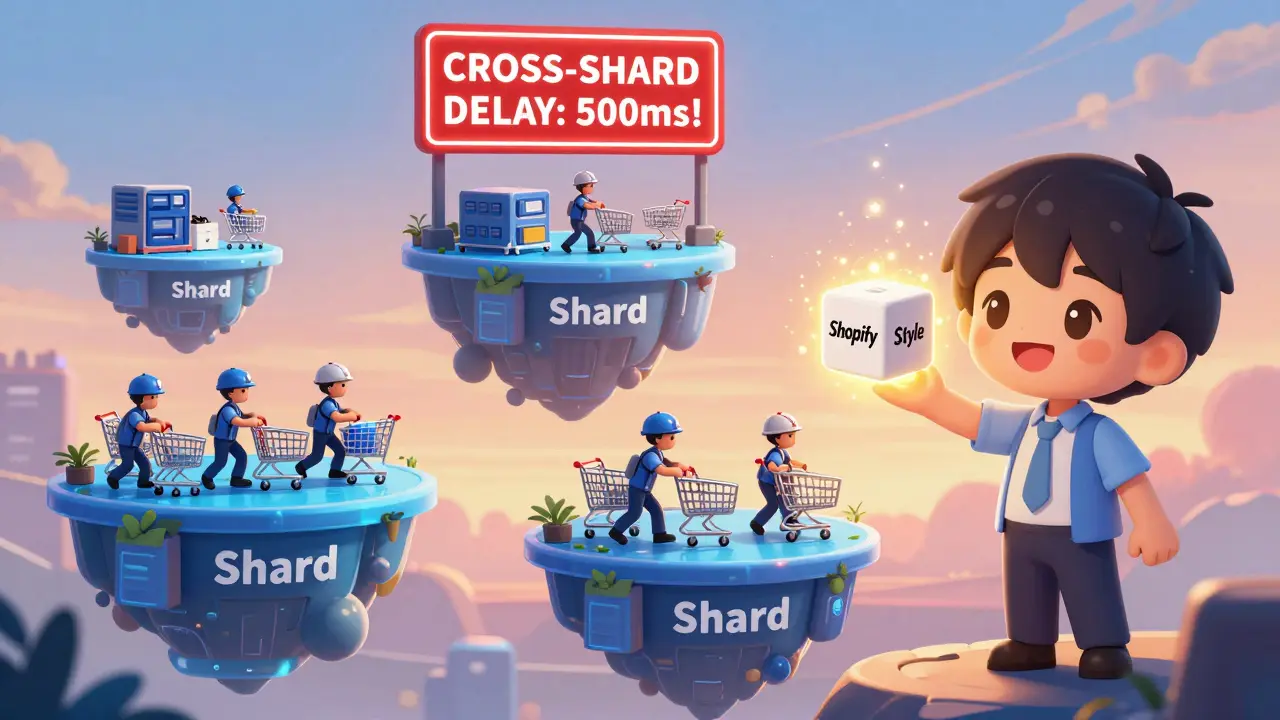
In MongoDB 6.0, cross-shard transactions took 3-5 times longer than single-shard ones. Percona’s benchmarks showed the same. Even with improvements in MongoDB 7.0 (released Dec 2023), cross-shard commits are still 60% slower than before.
Why? Because each shard has to coordinate. It’s like asking two banks to transfer money between them. Each one has to verify, lock, confirm, and commit. If one fails, the whole thing rolls back. That’s expensive.
One fintech startup lost $50K because they tried to run a multi-shard transaction for order reconciliation. The system got stuck in a deadlock. They didn’t realize cross-shard transactions were the bottleneck-they thought their "transaction sharding" setup was broken.
That’s the danger of the misnomer. People waste weeks trying to implement something that doesn’t exist. They don’t fix their architecture-they fix the wrong thing.
Where Sharding Works (and Where It Fails)
Sharding shines when your data is naturally partitioned.
- Good use cases: Social media feeds, user profiles, IoT sensor logs, chat histories. Each user’s data is independent. No need to join across shards.
- Bad use cases: Shopping carts, banking ledgers, inventory systems. If your transaction needs to check product availability, update stock, and charge a card-all on different shards-you’re asking for trouble.
Gartner’s 2022 case study found e-commerce platforms saw 40-60% slower performance when shopping carts spanned multiple shards. That’s not a small hit. It’s lost sales.
That’s why most enterprise systems use hybrid sharding. Shopify, for example, shards order data by customer ID-but keeps product catalog and inventory on a single, non-sharded database. They avoid cross-shard joins entirely.
Amazon’s Aurora Serverless v2 (released Oct 2022) auto-shards data based on load. Google’s "Oscars" project (announced Nov 2023) aims to make sharding invisible to apps. The goal isn’t to shard transactions-it’s to hide sharding from developers.
Common Mistakes and How to Avoid Them
Most sharding failures aren’t technical-they’re conceptual.
Mistake 1: Choosing the wrong shard key.
Don’t shard by "created_at" or "status." Those have low cardinality. You’ll end up with hotspots-one shard gets 80% of the traffic. AWS recommends using high-cardinality, frequently queried attributes: user ID, device ID, or location hash.
Mistake 2: Assuming sharding fixes performance.
Sharding scales writes. It doesn’t fix bad queries. If you’re doing full table scans across shards, you’ll drown in network latency. Index your shard keys. Use query routing. Know which shard your data lives on.
Mistake 3: Trying to do ACID across shards.
Forget about strong consistency. Sharded systems follow the CAP theorem-they trade consistency for availability. If you need strict ACID, don’t shard. Use a single database. Or accept eventual consistency and use the Saga pattern for business workflows.
Mistake 4: Ignoring rebalancing.
Shards get uneven over time. DataStax found 83% of sharding implementations hit hotspots. Use dynamic shard splitting-like Google Spanner does. Cassandra’s nodetool rebuild takes 2 hours per TB. Plan for it.
What’s Changing in 2025
Sharding isn’t going away. But the way we use it is.
CockroachDB 23.2 (Oct 2023) cut cross-shard latency by 35% for multi-region transactions. MongoDB 7.0 made distributed transactions faster. But they didn’t invent "transaction sharding." They just made the existing problem less painful.
By 2025, Gartner predicts 40% of new sharding setups will use AI to predict and rebalance shards automatically. Serverless databases will handle scaling without you lifting a finger.
Meanwhile, Stack Overflow data shows questions about "transaction sharding" dropped 62% since 2021. People are learning. The confusion is fading.
The real win? Understanding that sharding is about data-not transactions. Once you accept that, you stop wasting time on phantom solutions and start building real, scalable systems.
What You Should Do Now
If you’re thinking about sharding for your blockchain app:
- Ask: "Am I trying to scale data, or am I trying to scale transactions?" If it’s the latter, you’re asking the wrong question.
- Choose a shard key that’s high-cardinality and rarely changes-like wallet address or transaction hash.
- Keep cross-shard operations to a minimum. Design your data model so most queries hit one shard.
- Use a database that handles sharding for you-CockroachDB, MongoDB, or AWS Aurora-don’t roll your own unless you have a team of distributed systems engineers.
- Test cross-shard performance early. If a simple transfer takes 500ms, you’ve got a problem.
There’s no magic bullet. But there is a clear path: understand data sharding. Ignore the noise. Build smart. And never let marketing terms confuse your architecture.





Tara Marshall
December 9, 2025 AT 12:16Data sharding is real. Transaction sharding is a marketing lie. Been there, seen it. Teams waste months chasing ghosts while their DBs burn. Just shard by user ID and move on.
Nicole Parker
December 9, 2025 AT 14:41I love how this post cuts through the noise. I used to think "transaction sharding" was some next-gen tech until I saw a startup crash trying to make it work. Turns out they were just bad at designing their domain boundaries. The real win isn’t the tech-it’s knowing what problem you’re actually solving. Sometimes the simplest answer is the one nobody’s selling a course on.
michael cuevas
December 10, 2025 AT 20:35So you're telling me the entire blockchain marketing team didn't invent anything new? Shocking. I thought we were building the future. Turns out we're just rebranding 1990s database tricks with crypto buzzwords. My CEO still thinks "sharding" means we can process 10M TPS. I just nod and smile. It's easier than explaining CAP theorem to someone who thinks "decentralized" means "magic"
Jonathan Sundqvist
December 12, 2025 AT 15:48US companies are too soft. We don't need fancy sharding. Just throw more servers at it. If your DB can't handle 500k QPS, you're doing it wrong. China and Russia don't care about your "cross-shard latency"-they just make it work. Stop overengineering. Build simple. Scale hard. That's American engineering.
Annette LeRoux
December 13, 2025 AT 19:21This is the kind of post that makes me believe in tech again 🙌 I used to think "transaction sharding" was a thing too... until I lost 3 days debugging a deadlocked payment system. Now I just laugh when I hear it. Also, thank you for mentioning Vitess. That thing is a silent hero.
Jerry Perisho
December 15, 2025 AT 18:55Hash-based sharding with MurmurHash3 is the gold standard. Range-based causes hotspots. Directory-based adds complexity. Geo-sharding is brilliant for latency-sensitive apps. But the real lesson? Don't shard unless you have to. Most apps don't need it. And if you do, use CockroachDB or Aurora. Don't roll your own unless you enjoy debugging distributed deadlocks at 3am.
Manish Yadav
December 16, 2025 AT 20:25This is why America is falling behind. You people overthink everything. In India we just use one big server. If it breaks, we fix it. No sharding. No fancy words. Just work. Why waste time on this? Just make it fast. Simple. No theory. Just do.
Vincent Cameron
December 17, 2025 AT 22:33Isn't it ironic? We're trying to decentralize everything in Web3, yet we're still clinging to the illusion that we can control distributed systems like they're single-threaded. Maybe "transaction sharding" is just a metaphor for our collective denial. We want the scalability of shards without the chaos of coordination. But reality doesn't care about our desires. The universe prefers entropy. Always has. Always will.
Doreen Ochodo
December 19, 2025 AT 07:19Shard by user ID. Keep it simple. Test early. Don't let marketing confuse you. You got this 💪
Yzak victor
December 19, 2025 AT 08:55Man I remember when I first heard "transaction sharding" and thought I was missing something. Turned out I was just new. Took me 6 months and one failed launch to realize it was just bad terminology. The real issue? Cross-shard consistency. That’s the monster. Not the name. Once I stopped fighting the label and started fixing the problem, everything clicked.
Holly Cute
December 20, 2025 AT 18:41Okay but let's be real-this whole post is just a thinly veiled endorsement of MongoDB and CockroachDB. Who paid you? The "transaction sharding" myth is alive because vendors need to sell you expensive upgrades. You think Netflix shards because they care about architecture? No. They do it because they're forced to by legacy monoliths. The truth? Sharding is a technical debt hack. And now you're all treating it like gospel. Wake up.
Roseline Stephen
December 22, 2025 AT 07:33I appreciate the clarity. I've seen too many engineers try to force sharding into systems that don't need it. The cost of complexity often outweighs the benefit. Just because you can doesn't mean you should.
Glenn Jones
December 22, 2025 AT 12:49TRANSACTION SHARDING IS A LIE!! I SAID IT!! I’VE BEEN WORKING ON THIS FOR 8 YEARS AND NO ONE LISTENS!! I’M NOT EVEN SURE I BELIEVE IN SHARDING ANYMORE I JUST WANT TO CRY IN A CLOSET!! I WAS TOLD BY MY BOSS THAT WE NEEDED TO SHARD TRANSACTIONS BECAUSE "THEY SAID SO ON YOUTUBE" AND NOW OUR PAYMENT SYSTEM IS A MESS AND I HAVE TO WORK WEEKENDS TO FIX IT BECAUSE WE USED MONGODB 6.0 AND DIDN’T REALIZE CROSS-SHARD TRANSACTIONS WERE A NIGHTMARE AND NOW I’M ON 3 COFFEE AND I CAN’T SLEEP AND I THINK I’M LOSING MY MIND
Chris Mitchell
December 23, 2025 AT 11:30Stop calling it "transaction sharding." Call it what it is: distributed transaction coordination. The fix isn't more sharding-it's better patterns. Saga. Event sourcing. Eventually consistent workflows. The problem isn't the data. It's the mindset. Fix that first.
nicholas forbes
December 24, 2025 AT 20:08Agreed. But what if your app needs ACID? What if you're building a banking ledger? Do you just give up on scaling? Or do you accept that sharding isn't the answer and go back to monoliths? I'm not sure there's a clean solution here. The trade-offs are brutal.