

Imagine uploading a video and getting paid instantly for every view, without a middleman taking a massive cut. That was the promise of Contentos, a blockchain-based infrastructure designed to build a decentralized digital content ecosystem where creators publish, distribute, and monetize their work directly. Launched around 2018-2019, the project aimed to disrupt giants like YouTube and TikTok by using its native utility token, COS, to reward creators, viewers, and curators. The goal? To realign value flows in the global digital content industry, making it open, equal, and transparent.
Fast forward to June 2026, and the landscape has shifted dramatically. While the vision remains ambitious, the reality on the ground tells a different story. Today, COS functions as a micro-cap crypto asset with a live price hovering around $0.00033 USD per token. With a market capitalization near $6-7 million, it sits firmly in the high-risk tier of the broader crypto market. But what exactly is Contentos today? Is it still a viable platform for creators, or just a relic of the early Web3 hype cycle? Let’s break down the facts, the tech, and the current state of play.
The Core Idea: Decentralizing the Creator Economy
At its heart, Contentos is an infrastructure layer intended to decentralize the global content economy by embedding creator rewards, ownership tracking, and transparent revenue sharing directly into the blockchain protocol. Traditional platforms operate on opaque algorithms. You upload content, hope the algorithm likes it, and then wait months for ad revenue that might never come. Contentos flips this model. It uses smart contracts to encode incentive rules. When you create content, engage with others, or promote posts, these actions are recorded on-chain, and rewards are distributed automatically.
This system relies heavily on the COS token. Think of COS as the fuel for the engine. It’s used to:
- Reward creators for publishing quality content.
- Compensate viewers for watching and engaging.
- Promote content through paid advertising within the ecosystem.
- Support network operations via staking and governance.
The theory is sound: if users own the data and the value they generate, they should capture more of the profit. However, theory often meets friction in practice, especially when competing against entrenched incumbents with billions in marketing budgets.
Technical Architecture and Tokenomics
Contentos didn’t start from scratch. Initially, it had its own chain, but it later integrated with Binance Chain and Binance Smart Chain (BNB Chain). This move was strategic. By leveraging the BNB ecosystem, Contentos gained access to faster transaction throughput, lower fees, and a broader user base already familiar with Binance wallets. As of 2022-2023, the project described itself as being "powered by the Binance Smart Chain protocol," highlighting this deep technical linkage.
Let’s look at the numbers, because in crypto, tokenomics is everything. Here is the breakdown of the COS supply:
| Metric | Value |
|---|---|
| Total Supply | 10 Billion COS |
| Circulating Supply | ~5.17 Billion COS |
| Non-Circulating Reserve | ~4.83 Billion COS |
| Token Type | ERC-20 / BSC Compatible Utility Token |
| Current Price (Approx.) | $0.00033 USD |
| Market Cap | ~$6.08 Million USD |
A few things stand out here. First, about half of the total supply is currently circulating. The remaining ~4.83 billion tokens are locked or reserved for ecosystem purposes. This creates a potential "overhang." If those tokens unlock over time, it could increase sell pressure, diluting the value of existing holdings. Second, the fixed maximum supply of 10 billion is substantial. For a micro-cap project, this means each individual token must represent significant utility to hold value, which brings us to the ecosystem products.
Ecosystem Products: COS.TV and Beyond
You can’t have a content ecosystem without actual content. Contentos built several flagship applications to drive usage:
- COS.TV: This is the core video platform. Users upload videos, watch content, and earn COS for viewing, commenting, and sharing. It positions itself as a Web3 alternative to YouTube, allowing micro-transactions that would be uneconomical on traditional platforms due to payment processing fees.
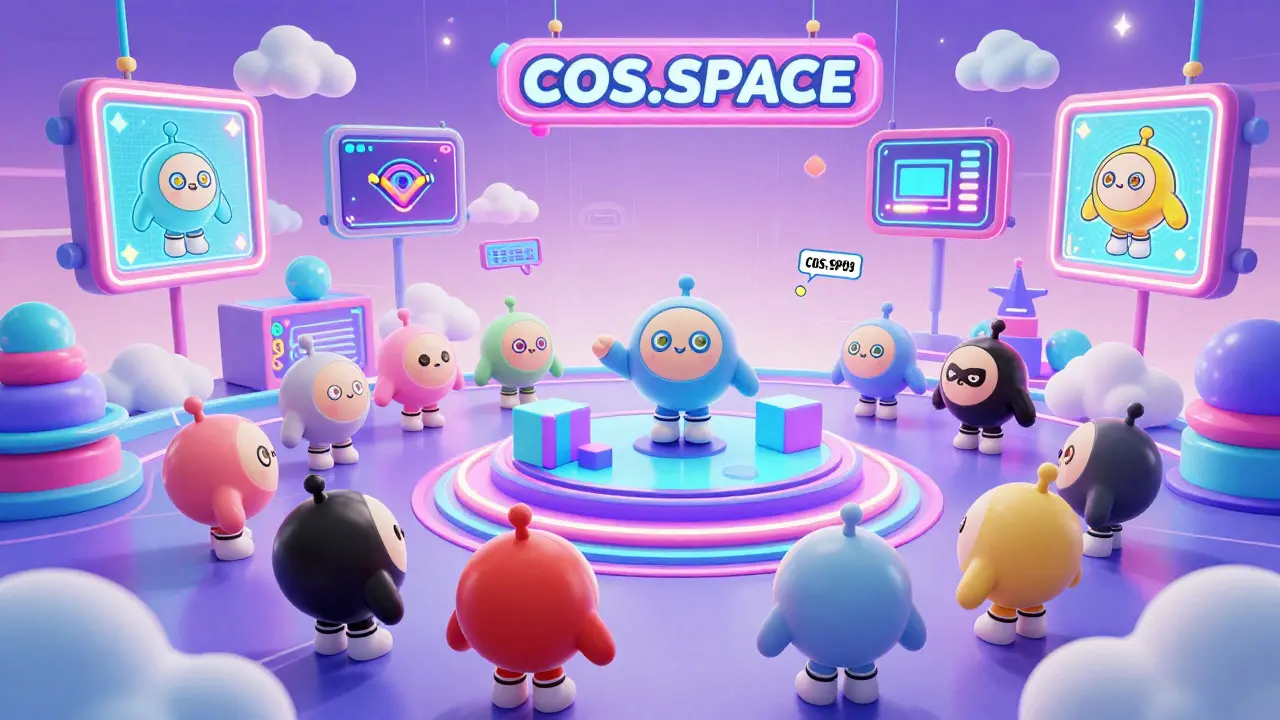
- COS.SPACE: Launched in 2022, this is the metaverse component. It offers a "virtual real" environment where users can host events, showcase content in 3D spaces, and use NFTs. It aims to gamify content consumption.
- AI Integration: In April 2023, Contentos announced a "Content AI Roadmap." This plan involves integrating generative AI tools for creation, recommendation, and moderation. The idea is to combine AI efficiency with blockchain transparency, ensuring creators retain ownership even when AI assists in production.
These products show ambition. They cover video, social interaction, virtual worlds, and artificial intelligence. However, building one successful app is hard; building four interconnected ones is exponentially harder. The challenge isn’t just technology-it’s adoption. Can these apps attract enough users to create a self-sustaining network effect?

Market Reality: Volatility and Competition
Let’s address the elephant in the room: price performance. Historical data shows a stark decline. The earliest recorded price of COS was around $0.0480 USD. By June 2026, the price had fallen to approximately $0.00033 USD. That represents a drawdown of over 99% from its initial highs. Even accounting for general crypto market cycles, this is severe depreciation.
Why such a drop? Several factors contribute:
- Fierce Competition: Contentos competes with Theta Network (video), Audius (music), Steem/Hive (blogging), and LBRY/Odysee (decentralized video). Projects like Theta and Audius have larger market caps, higher liquidity, and stronger brand recognition.
- Liquidity Issues: With a market cap under $10 million, trading volume is modest. On June 22, 2026, CoinGecko reported a 24-hour trading volume of just over $311,000. Low liquidity makes it hard for large investors to enter or exit without moving the price significantly.
- User Retention Challenges: Early adopters praised the concept of earning tokens for watching videos. But as the USD value of rewards plummeted, many users left. Why spend hours watching low-quality content for fractions of a cent when mainstream platforms offer better experiences and fiat monetization options?
Community sentiment reflects this struggle. Data from Coinbase shows limited engagement, with Reddit discussions often skewing negative or lukewarm. Reviews point out complex onboarding processes-setting up wallets, linking accounts, and navigating exchange registrations can take hours for beginners. Meanwhile, content quality on COS.TV varies widely, ranging from high-effort productions to spammy, low-value posts incentivized purely by activity metrics.
Is Contentos Still Worth Your Attention?
So, where does that leave us? Contentos is not dead. It’s still operational, with active development on its AI roadmap and metaverse features. It maintains listings on major exchanges like Binance and Gate.io, providing some level of legitimacy and accessibility. For niche audiences interested in experimenting with decentralized media, it offers a functional sandbox.
However, for investors seeking stability or rapid growth, the risks are substantial. The combination of a large token supply overhang, intense competition from both Web2 giants and other Web3 projects, and historical volatility makes COS a speculative bet. Experts remain cautiously skeptical. CoinBureau notes that while the ambition is commendable, achieving sustainable token economics and network effects remains unproven. Price predictions vary wildly-from optimistic bullish scenarios suggesting a rise to $0.00666 USD by late 2025, to bearish models projecting further declines to $0.00025 USD in mid-2026.
If you’re a creator, consider whether your audience is already on COS.TV. If not, the effort required to migrate may outweigh the benefits of decentralized rewards. If you’re an investor, understand that you’re buying into a micro-cap project with significant execution risk. The future of Contentos depends entirely on its ability to convert conceptual promise into sustained, real-world usage-and right now, that bridge is still under construction.
What is the main purpose of the Contentos (COS) token?
The COS token is a utility token used within the Contentos ecosystem to reward creators for publishing content, compensate viewers for engagement, facilitate advertising payments, and support network governance through staking. It acts as the primary medium of exchange for value distribution on the platform.
How does Contentos compare to YouTube?
Unlike YouTube, which centralizes control and takes a large cut of ad revenue, Contentos aims to decentralize ownership and reward users directly via blockchain transactions. However, YouTube offers vastly superior user experience, higher audience reach, and stable fiat monetization, while Contentos struggles with lower liquidity, smaller user bases, and volatile token values.
Is Contentos safe to invest in?
Contentos is considered a high-risk investment. As of June 2026, it is a micro-cap asset with a market cap under $10 million and has experienced over 99% price depreciation from its early highs. Its future viability depends on successful adoption of its AI and metaverse roadmaps, which remains uncertain amidst strong competition.
What is COS.TV?
COS.TV is the flagship video platform of the Contentos ecosystem. It allows users to upload, watch, and share videos while earning COS tokens for various activities like viewing, commenting, and participating in promotional campaigns. It serves as the primary interface for content creation and consumption within the network.
Does Contentos use Artificial Intelligence?
Yes, Contentos announced a "Content AI Roadmap" in 2023. This initiative aims to integrate generative AI tools for content creation, recommendation algorithms, and moderation. The goal is to enhance user experience and content discovery while maintaining blockchain-based ownership and transparent reward tracking.




Madhu Menon
June 25, 2026 AT 08:49The philosophical implication of decentralizing content is that we are trying to solve a human problem with code, but the code cannot force people to care about quality. We see this in every utopian experiment where the incentive structure rewards volume over value. The result is a sea of mediocrity because the algorithm doesn't judge art, it just counts clicks. :/
Narendra Kulkarni
June 25, 2026 AT 18:34i think its a nice idea but maybe too complex for normal users who just want to watch videos without setting up wallets and dealing with gas fees or whatever that means lol. it feels like they are trying to reinvent the wheel when youtube already works fine for most people.
Charles Pawlikowski
June 25, 2026 AT 19:03another failed crypto project trying to scam people into thinking they can get rich quick by watching cat videos. typical american greed mixed with tech bro nonsense. nobody cares about your decentralized dream when the token is worth less than dust. stay woke america :)
Mekz Wheoki
June 26, 2026 AT 11:29Ah yes, because nothing says 'trustworthy platform' like a 99% drop in value and a user base held together by bots and desperation. I suppose if you enjoy losing money faster than you can spend it, Contentos is right up your alley. Truly inspiring stuff.
verna kennedy
June 27, 2026 AT 14:18It is frankly disappointing to see such a lack of due diligence from the community here. You would expect creators to understand that sustainable economics requires more than just hype and buzzwords. This project lacks the fundamental rigor needed to compete with established platforms, and anyone investing without understanding the tokenomics is simply being reckless. It is a cautionary tale of ambition outpacing execution.
Andrea Burd
June 29, 2026 AT 14:11ugh another one of these web3 trash projects. i mean really? who has time to read all this bs about metaverse and ai when the price is basically zero. its so pretentious to think you can disrupt youtube with a clunky app that crashes every five seconds. waste of my time even reading this post.
Amit Thakur
June 29, 2026 AT 20:53Look at the technical architecture here and you realize the integration with BSC was a band-aid on a bullet hole. The latency issues and the smart contract vulnerabilities inherent in their early design choices have never been fully resolved. They are burning through runway trying to patch legacy code while competitors are building native solutions. It's a disaster waiting to happen for anyone holding bags.
Skm Shubham
July 1, 2026 AT 10:40This entire ecosystem is built on sand. The metrics are manipulated, the engagement is fake, and the team has clearly abandoned any real innovation in favor of pumping the narrative. If you look closely at the on-chain data, you'll see massive wash trading designed to create an illusion of liquidity. Don't be a fool and buy the dip on a corpse.
Kelly Tenney
July 3, 2026 AT 02:43I understand the frustration many feel, but let's remember why we started supporting these kinds of projects in the first place. Innovation takes time and often fails before it succeeds. Maybe there is still a kernel of truth in what they are trying to do with AI integration. Let's give them the benefit of the doubt and focus on the potential rather than just the past failures.
Nick Rice
July 3, 2026 AT 18:05You need to wake up and smell the coffee because this isn't innovation, it's stagnation disguised as progress. The market has spoken and it said no. Stop making excuses for poor product-market fit and accept that centralized platforms win because they provide utility without friction. Your 'decentralized' reward system is a joke when the rewards are worth pennies.
Eric Scheinberg
July 3, 2026 AT 18:43The economic model is fundamentally flawed due to the infinite dilution pressure from the non-circulating reserve. When half the supply is locked away for future distribution it creates a constant sell wall that prevents any meaningful price appreciation regardless of adoption rates. This is basic supply and demand economics which seems to have been overlooked by the developers.
pankaj chawla
July 3, 2026 AT 19:57We should probably work together to figure out if there is any real use case left for this token. Maybe if we combine our resources we can push some actual content onto COS.TV and see if the rewards mechanism actually works as advertised. It might be worth a shot to test the waters before writing it off completely.
Manish Prajapat
July 5, 2026 AT 17:16One must consider the broader implications of attempting to gamify human attention spans. By rewarding mere consumption we risk creating a society that values quantity of interaction over depth of thought. The technology may be sound but the psychological impact of such systems is deeply concerning for the long term health of digital discourse.
John Doe
July 6, 2026 AT 17:41I am literally shaking with rage every time I see another article defending these zombie chains. How can anyone look at the chart and not see the absolute carnage? It is tragic how easily people are fooled by fancy words like metaverse and AI when the reality is just empty servers and broken promises. My heart breaks for the retail investors who lost everything believing in this fairy tale.
Rob Aronson
July 8, 2026 AT 06:04From a pure DeFi perspective the liquidity pools are dried up and the impermanent loss exposure for LPs has been catastrophic 📉. The cross-chain bridges add unnecessary complexity and security risks without providing tangible benefits to the end user. It is a textbook example of solutionism where the tech solves problems that don't exist 😬.
Danna Charris
July 8, 2026 AT 21:39Predictably mediocre. The interface is ugly and the user experience is abysmal compared to modern standards. Only true enthusiasts or desperate speculators would bother with this garbage.
Mauricio Contreras Loredo
July 9, 2026 AT 11:32Oh wow, look at us acting like experts on a dead coin. Can we please just admit that YouTube won and move on? It's hilarious how everyone thinks they can outsmart Mark Zuckerberg with a blockchain wrapper. Keep dreaming folks, it's cute.
Madhu Menon
July 10, 2026 AT 11:07And thus the cycle continues, driven by hope rather than evidence. :/