

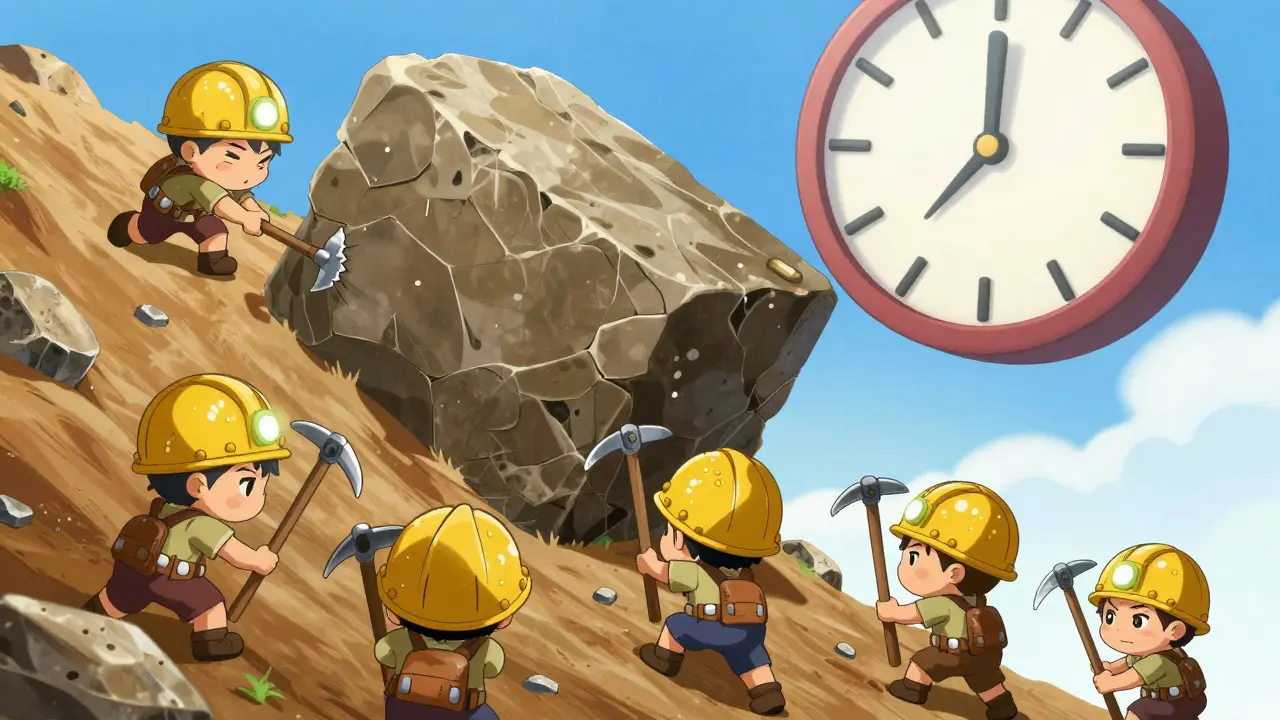
Imagine a piece of software designed to slowly break itself until the people running it are forced to upgrade it. That is essentially what the Difficulty Bomb is a programmed algorithmic mechanism in the Ethereum protocol that systematically increased the computational difficulty of mining new blocks. It wasn't a bug or a mistake; it was a calculated, ticking clock meant to ensure Ethereum didn't get stuck in the past.
For years, this "bomb" created a looming deadline for developers and miners. If they didn't move the network toward a more sustainable system, the blockchain would eventually hit an "Ice Age," where blocks would take so long to mine that the entire network would grind to a halt. It was the ultimate pressure tactic to move from energy-heavy mining to a greener, more scalable alternative.
Quick Summary: The Essentials
- Purpose: To force Ethereum to transition from Proof of Work (PoW) to Proof of Stake (PoS).
- Mechanism: Exponentially increased mining difficulty at specific block heights.
- Outcome: Played a critical role in triggering "The Merge" on September 15, 2022.
- Impact: Led to a 99.95% reduction in the network's total energy consumption.
- Current Status: Neutralized; it is no longer active since PoW mining ended.
How the Bomb Actually Worked
To understand the bomb, you first have to understand Proof of Work ( a consensus mechanism where miners compete to solve complex puzzles to secure the network). In a normal PoW system, difficulty adjusts to keep block times consistent. But the Difficulty Bomb added an extra layer of math that grew exponentially as the block number increased.
Technically, the bomb lived inside the Ethash algorithm. After a certain block height, the formula began adding a value that grew larger every 100,000 blocks. This meant that even if more miners joined the network with faster hardware, the "bomb" would outpace them. Block times, which were supposed to be around 15 seconds, began to stretch. By mid-2021, they hit 30 seconds. If the bomb hadn't been stopped, experts predicted blocks would eventually take 15 minutes or more, making the network unusable for real-world apps.
For the people actually mining, this was a nightmare. Imagine spending thousands on GPUs only to find your profit margins evaporating because the network is deliberately making the puzzle harder. Some miners reported daily earnings dropping from $42 down to $27 in just a few months as the bomb tightened its grip.
The Constant Tug-of-War: Delays and Hard Forks
The bomb wasn't a one-time event; it was a series of deadlines. Because the transition to Proof of Stake ( a consensus mechanism where validators lock up cryptocurrency to secure the network instead of mining) was a massive technical undertaking, the community had to keep "pushing the bomb back."
This was done through Hard Forks ( major protocol upgrades that require all nodes to update their software to stay on the same chain). Whenever the bomb got too close to detonating, the developers would release an Ethereum Improvement Proposal (EIP) to delay it. For example, EIP-649 and EIP-1234 pushed the deadline by millions of blocks to give the team more time to build the PoS infrastructure.
This created a strange tension. While the bomb ensured the roadmap was followed, the repeated delays frustrated some. It actually contributed to the rise of Ethereum Classic, as some miners preferred a world where PoW remained the standard and no "bomb" could force them off their rigs.
Comparing the "Bomb" to Other Upgrade Methods
Most blockchains handle upgrades like a democratic vote or a gentle suggestion. Ethereum's approach was more like a forced eviction notice. Let's look at how it stacks up against other major networks.
| Feature | Ethereum (Difficulty Bomb) | Bitcoin (Soft Forks) | Cardano/Polkadot (Governance) |
|---|---|---|---|
| Approach | Technical Coercion | Miner Signaling | On-chain Voting |
| Urgency | Extreme (Hard Deadline) | Low (Consensus-based) | Moderate (Vote-based) |
| Risk | Chain Splits/Fragmentation | Slow Evolution | Governance Deadlock |
| Outcome | Rapid Pivot to PoS | Stable, Slow Changes | Iterative Updates |
The Climax: The Merge and Neutralization
The ticking clock finally stopped on September 15, 2022, during The Merge. This was the moment Ethereum officially switched its consensus engine from PoW to PoS. Because the network no longer relied on mining to create blocks, the Difficulty Bomb became irrelevant. You can't blow up a mining operation that no longer exists.
The results were immediate and staggering. The network's energy use plummeted by over 99.9%. For the planet, this was a huge win. For investors, it provided a clear signal that Ethereum was ready for institutional adoption. Many big firms, including those in traditional finance, had been waiting for this transition to happen before committing billions of dollars to the ecosystem.
However, the aftermath wasn't great for everyone. GPU manufacturers took a hit; NVIDIA saw a significant revenue drop as millions of mining rigs were liquidated. Miners who hadn't transitioned to staking found themselves with expensive hardware that had no purpose on the Ethereum network.

Was the Difficulty Bomb Actually a Good Idea?
Depending on who you ask, the bomb was either a masterstroke of engineering or a violation of decentralization. Critics, including some Bitcoin developers, argued that artificially breaking your own network to force an upgrade is a dangerous precedent. They believe that if a community doesn't want to upgrade, they shouldn't be forced to by a line of code.
On the other hand, supporters argue that without the bomb, Ethereum would have become a stagnant "ghost chain." The pressure created by the bomb forced a level of coordination that is almost unheard of in decentralized systems. Research from the University of Cambridge even suggested that this coercive model achieved consensus on major upgrades significantly faster than purely governance-based models.
In a way, the bomb solved the "coordinator's dilemma." It removed the option to do nothing, forcing all stakeholders to move toward a shared goal: a scalable, sustainable future.
Did the Difficulty Bomb actually destroy the network?
No, it didn't destroy the network, but it was designed to make it unusable if not addressed. It didn't delete data or steal funds; it simply made mining new blocks so difficult that transactions would stop moving. The only way to "defuse" it was to either upgrade the protocol via a hard fork (delaying it) or transition to Proof of Stake entirely.
Can the Difficulty Bomb come back in the future?
It's unlikely in its original "nuclear" form. The Ethereum Foundation has shifted toward using economic incentives rather than technical coercion for updates. However, Vitalik Buterin has mentioned that "adaptive difficulty mechanisms" might be used for specific parts of the network, like shard chains, but they wouldn't be designed to threaten the entire network's existence.
How did the bomb affect Ethereum Classic (ETC)?
Ethereum Classic is essentially the version of the chain that refused to follow certain paths of the original Ethereum team. Because ETC stuck with Proof of Work, it didn't implement the same transition plan. This led many miners to migrate to ETC during the bomb's active phases, causing a massive spike in ETC's hashrate as miners sought a safe haven from the ticking clock.
What happened to the miners' hardware after the Merge?
Since Ethereum no longer required mining, millions of GPUs became redundant. This led to a massive liquidation event where miners sold their gear at a discount, which ironically helped gamers get better GPUs for a while. Some miners switched to other PoW coins, but the massive profitability of Ethereum mining was gone forever.
Why was the bomb necessary for the transition to PoS?
In a decentralized network, getting everyone to agree on a massive change is incredibly hard. Miners, who make money from PoW, had little incentive to switch to a system that made their hardware worthless. The bomb created a "ticking clock" that made the cost of staying on PoW higher than the cost of switching, effectively forcing the transition.
What's Next for Ethereum?
With the bomb now a piece of history, Ethereum is focusing on scalability and efficiency. The transition it forced has opened the door for things like L2 scaling solutions and a more sustainable ecosystem. However, the community now faces a new challenge: without a "forcing function" like the bomb, coordinating major upgrades can take longer. We've already seen some delays in planned upgrades because the urgency isn't as visceral as it was when the network was facing a technical "Ice Age."
If you're following the project, keep an eye on how they handle the next set of major upgrades. Without a bomb to push them, Ethereum must rely on social consensus and economic incentives to keep evolving at the speed the market demands.





vijendra pal
April 5, 2026 AT 08:46Totaly obvious why they did this!! PoW was just too slow for the vision 🚀 whoever thinks this was a mistake just doesnt get how scaling works in the real world lol
Emma Pease-Byron
April 7, 2026 AT 00:37The sheer audacity of calling a forced protocol failure a "masterstroke of engineering" is almost impressive. One might imagine that true decentralization involves actual consensus rather than a digital gun to the head of every node operator.
Joshua Aldrich
April 7, 2026 AT 08:28its kinda fascinatng when u think about it from a game theory perspective... like the devs basicly built a self destruct button to make sure nobody stayed lazy. maybe it sounds harsh but in a decentralized world without a central boss you need some kind of pressure or else things just stagnate forever. i reckon it was the only way to actually get the merge done without years of arguing about it in forums
Alexandra Lance
April 7, 2026 AT 09:15Typical centralized theater 🙄 just a fancy way to tell us that the "Foundations" hold all the keys while we pretend it's a community effort. I bet there were secret deals made behind the scenes to decide when the bomb would actually go off 🕵️♀️💰
Sonya Bowen
April 8, 2026 AT 23:24The trade-off between speed and purity is a classic dilemma. Forcing an upgrade ensures survival but risks the philosophy of the chain.
Lauren Gilbert
April 10, 2026 AT 07:42I find myself wondering if the psychological weight of a ticking clock is actually a more honest form of governance than the endless bureaucratic voting we see in other projects because at least the bomb provided a clear reality that everyone had to face regardless of their personal preference or ideological stance on mining and the environment, and while it felt violent to some, perhaps it was simply a necessary catalyst for a biological-like evolution where the old skin had to be shed painfully for the organism to actually grow and breathe in a new era of efficiency.
Diana Martín Prieto
April 11, 2026 AT 04:36It's really great to see how this transition helped the environment! The 99.9% reduction is a huge win for anyone who cares about the planet. If you're still mining on ETC, it's a good time to look into staking options since it's much more sustainable for the long term.
Bruce Micciulla Agency
April 11, 2026 AT 18:47the math is basic but the execution was clumsy at best and anyone who thinks this was seamless is lying to themselves because the liquidation of gpu markets caused a ripple effect that hit small scale operators way harder than the whales who just pivoted their capital into staking pools without breaking a sweat while the retail miners got left holding overpriced silicon that became paperweights overnight
Hugo Lopez
April 13, 2026 AT 09:36I really appreciate how this explanation breaks down a complex topic! It's a bit scary to think about a "bomb" in the code, but the result for the environment is just wonderful 🌿✨
Carmelita Gonzales
April 14, 2026 AT 01:32it is interesting how different people view the loss of the mining rigs some felt it was a tragedy others a relief
Susan Payne
April 15, 2026 AT 05:57The lack of professional ethics in this "forcing function" is absolutely appalling. One does not simply threaten the existence of a network to achieve a goal.
Manisha Sharma
April 16, 2026 AT 21:43ethereum is just copying what we do in india with fast decisions lol the west is too slow and needs a bomb to move an inch. thier decentralization is a joke anyway compared to real power structures 🇮🇳
Patty Levino
April 17, 2026 AT 03:50If anyone is feeling stressed about their old hardware, just remember that many people used those GPUs to get back into gaming. It's a silver lining for the community.
Carol Prates
April 17, 2026 AT 19:24Omg imagine the panic of the miners watching those block times hit 30 seconds! The drama must have been insane on the forums back then, I love the chaos of it all!
Nicholas Whooley
April 18, 2026 AT 14:37It is encouraging to see that the network has evolved into a more sustainable model. While the method was unconventional, the result serves the greater good of the ecosystem.