
You probably know the frustration. You want to hold your wealth in Bitcoin, but you also need a stable unit of account for everyday transactions or DeFi yields. Traditional stablecoins like USDT or USDC solve the volatility problem, but they introduce a new one: counterparty risk. They rely on banks holding fiat reserves that can be frozen, audited, or mismanaged. What if you could have a dollar-pegged token backed entirely by Bitcoin, with no bank in sight? That’s exactly what Dollar on Chain (DOC) promises.
Dollar on Chain (DOC) is a decentralized stablecoin fully collateralized by Bitcoin, designed to maintain a 1:1 peg with the US dollar without relying on traditional fiat currency reserves. Launched on the Rootstock (RSK) network, DOC represents a shift away from centralized custodians toward cryptographic certainty. If you’re a Bitcoin maximalist looking to participate in DeFi without selling your sats, this guide breaks down how DOC works, why it matters, and whether it fits your portfolio.
The Core Problem DOC Solves
Most stablecoins today are essentially IOUs. When you hold USDC, you trust Circle to keep enough cash in a bank. When you hold USDT, you trust Tether. But history has shown these trusts can be fragile. Regulatory freezes, banking insolvencies, and opaque audits create risks that Bitcoin holders generally try to avoid.
DOC flips the script. It doesn’t use dollars as collateral. It uses Bitcoin. Specifically, it uses rBTC, which is Bitcoin wrapped on the RSK sidechain. This means the value backing every DOC token is secured by the same proof-of-work consensus that secures Bitcoin itself. There are no bank accounts to freeze. There are no CEOs to change reserve policies overnight. The system runs on smart contracts, transparently verifiable by anyone.
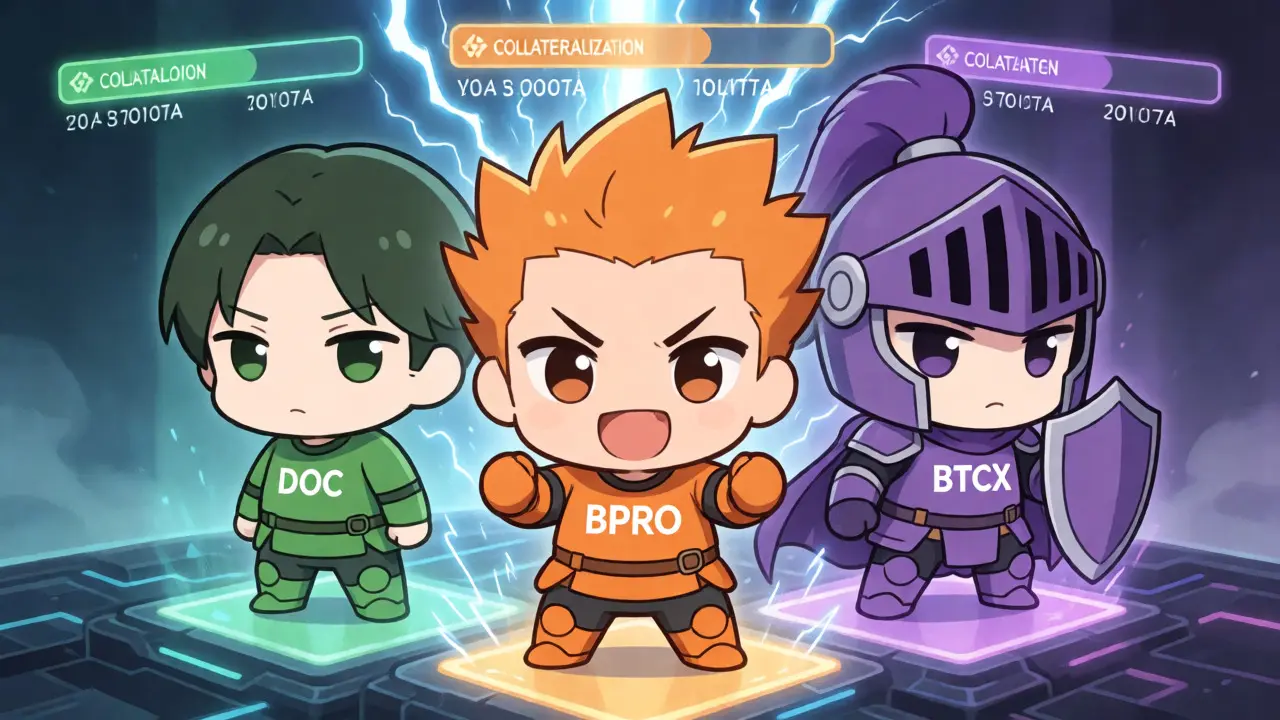
How DOC Works: The Three-Token System
To understand DOC, you need to look at its architecture. It’s not just one token; it’s a three-part ecosystem operating on the RSK blockchain. Think of it as a machine where each part plays a specific role to keep the price near $1.00.
- DOC: The stablecoin itself. It trades close to $1.00 and is used for payments, lending, and trading.
- BPRO (Bitcoin Pro Token): This token provides leverage to Bitcoin holders. It absorbs the volatility of Bitcoin so DOC can remain stable. BPRO holders take on more risk for higher potential returns.
- BTCX (BitcoinX): A derivative instrument that helps manage supply and demand imbalances. It acts as a buffer during extreme market stress.
When you mint DOC, you lock up rBTC as collateral. The protocol requires over-collateralization-typically around 150%. So, if you want to mint $100 worth of DOC, you might lock up $150 worth of rBTC. Why so much? Because Bitcoin is volatile. If Bitcoin crashes, the collateral needs to stay above the debt value to prevent liquidation issues.
Why Choose DOC Over USDT or DAI?
You might ask, "Why not just use DAI?" MakerDAO’s DAI is multi-collateral, meaning it accepts ETH, USDC, and other assets. While better than pure fiat-backed coins, it still relies on Ethereum-based assets and some centralized components. DOC goes further by using only Bitcoin. For many in the Bitcoin community, this purity is non-negotiable.
| Feature | Dollar on Chain (DOC) | Tether (USDT) | USD Coin (USDC) | DAI |
|---|---|---|---|---|
| Collateral Type | 100% Bitcoin (rBTC) | Fiat Cash & Equivalents | Fiat Cash & Equivalents | Mixed Crypto (ETH, USDC, etc.) |
| Custody Model | Non-Custodial Smart Contracts | Centralized Custodian | Centralized Custodian | Decentralized Protocol |
| Blockchain | Rootstock (RSK) | Multi-chain (Ethereum, Tron, etc.) | Multi-chain (Ethereum, Solana, etc.) | Ethereum |
| Counterparty Risk | Low (Code-based) | High (Banking/Regulatory) | High (Banking/Regulatory) | Medium (Oracle/Crypto Volatility) |
| Liquidity (Approx.) | Niche ($30k-$100k daily vol) | Huge ($50B+ daily vol) | Huge ($10B+ daily vol) | Large ($1B+ daily vol) |
The trade-off here is clear. DOC offers superior decentralization and censorship resistance but suffers from lower liquidity. You won’t find deep order books on major exchanges yet. Trading large amounts might cause slippage, whereas USDT can handle millions in seconds.
Getting Started: How to Mint and Use DOC
If you’re ready to try DOC, you don’t need a bank account. You need a compatible wallet and some rBTC. Here’s the typical workflow for users in the RSK ecosystem.
- Get rBTC: Bridge your Bitcoin to the RSK network using a bridge provider. This turns BTC into rBTC, an ERC-20 compatible token on RSK.
- Connect Wallet: Use a wallet that supports RSK, such as MetaMask (configured for RSK), Defiant, or Nifty Wallet. Connect to the Money on Chain dApp.
- Mint DOC: Deposit rBTC into the contract. The interface will show you how much DOC you can mint based on current collateral ratios. Confirm the transaction and pay gas fees in rBTC.
- Use DOC: Send DOC to friends, lend it on Sovryn, or provide liquidity in DEX pools.
Users report that the initial setup takes about 2-3 hours due to the learning curve of bridging and wallet configuration. However, once set up, minting and redeeming are fast, often completing in under five minutes. Gas fees are generally low compared to Ethereum mainnet, costing cents rather than dollars.
Risks and Limitations You Should Know
No technology is perfect, and DOC has distinct challenges. First, it’s tied to the health of the RSK network. If RSK faces congestion or bugs, DOC operations could slow down. Second, liquidity is thin. With a market cap hovering around $4.5 million as of early 2026, it’s tiny compared to the billion-dollar giants. This means institutional players largely ignore it for now.
There’s also the complexity factor. Understanding the interaction between DOC, BPRO, and BTCX isn’t trivial. If you’re just starting out, you might find the mechanics overwhelming compared to simply buying USDT on Coinbase. Critics point out that while the code is secure, user error-like sending tokens to the wrong address-is still possible.
Finally, regulatory clarity is evolving. Because DOC doesn’t involve fiat reserves directly, it avoids some money-transmitter laws. However, global regulators are increasingly scrutinizing all stablecoins. If rules tighten on crypto-backed derivatives, DOC’s model might face new compliance hurdles.
Who Is DOC For?
DOC isn’t for everyone. It’s not ideal for merchants needing instant, high-volume settlements across borders today. Instead, it targets a specific niche: Bitcoiners who want to stay in the Bitcoin ecosystem while accessing DeFi tools.
If you believe Bitcoin is the ultimate store of value and distrust central banks, DOC aligns with your philosophy. It allows you to earn yield on your Bitcoin holdings without selling them for fiat. For example, you can deposit rBTC, mint DOC, lend that DOC on Sovryn for interest, and still retain exposure to Bitcoin upside through your collateral position.
Future Outlook and Roadmap
The team behind Money on Chain is actively expanding DOC’s utility. Recent updates include deeper integration with Sovryn’s lending markets and expanded wallet support. Looking ahead to late 2026, the roadmap includes cross-chain bridging capabilities, potentially allowing DOC to move beyond RSK. Partnerships with additional centralized exchanges aim to boost liquidity, addressing one of its biggest weaknesses.
Industry analysts suggest DOC could capture a small but significant slice of the growing Bitcoin DeFi market. If RSK adoption continues its upward trend, DOC becomes the default stablecoin for Bitcoin-native applications. However, it remains a bet on the success of Layer 2 solutions for Bitcoin.
Is DOC a scam?
No, DOC is a legitimate project developed by Money on Chain. Its smart contracts have been audited, and the collateral is verifiable on-chain. However, like any DeFi protocol, it carries technical and market risks.
Can I buy DOC with credit card?
Direct purchase with credit cards is limited due to low exchange listings. Most users acquire DOC by bridging Bitcoin to rBTC and then minting DOC via the Money on Chain dApp.
Does DOC pay interest?
The DOC token itself does not pay interest. However, you can earn yield by lending DOC on platforms like Sovryn or providing liquidity in DEX pools within the RSK ecosystem.
What happens if Bitcoin crashes?
Because DOC is over-collateralized, a moderate Bitcoin crash doesn’t immediately threaten the peg. The system uses incentives to encourage BPRO holders to absorb losses. In extreme cases, the protocol may trigger mechanisms to restore balance, but forced liquidations are minimized by design.
Which wallets support DOC?
Compatible wallets include MetaMask (with RSK configured), Defiant, Nifty Wallet, and several others added in recent updates. Always verify the official list on the Money on Chain website before connecting.