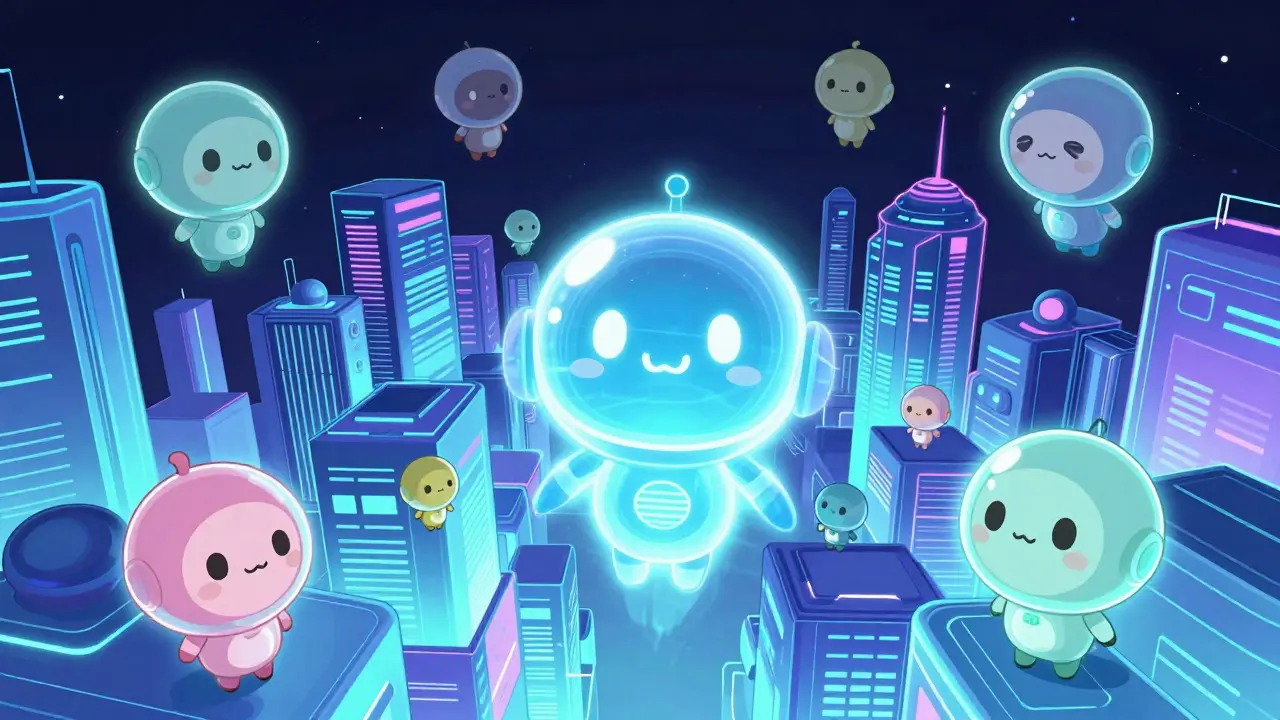
Most people searching for "Mirai" in the crypto space are actually looking for two completely different things. One is a payment token called MRI. The other is MIRAI, an Ethereum-based cryptocurrency that powers an AI-driven metaverse platform focused on world-building and synthetic real-world assets. If you clicked here because you saw the ticker MIRAI on a chart or a social media post, you are looking at the latter. It is a micro-cap asset with a massive story but very thin liquidity, which makes it a fascinating yet risky topic to unpack.
This guide breaks down exactly what MIRAI is, how its technology works, and why the numbers look the way they do. We will skip the fluff and get straight to the facts: the token standard, the team behind it, the actual market data, and the risks you need to know before touching a single dollar of it.
Key Takeaways
- MIRAI is an ERC-20 token on the Ethereum network, not a standalone blockchain.
- The project aims to create an AI metaverse with dynamic agents and a marketplace for Synthetic Derivative Real-World Assets (RWAs).
- It is currently a micro-cap coin with a market cap hovering around $71,700 USD, ranking near #7137 globally.
- Nearly 1 billion tokens are already in circulation, meaning there is no significant future inflation from new releases.
- Liquidity is low; trading primarily happens on Uniswap, and price volatility is extreme.
What Exactly Is the MIRAI Platform?
To understand the coin, you have to understand the product it supports. MIRAI is positioned as infrastructure for immersive digital experiences. Unlike traditional metaverse projects that focus heavily on virtual land sales or avatar cosmetics, MIRAI leans into interconnected world-building where users interact with adaptive AI agents.
The core differentiator here is the use of proprietary technology branded as HyperGen. While specific technical specs aren't public, HyperGen appears to be the engine driving content generation within these virtual worlds. Think of it as the backend that allows environments to change based on user behavior rather than staying static.
Then there is the financial layer: the marketplace for Synthetic Derivative RWAs. This is where MIRAI tries to bridge DeFi and the physical world. Instead of just holding NFTs, users can trade synthetic versions of real-world assets. The project claims to be the first AI metaverse to offer this, leveraging cross-chain interoperability via the Axelar Network to move assets between Ethereum and other chains.
Token Structure and On-Chain Data
MIRAI operates as a standard ERC-20 token on the Ethereum mainnet. This means it relies on Ethereum's security and gas fees for transactions. There is no separate Layer 2 or sidechain dedicated solely to MIRAI; it lives directly on L1.
| Attribute | Value | Note |
|---|---|---|
| Ticker | MIRAI | Do not confuse with MRI (Mirai) |
| Network | Ethereum | ERC-20 Standard |
| Total Supply | 1,000,000,000 | Fixed supply |
| Circulating Supply | ~999,999,907 | Approximately 100% circulating |
| Market Cap | ~$71,700 USD | Micro-cap classification |
| Holders | ~3,070 | Low distribution breadth |
| Contract Address | 0x42c8...79EE | Verify before buying |
The supply situation is interesting. With nearly one billion tokens already in circulation, you don't have to worry about upcoming vesting schedules or team unlocks dumping on the market. However, the holder count is surprisingly low for a project claiming to build a mass-market metaverse. Only about 3,000 addresses hold the token, suggesting that while the supply is high, the community might be concentrated among early adopters or speculators rather than active users.

Price History and Volatility Reality Check
If you are looking at price charts, prepare for some wild swings. MIRAI hit an all-time high (ATH) of $0.01873 USD on December 1, 2024, according to CoinMarketCap. Some aggregators like KuCoin report a slightly higher ATH of $0.0312 USD, likely due to differences in exchange coverage during low-liquidity periods.
As of mid-2026, the price has settled significantly lower, often trading in the fractions of a cent (e.g., $0.00007 - $0.0003 range depending on the snapshot). This represents a drawdown of over 99% from its peak. For context, the all-time low was recorded recently in April 2026 at $0.000017 USD. This level of volatility is typical for micro-cap tokens where a single large trade can move the price by double digits.
Trading volume is another red flag to watch. At various snapshots, 24-hour volume has been reported as close to zero on some platforms, while others show a few thousand dollars. This inconsistency highlights the lack of deep liquidity. You might find it difficult to sell a large position without moving the price against yourself.
How to Buy and Store MIRAI
Because MIRAI is not listed on major centralized exchanges like Binance or Coinbase for spot trading, you have to go through decentralized exchanges (DEXs). The primary venue is Uniswap on Ethereum.
Here is the practical workflow you will follow:
- Set up a wallet: Use a self-custody wallet like MetaMask or Trust Wallet. Ensure it supports Ethereum.
- Buy ETH: Acquire Ether on a major CEX or directly via a DEX. You need ETH to pay for gas fees and to swap for MIRAI.
- Connect to Uniswap: Link your wallet to the Uniswap interface.
- Add the token manually: Since MIRAI is small, it may not appear in the default search. You will likely need to paste the official contract address:
0x42c83a91B3a79dE5488CD9280A4dF564e13A79EE. - Execute the swap: Trade your ETH for MIRAI. Double-check the slippage settings, as low liquidity can result in poor execution prices.
For storage, treat MIRAI like any other ERC-20 token. You can keep it in your hot wallet for easy access, but if you plan to hold long-term, moving it to a hardware wallet like Ledger or Trezor is safer against phishing attacks or seed phrase loss.
Risks and Things to Watch Out For
Before you invest, let's talk about the downsides. First, the name confusion is a real hazard. There is a token called MRI (Mirai) which is a proof-of-stake payment token with a total supply of only 16 million. It is a completely different project. Make sure you are looking at the right contract address every time.
Second, regulatory ambiguity surrounds the "Synthetic Derivative RWA" feature. How are these assets priced? Who backs them? Are they considered securities? None of the public documentation provides clear answers, leaving investors to guess how regulators in the US, EU, or Asia might view these products in the future.
Finally, there is the development transparency issue. While the founders are listed as Paras Jha, Josiah White, and Dalton Norman, detailed biographies, LinkedIn profiles, or governance structures are scarce. In the crypto world, anonymous or semi-anonymous teams carry higher risk because accountability is harder to enforce if the project stalls.
Frequently Asked Questions
Is MIRAI a good investment in 2026?
MIRAI is a high-risk, speculative asset. With a market cap under $100k and extreme volatility, it suits traders comfortable with potential total loss. It is not suitable for conservative portfolios. The bearish technical sentiment and low liquidity suggest caution is required.
Where can I buy MIRAI coin?
You can buy MIRAI on Uniswap using an Ethereum-compatible wallet. It is not currently listed on major centralized exchanges like Binance or Coinbase for direct spot trading. You must swap ETH for MIRAI via a DEX.
What is the difference between MIRAI and MRI?
They are two distinct projects. MIRAI is an Ethereum ERC-20 token for an AI metaverse with ~1 billion supply. MRI is a Proof-of-Stake payment token with ~16 million supply, focused on AR and e-commerce. Do not mix up their contract addresses.
Does MIRAI have a maximum supply?
Yes, the maximum supply is fixed at 1,000,000,000 tokens. Nearly all of these are already in circulation, so there is no planned inflation from new token issuance.
Who are the founders of MIRAI?
The reported founders are Paras Jha, Josiah White, and Dalton Norman. However, detailed public information about their roles and backgrounds is limited compared to larger crypto projects.