

Imagine you run a small coffee shop in Hanoi. A customer walks in, buys a latte, and offers to pay with Bitcoin. It seems like the future of finance-fast, borderless, and modern. But in Vietnam, that simple transaction could cost you between 150 million and 200 million Vietnamese Dong (roughly $6,500 to $8,900 USD). This isn't a hypothetical scenario from a dystopian novel; it is the current legal reality under the strict regulatory framework enforced by the State Bank of Vietnam (SBV), which has maintained a comprehensive ban on using cryptocurrencies as payment methods since January 1, 2018.
If you are doing business in or sending money to Vietnam, understanding this fine is not just about avoiding penalties-it’s about navigating one of the most complex regulatory environments in Southeast Asia. While holding crypto might feel safe, using it to buy goods or services triggers immediate administrative sanctions. Let’s break down exactly what the law says, why it exists, and how it affects you today in 2026.
The Legal Basis: Decree No. 96/2014/ND-CP
To understand the fine, we have to look at the specific law that authorizes it. The penalty stems from Decree No. 96/2014/ND-CP, specifically Clause 6, Article 27, which governs administrative sanctions in monetary and banking activities. This decree explicitly states that the issuance, supply, and use of Bitcoin and other similar virtual currencies as a means of payment is a prohibited activity in Vietnam.
The law does not leave much room for interpretation. Here is what the regulation covers:
- Issuance: Creating new tokens or coins intended for circulation as money.
- Supply: Distributing these assets to others for payment purposes.
- Use: Accepting or spending cryptocurrency to settle debts, buy goods, or pay for services.
Under this decree, anyone caught violating these rules faces a fine ranging from 150 million to 200 million VND. This legal foundation was solidified after Prime Minister Nguyen Xuan Phuc directed the government to develop a clear legal framework for virtual currencies, resulting in the SBV’s official announcement on October 28, 2017. By January 1, 2018, the clock started ticking on enforcement.
Payment vs. Asset: The Critical Distinction
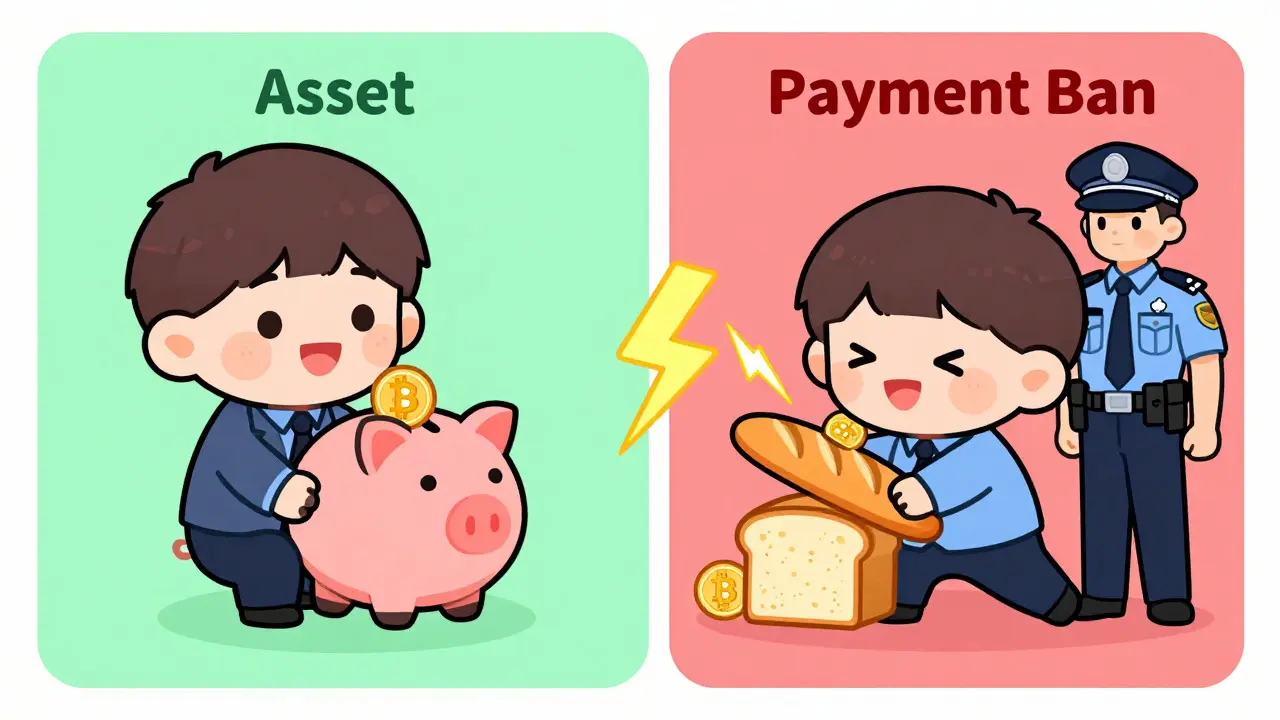
One of the biggest misconceptions among newcomers to the Vietnamese market is that crypto is banned entirely. This is incorrect. The SBV distinguishes sharply between cryptocurrency as an asset and cryptocurrency as a payment instrument.
You can own Bitcoin. You can trade it on exchanges (though local exchange operations have faced their own regulatory hurdles). You can hold Ethereum in your wallet. However, the moment you use those assets to transfer value in exchange for tangible goods or services, you step into illegal territory. According to Article 4.6 of Decree 101/2012/ND-CP on non-cash payments, only specific instruments like checks, payment orders, collection orders, and bank cards are recognized as lawful means of payment.
This creates a unique gray area. If you sell a used phone to a friend and accept USDT, you are technically committing an administrative offense. If you simply hold USDT in your digital wallet as an investment, you are generally operating within a tolerated space, provided no formal payment transaction occurs. Le Truong Tung, president of FTP University, explained the SBV's rationale: accepting bitcoin as payment complicates economic control, opens doors for tax evasion, and challenges national sovereignty over currency issuance.
| Action | Legal Status | Potential Penalty |
|---|---|---|
| Holding Crypto (Investment) | Tolerated / Gray Area | None (currently) |
| Using Crypto for Payment | Illegal | 150-200 Million VND Fine |
| Operating Unlicensed Exchange | Illegal | Heavy Administrative/Criminal Sanctions |
| Mining Crypto | Restricted / Regulated | Varies by electricity usage & location |

Why Such Strict Regulations?
Vietnam’s approach stands out even in Southeast Asia. Neighbors like Thailand and Singapore have developed licensing regimes for digital payment token services. Thailand allows cryptocurrency exchanges under strict supervision, while Singapore’s Monetary Authority created a robust framework for digital assets. Vietnam, however, chose a harder line.
The primary driver is monetary sovereignty. The SBV wants to maintain full control over the flow of capital and the stability of the Vietnamese Dong. Dr. Nguyen Xuan Thanh, former director of the Vietnam Program at Harvard University's Kennedy School, noted that Vietnam’s approach reflects traditional central banking concerns. They fear that if crypto becomes a common payment method, the state loses visibility into transactions, making it difficult to track inflation, enforce taxes, and prevent money laundering.
Furthermore, there is the issue of consumer protection. In the early days of crypto adoption, scams were rampant. By banning crypto payments, the SBV effectively removed a major vector for fraud where consumers had little recourse if a merchant disappeared with their Bitcoin. However, critics like Le Hong Hiep from Singapore's ISEAS-Yusof Ishak Institute argue that this blanket ban misses the opportunity to harness blockchain technology while failing to address the underlying demand for alternative payment methods.
Enforcement Reality: Theory vs. Practice
While the law is clear, enforcement tells a different story. The 150-200 million VND fine is technically enforceable, but in practice, it is rarely applied to individual consumers buying a cup of coffee. Instead, regulators focus on high-profile cases and institutional violations.
For example, in July 2017, before the official 2018 ban took effect, a Vietnamese university announced plans to accept Bitcoin for tuition fees. The SBV immediately intervened, warning that this would violate existing regulations. The institution quickly abandoned the plan. This case set a precedent: institutions are watched closely, while peer-to-peer transactions often fly under the radar unless they involve large sums or suspicious patterns flagged by customs or financial intelligence units.
By November 2019, the SBV reported coordinating additional penal sanctions for acts involving illegal cryptocurrencies. Yet, despite the strict laws, Vietnam ranked 8th globally in cryptocurrency adoption according to Chainalysis' 2021 Global Crypto Adoption Index. How is this possible? Most users engage in peer-to-peer (P2P) trading via platforms like Binance P2P or LocalBitcoins, treating crypto as a store of value rather than a direct payment method. They convert crypto to VND through intermediaries, then spend VND, thereby sidestepping the "payment" prohibition.
Impact on Businesses and Expats
If you are an expat living in Ho Chi Minh City or a foreign company setting up operations in Vietnam, this regulation requires careful navigation. Here are three key scenarios to consider:
- Freelancers and Remote Workers: Many Vietnamese freelancers receive payments in crypto from international clients. As long as they convert these funds to VND via P2P markets before paying local bills, they remain compliant. Directly paying a landlord in USDT, however, puts both parties at risk.
- E-commerce Merchants: Online stores must avoid integrating crypto payment gateways directly. Using third-party processors that handle the conversion off-shore and deposit VND into local bank accounts is a safer, albeit more complex, route.
- Real Estate Transactions: High-value real estate deals sometimes see attempts to use crypto. These are heavily scrutinized. Customs and tax authorities monitor large cross-border flows. Attempting to bypass the banking system with crypto can lead to frozen assets and significant fines.
The tension is palpable. Non-cash payments in Vietnam have been growing at 35% annually since 2015, driven by digital banking solutions like MoMo and ZaloPay. The SBV encourages this innovation because it keeps transactions within the regulated banking system. Crypto, by contrast, operates outside this loop, creating a paradox where the country is a global leader in adoption yet legally hostile to its utility.
Future Outlook: Regulatory Evolution
As of 2026, the core prohibition remains, but the landscape is shifting. The Ministry of Finance has introduced draft circulars on tax management for virtual asset transactions, signaling a move toward recognizing crypto as a taxable asset. This implies that while you still can’t buy bread with Bitcoin, you will likely need to declare your crypto holdings for capital gains tax purposes.
Dr. Tran Ngoc Ca, former Deputy Director of Vietnam's Academy of Finance, stated in a 2023 interview that the 150-200 million VND fine has become increasingly difficult to implement as usage grows. There is mounting pressure for regulatory modernization. We may see a future where licensed entities can offer crypto-related services, similar to Singapore’s model, but for now, the ban on payments stands firm.
For businesses, the advice is simple: stick to fiat for domestic transactions. Use crypto for cross-border settlements only if you have robust compliance structures in place. For individuals, treat crypto as a savings account, not a wallet. Keep your daily spending in VND to avoid the wrath of Decree 96/2014/ND-CP.
Is it illegal to own Bitcoin in Vietnam?
No, owning Bitcoin is not explicitly illegal. The ban applies specifically to using Bitcoin and other cryptocurrencies as a means of payment. Holding them as an investment asset is currently tolerated, though the legal framework is evolving toward taxing these assets.
How much is the fine for using crypto payments?
The fine ranges from 150 million to 200 million Vietnamese Dong (approximately $6,500 to $8,900 USD), depending on the severity and nature of the violation, as stipulated in Decree No. 96/2014/ND-CP.
Can I pay my rent in Vietnam using USDT?
Technically, no. Paying rent with USDT constitutes using cryptocurrency as a payment method, which is prohibited. Both the tenant and the landlord risk administrative fines. It is safer to convert USDT to VND via P2P platforms first.
Why does Vietnam ban crypto payments?
The State Bank of Vietnam cites concerns over monetary sovereignty, tax evasion, money laundering, and the complexity of controlling an economy where transactions occur outside the traditional banking system.
Are there any exceptions for businesses?
Currently, there are no broad exceptions for businesses to accept crypto as direct payment. Some companies use offshore payment processors that convert crypto to fiat before settling with the Vietnamese entity, but direct acceptance remains risky.