

Binance Fee Calculator
Estimate Your Binance Trading Savings
Find out how much you could save on trading fees by using Binance versus other exchanges. Input your monthly trading volume to see potential annual savings.
Binance Fee Structure
Base fee: 0.10% for spot trades
High-volume discount: As low as 0.0190% for $1M+ monthly volume
BNB discount: 25% discount on all fees when using BNB as payment
Stablecoin pairs: 0% fees on pairs like BUSD/USDT
Estimated Annual Savings
Your Current Fees
$0.00/year
Binance Fees
$0.00/year
Potential Savings
$0.00/year
Fee Comparison
| Exchange | Base Fee | High Volume Discount | BNB Discount | Stablecoin Fees |
|---|---|---|---|---|
| Binance | 0.10% | 0.0190% | 25% discount | 0% on BUSD/USDT |
| Coinbase | 0.50% | 0.40% | No | 0.50% |
| Kraken | 0.26% | 0.12% | No | 0.20% |
How to Maximize Your Savings
- Hold BNB to get a 25% discount on all trading fees
- Trade stablecoin pairs like BUSD/USDT for 0% fees
- Increase your trading volume to qualify for lower fee tiers
- Use Binance's referral program to earn additional discounts
- Consider Binance US if you're in the United States (but expect higher fees)
When you open the Binance app on your phone and see your portfolio up 8% in ten minutes, it’s easy to think this is the best crypto exchange ever. And for millions of traders, it is. But if you’ve ever waited three days for customer support to reply during a market crash, or gotten locked out because you didn’t whitelist a withdrawal address, you know it’s not perfect. Binance isn’t just another exchange-it’s the biggest, most powerful, and most controversial one in crypto. As of December 2025, it handles $65 billion in daily trades, serves 120 million users, and lists over 350 cryptocurrencies. But what does that actually mean for you?
Why Binance Still Leads the Market
Binance didn’t get big by accident. It launched in 2017 when most exchanges were slow, clunky, and limited to a handful of coins. Binance changed that. It offered lower fees, faster trades, and way more options. Today, that edge still holds. If you’re trading Bitcoin, Ethereum, Solana, or even obscure memecoins, Binance has it-and the liquidity to move big orders without slippage. Compare that to Coinbase, which only lists around 250 coins, or Kraken with 200. Binance’s selection isn’t just wider-it’s deeper. You can trade spot, margin, futures, and options all in one place. Even institutional traders use it: hedge funds like Pantera Capital and Galaxy Digital move billions daily through Binance’s institutional platform.Trading Fees That Actually Matter
Fees are where Binance crushes the competition. For spot trades, the base fee starts at 0.10%, but if you trade more than $1 million in 30 days, it drops to 0.0190%. That’s less than half of what Kraken charges and a fifth of what Coinbase Advanced Trade takes. And if you hold BNB, the platform’s native token, you get an automatic 25% discount on every trade. For active traders, that’s hundreds-sometimes thousands-of dollars saved per year. Even better, some stablecoin pairs like BUSD/USDT have 0% fees. No other major exchange offers that consistently. The only catch? Binance US, the American version, has higher fees (0%-0.6%) because of regulatory restrictions. If you’re outside the U.S., you’re getting the real deal.Security: Cold Storage, SAFU, and What You’re Really Protecting
Security is where Binance gets a lot of praise-and a lot of skepticism. The platform stores 98% of user funds in cold wallets, meaning they’re offline and out of reach from hackers. Only 2% are kept in hot wallets for daily withdrawals. That’s better than most. Then there’s the Secure Asset Fund for Users (SAFU), a $1.05 billion reserve set aside to cover losses from hacks. That fund was built after the 2019 breach and has never been touched. Binance also uses threshold signature schemes (TSS), which require multiple authorized parties to approve large transfers. It’s military-grade tech. But here’s the truth: your biggest risk isn’t Binance getting hacked. It’s you. If you don’t use two-factor authentication, reuse passwords, or click phishing links, your account is vulnerable. And if you enable withdrawals to an unverified address without whitelisting it, you could lose everything in seconds. Binance gives you the tools. It’s up to you to use them.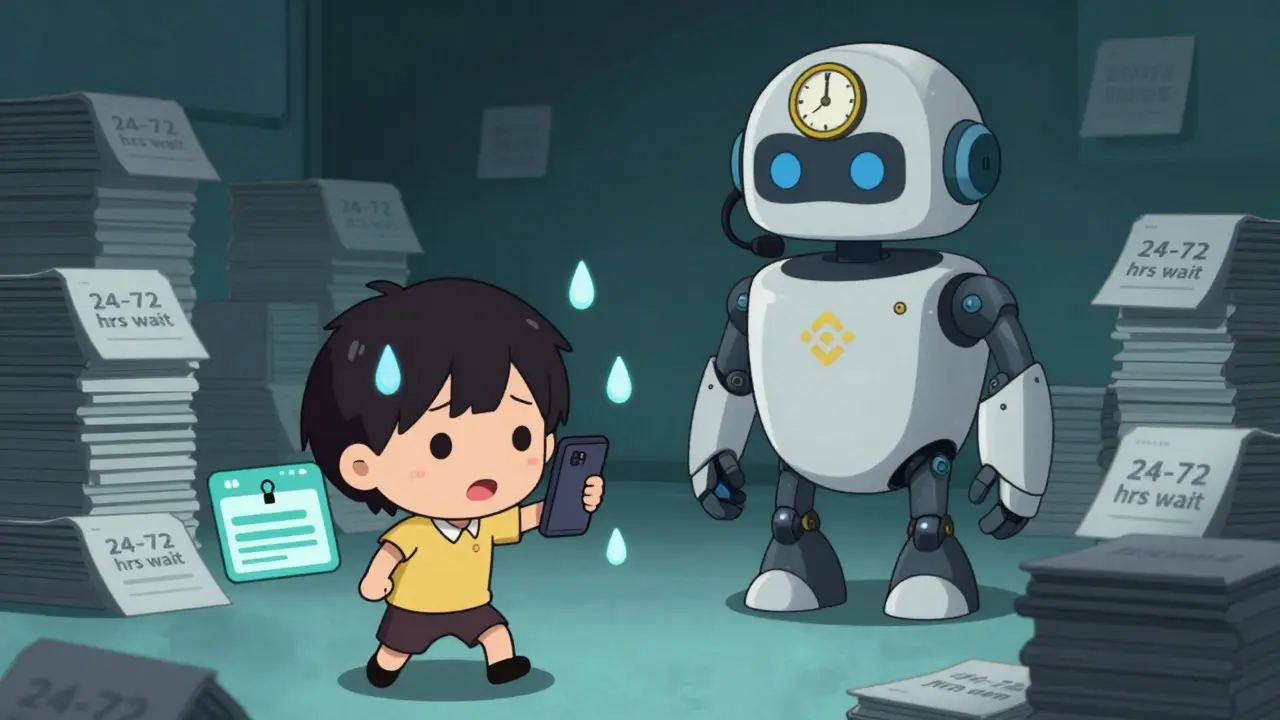
The Mobile App: Powerful, But Not for Beginners
The Binance app is downloaded over 100 million times. It’s fast, responsive, and works even on older phones. You can check prices, place trades, stake coins, and even use Binance Pay-all in one place. The interface supports biometric login, real-time alerts, and sub-100ms execution during peak hours. But it’s not friendly. New users get overwhelmed. The main screen is packed with tabs: Spot, Futures, Earn, Launchpad, NFTs, DeFi. There’s no guided onboarding. No “how to buy Bitcoin” tutorial. You’re thrown into the deep end. That’s fine if you’ve traded before. If you’re new? You’ll spend hours watching YouTube tutorials or reading Binance Academy’s 500+ guides just to figure out how to place a simple limit order.Customer Support: The Weak Spot
This is where Binance loses points. Most users report support responses take 24 to 72 hours. During market crashes-when you need help the most-it can stretch to five days. Reddit threads are full of stories like one from u/CryptoTrader2025, who waited 14 days to get a locked account unlocked. Compare that to Coinbase, which usually replies within 24 hours. Binance’s support team is stretched thin. With 120 million users and only a handful of support centers, it’s inevitable. Enterprise clients with $1 million+ in monthly volume get dedicated managers. Regular users? You’re on your own. The app’s chatbot helps with basic questions, but if you’re dealing with a withdrawal delay or KYC rejection, you’re stuck waiting.
Regulatory Risks: The Shadow Over Binance
Binance isn’t licensed in the U.S., U.K., or the EU. It operates in a legal gray zone. In 2024, it settled with the SEC and CFTC for $4.3 billion over allegations of operating as an unregistered securities exchange. That’s a massive fine, but it didn’t shut them down. It just forced changes. They delisted 12 privacy coins like Monero. They tightened KYC rules. They’re still expanding into new countries, but with temporary licenses. In Europe, they’re allowed to operate in 15 countries under temporary permits. In the U.S., you have to use Binance US, which has fewer coins, higher fees, and stricter limits. If you’re outside the U.S., you’re fine-for now. But if the U.S. government cracks down harder, Binance could lose access to major markets. That’s not speculation. It’s already happening.Who Should Use Binance?
If you’re an active trader who wants low fees, deep liquidity, and access to hundreds of coins, Binance is the best choice. If you’re into DeFi, staking, or futures trading, it’s unmatched. If you’re comfortable with a complex interface and know how to secure your account, you’ll thrive. But if you’re a beginner who just wants to buy Bitcoin and hold it, Binance is overkill. You’ll get lost. You’ll make mistakes. You’ll get frustrated. Coinbase, Kraken, or even a simple app like Cash App might be better for you.What’s Next for Binance?
Binance isn’t standing still. In November 2025, they launched Binance Pay 3.0, letting users pay for goods in crypto across 30 new countries. They integrated Chainlink’s CCIP for cross-chain transfers, making it easier to move tokens between blockchains. And they’re working on Binance Chain 3.0 for Q2 2026, which will use zero-knowledge proofs for private transactions. They’re also planning to support 100+ fiat currencies by the end of 2026. But their biggest challenge isn’t tech-it’s trust. Can they survive the regulatory storm? Only time will tell. For now, they’re still the giant. But giants can fall.Is Binance safe to use in 2025?
Yes, technically. Binance stores 98% of funds offline, uses advanced security like TSS, and has a $1.05 billion SAFU fund. But safety depends on you. If you don’t use two-factor authentication, reuse passwords, or fall for phishing scams, your account is at risk. The exchange is secure. Your device and habits are the weak link.
How do I reduce Binance trading fees?
Hold BNB (Binance Coin) in your wallet and select it as your fee payment method. That gives you a 25% discount on every trade. You can also reduce fees by increasing your 30-day trading volume. High-volume traders pay as low as 0.0190%. Trading stablecoin pairs like BUSD/USDT also has 0% fees.
Can I use Binance in the United States?
You can’t use the global Binance platform in the U.S. Instead, you must use Binance US, a separate platform with fewer coins (around 150), higher fees (0%-0.6%), and stricter withdrawal limits ($5,000 daily via ACH). Binance US is fully compliant with U.S. regulations but lacks the features and liquidity of the main platform.
Why is Binance customer support so slow?
Binance has over 120 million users worldwide but a limited support team. Most tickets take 24-72 hours to respond. During market crashes or high-volume periods, delays can stretch to five days. Enterprise clients with $1 million+ monthly volume get priority. Regular users rely on the help center and chatbot, which handle basic issues but can’t solve complex account problems.
What are the biggest risks of using Binance?
The biggest risks are regulatory crackdowns, especially in the U.S. and EU, which could limit access or shut down services. On the user side, the main risks are poor personal security: weak passwords, no 2FA, phishing scams, and misconfigured API keys. Also, Binance’s complex interface leads to mistakes-like withdrawing to the wrong address or enabling margin without understanding the risks.
Should I use Binance for long-term crypto holding?
You can, but it’s not ideal. Binance is built for trading, not storage. For long-term holding, move your coins to a hardware wallet like Ledger or Trezor. If you leave them on Binance, you’re trusting the exchange with your assets. Even with SAFU and cold storage, exchanges are targets. Never store large amounts on any exchange long-term.
How does Binance compare to Coinbase?
Coinbase is simpler and more regulated, especially in the U.S. It’s better for beginners and has faster support. But Binance has far more coins (350+ vs. 250), much lower fees, higher liquidity, and advanced trading tools. If you want to trade actively or access DeFi and futures, Binance wins. If you just want to buy Bitcoin and sleep well, Coinbase is safer and easier.
What happens if Binance gets shut down?
If Binance loses its operating licenses, it could freeze withdrawals temporarily while it complies with regulators. In 2021, Binance temporarily halted withdrawals in several countries during regulatory reviews. Users eventually got their funds back, but it took weeks. That’s why you should never keep all your crypto on an exchange. Use Binance to trade. Move your holdings to a personal wallet for long-term storage.


Andy Walton
December 15, 2025 AT 17:57Candace Murangi
December 16, 2025 AT 21:02Albert Chau
December 17, 2025 AT 09:19Madison Surface
December 17, 2025 AT 22:13Tiffany M
December 19, 2025 AT 13:40Eunice Chook
December 21, 2025 AT 09:13Lynne Kuper
December 22, 2025 AT 18:07Jessica Eacker
December 22, 2025 AT 18:41Kathleen Sudborough
December 24, 2025 AT 11:11Claire Zapanta
December 25, 2025 AT 22:29Kathy Wood
December 27, 2025 AT 09:11Abhishek Bansal
December 29, 2025 AT 00:04Anselmo Buffet
December 29, 2025 AT 14:51Steven Ellis
December 30, 2025 AT 20:35Sue Gallaher
January 1, 2026 AT 18:42Hari Sarasan
January 2, 2026 AT 09:07Stanley Machuki
January 3, 2026 AT 12:04Lloyd Cooke
January 4, 2026 AT 21:10Kurt Chambers
January 6, 2026 AT 13:24Kelly Burn
January 7, 2026 AT 12:06John Sebastian
January 8, 2026 AT 03:25Lois Glavin
January 9, 2026 AT 12:39Bridget Suhr
January 11, 2026 AT 08:19Jessica Petry
January 12, 2026 AT 22:55