
Imagine handing over your passport, driver's license, and bank details every time you book a flight or open a new account. Now imagine keeping all that data in your pocket, sharing only the specific piece of information a company needs, without ever giving them the master key to your personal life. That is the promise of blockchain digital identity solutions, a technology stack that shifts control from centralized databases back to the individual. By 2032, this sector is projected to explode from $1.57 billion to nearly $119 billion, driven by a compound annual growth rate of 85.6%. But why the sudden surge? Because traditional identity systems are breaking under the weight of data breaches, slow verification processes, and user fatigue.
Key Takeaways
- Market Explosion: The global blockchain identity market is growing at an 85.6% CAGR, reaching $118.96 billion by 2032.
- Core Tech: Systems rely on Decentralized Identifiers (DIDs) and Verifiable Credentials (VCs) standardized by W3C.
- Speed Advantage: Verification drops from days to seconds; JPMorgan cut KYC time from 5 days to under 2 hours.
- Adoption Hurdle: 45% of enterprise projects fail due to poor user experience, not technical flaws.
- Regulatory Shift: 32 countries now have blockchain-friendly frameworks, with eIDAS 2.0 in the EU driving compliance.
How Self-Sovereign Identity Actually Works
To understand the value, you have to look at the mechanics. Traditional identity is custodial. A bank stores your ID, a hospital stores your records, and a government holds your citizenship proof. If any one of those servers gets hacked, your identity is compromised. In a Self-Sovereign Identity (SSI) model, you hold the keys.
The foundation here is the Decentralized Identifier (DID), a unique string that points to a set of cryptographic keys rather than a central server record. When you need to prove something-like being over 18-you don't show your birth certificate. You present a Verifiable Credential (VC), a digital document signed by a trusted issuer. The verifier checks the signature against the blockchain using public key cryptography. This process takes 1.2 to 2.8 seconds, according to benchmarks from Dock.io, compared to the 2-5 business days typical for manual Know Your Customer (KYC) checks.
This isn't just faster; it's more private. You use zero-knowledge proofs to share only what is necessary. For example, a bar can verify you are 21+ without learning your exact date of birth. This transforms enterprises from identity custodians, who carry the liability of storing your data, to identity verifiers, who simply validate claims. As Bob Greifeld, CEO of Nasdaq, predicted in 2015, this shift represents one of the biggest opportunity sets for the next decade.
Market Dynamics and Sector-Specific Impact
The numbers paint a picture of rapid maturation. North America leads the charge, valued at $0.47 billion in 2025, largely due to early adoption in Silicon Valley and supportive government initiatives like DHS funding. However, the growth rates tell a more nuanced story about where the pain points are greatest.
| Sector | Current Adoption Rate | CAGR Projection | Primary Driver |
|---|---|---|---|
| Financial Services | 48% | High | Reducing KYC costs by 60-70% |
| Healthcare | 37% | 87.80% | Digital health credentials post-pandemic |
| Government | 29% | Moderate | Cross-border verification and fraud reduction |
| Consumer | 18% | Growing | Data privacy and control |
Healthcare is seeing the highest growth rate at 87.80% CAGR. Why? Because the pandemic exposed how fragile centralized medical records are. Blockchain allows patients to move their history between providers seamlessly. In finance, the impact is tangible cost savings. JPMorgan’s 2024 implementation slashed identity verification time from five days to under two hours, directly impacting operational efficiency. Meanwhile, government programs like Estonia’s e-Residency reduced verification times from two weeks to 48 hours, proving that national-scale deployment is viable.

Comparative Analysis: Blockchain vs. Traditional IAM
Is blockchain always better? Not necessarily. It depends on your constraints. Traditional Identity and Access Management (IAM) systems are mature, well-regulated, and easy to integrate with legacy infrastructure. But they are siloed. Your identity at Bank A doesn’t help you at Hospital B. Blockchain bridges these silos through interoperability standards like W3C VCs.
However, there are trade-offs. User error remains a significant barrier. During initial implementation phases, user error rates average 22%, often due to confusion around digital wallet management. Trustpilot reviews of consumer-facing apps average just 3.2 out of 5 stars, with 57% of negative feedback citing recovery challenges. If you lose your seed phrase, recovering access is harder than resetting a password. This usability gap is why Dr. Avivah Litan of Gartner warned that 45% of enterprise implementations fail to achieve ROI-not because the tech fails, but because the user experience design is poor.
Implementation Roadmap and Resource Requirements
If you are considering deploying this technology, plan for a 6-9 month timeline for full integration. Start with a proof-of-concept phase lasting 8-12 weeks. You cannot do this with just IT staff. You need a cross-functional team including blockchain developers, IAM specialists, and compliance officers. In North America, blockchain developers command salaries between $125,000 and $175,000 annually, reflecting the specialized skill set required.
Common pitfalls include regulatory alignment (cited by 78% of enterprises) and legacy system integration (72%). To mitigate these risks, choose platforms that support existing standards. Consensys’ Identity Developer Kit is highly rated for its documentation, scoring 4.7/5, whereas smaller vendors often lag behind. Remember, 63% of enterprise users require specialized training. Budget for change management as much as you do for software licenses.
Future Trends and Regulatory Landscape
The ecosystem is evolving rapidly. Four trends are shaping the next phase of adoption:
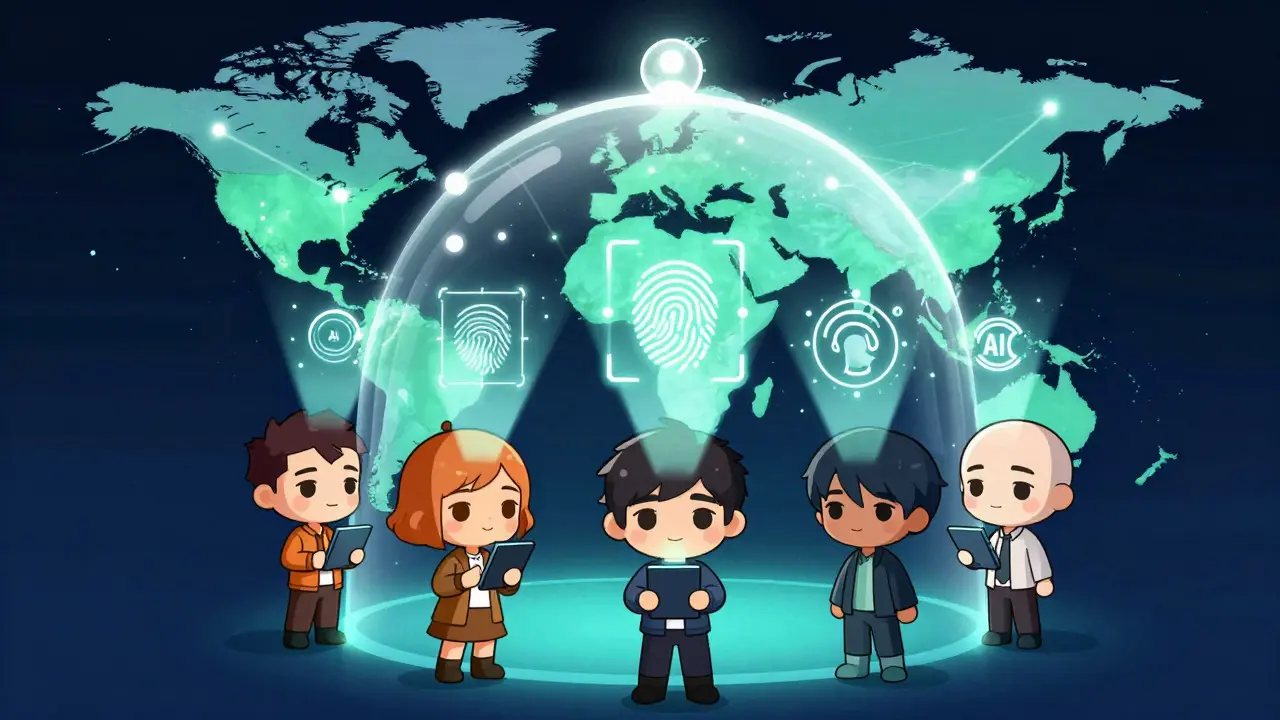
- Biometric Integration: Biometric verification linked to blockchain wallets is growing at 92% year-over-year.
- Regulatory Sandboxes: 17 countries now operate sandboxes enabling cross-border identity verification.
- AI Fraud Detection: AI layers are reducing false positives in identity checks by 63%.
- Data Monetization: Frameworks allowing users to profit from their verified identity attributes are emerging.
Regulation is no longer a blocker but an enabler. As of Q1 2025, 32 countries have implemented blockchain-friendly digital identity frameworks. In the EU, the upcoming eIDAS 2.0 regulation will mandate digital identity wallets, creating a massive compliance-driven market. Gartner predicts that by 2028, blockchain identity solutions will be mandatory for 75% of enterprise digital interactions. The question is no longer whether to adopt, but how quickly you can adapt before competitors do.
Frequently Asked Questions
What is the difference between a DID and a traditional username?
A traditional username points to a central database record controlled by a company. A Decentralized Identifier (DID) points to a cryptographic key pair owned by the user. You can change the DID method or network without losing your identity, and no single entity controls your existence on the web.
Are blockchain digital identities secure from hackers?
They are more secure against database breaches because there is no central database to hack. However, security depends on how well you manage your private keys. If you lose your hardware wallet or seed phrase, you lose access. Therefore, robust backup strategies are critical for long-term security.
Which industries are adopting blockchain identity first?
Financial services lead with 48% adoption, followed by healthcare at 37% and government at 29%. Finance drives adoption due to high KYC costs, while healthcare benefits from the need for portable patient records across different providers.
How long does it take to implement a blockchain identity system?
Full enterprise integration typically takes 6-9 months. A proof-of-concept phase usually requires 8-12 weeks. The timeline varies based on legacy system complexity and the availability of skilled blockchain developers.
Is blockchain identity compliant with GDPR?
Yes, often more so than traditional systems. Since users control their data and can revoke access easily, SSI aligns well with GDPR principles like data minimization and right to erasure. However, specific legal interpretations vary by jurisdiction, so compliance review is essential.