
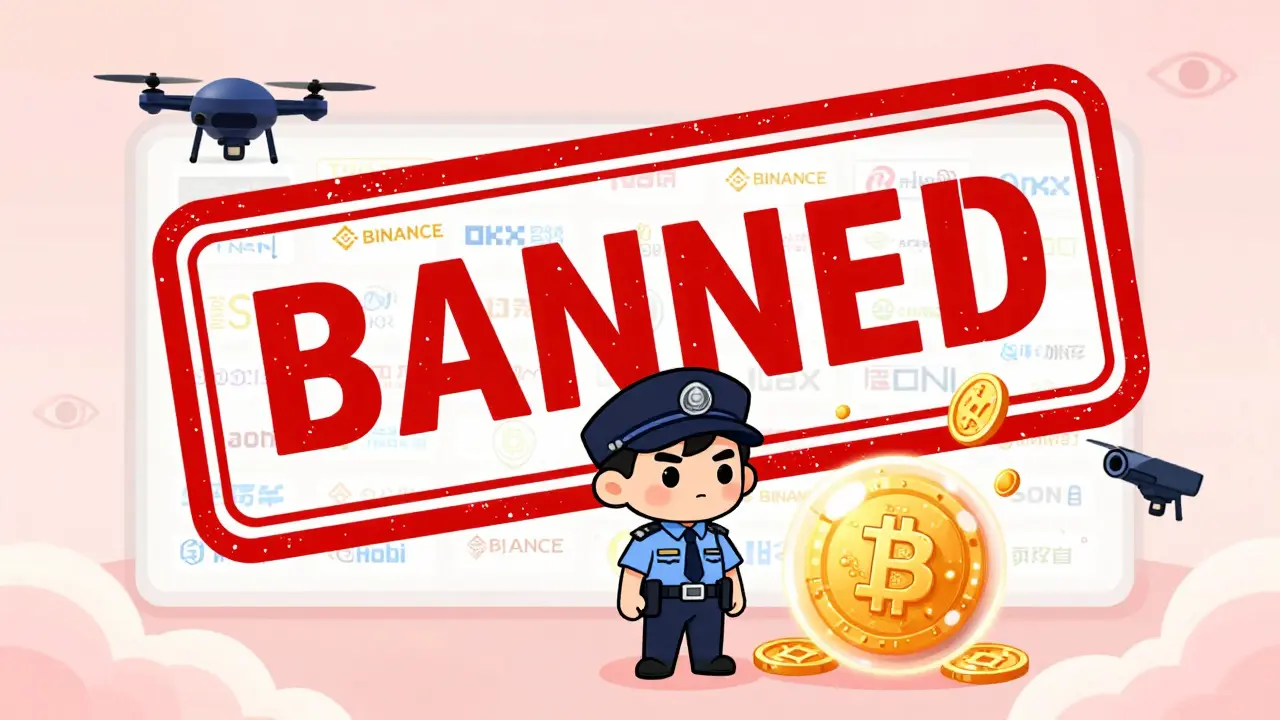
If you’re a resident of China, any cryptocurrency exchange is off-limits. Not some. Not most. All of them. As of June 1, 2025, the People’s Bank of China (PBOC) issued a total ban on every form of cryptocurrency activity - trading, mining, holding, or even accessing foreign exchanges through a VPN. This isn’t a gray area. It’s a legal wall. Crossing it isn’t just risky - it’s illegal.
You might think, "But I’ve used Binance or OKX before." That doesn’t matter anymore. Those platforms are now legally blocked from serving Chinese residents. Even if you find a way to log in, you’re breaking the law. The government doesn’t just block websites - it tracks your bank transfers, monitors your payment apps, and flags any transaction that looks like crypto activity. Your phone, your bank account, your internet history - all are under surveillance for signs of digital currency use.
There Are No Safe Exchanges - Not Even the Ones Based in China
Some people assume that because Huobi or OKX started in China, they might still be legal. That’s wrong. Huobi shut down its China operations years ago. OKX stopped serving mainland users in 2021. Both are now foreign-registered entities, and under the 2025 ban, that makes them just as illegal as Binance or Coinbase. The law doesn’t care where the company is headquartered. It cares that you, a Chinese citizen, are using it.
Here’s the full list of exchanges you must avoid:
- Binance
- Coinbase
- Kraken
- OKX
- Huobi
- Bitfinex
- KuCoin
- Gate.io
- Bybit
- Bitstamp
- Any decentralized exchange (DEX) like Uniswap or PancakeSwap
- Peer-to-peer (P2P) platforms
- Over-the-counter (OTC) desks
It doesn’t matter if you use a mobile app, a website, or an API. If it lets you buy, sell, or trade crypto - and you’re in China - it’s banned.
How Enforcement Works: It’s Not Just About Websites
The Chinese government doesn’t rely on blocking websites alone. That’s too easy to bypass. Instead, they’ve built a full system to catch crypto users:
- Bank monitoring: All banks and payment processors (like Alipay and WeChat Pay) are required to flag transfers that match crypto transaction patterns - even small, repeated deposits to foreign wallets.
- Internet censorship: Search engines, social media, and app stores block crypto-related content. If you try to download a crypto app, it won’t appear in your app store.
- Offline inspections: Authorities can show up at your home or office if your financial behavior raises red flags. They’ve done this before.
- Criminal penalties: Violators can face asset seizure, fines up to 500,000 RMB (about $70,000 USD), and even criminal charges under anti-money laundering laws.
One man in Guangzhou was fined 300,000 RMB in late 2025 after his bank reported 17 transfers to a Binance wallet over six months. He didn’t trade. He just held Bitcoin. He still got punished.

Why China Banned Crypto - And Why It Won’t Change Soon
China didn’t ban crypto because it’s dangerous. It banned it because it threatened control. The government wants to own the digital money system. That’s why they created the digital yuan (e-CNY). It’s a state-controlled CBDC - fully trackable, fully regulated, and fully under the PBOC’s command.
Compare that to Bitcoin. Bitcoin is decentralized. No one controls it. No government can freeze it, track every transaction, or stop you from sending it abroad. That’s the problem. China’s financial system runs on control. Crypto breaks that.
Other countries - like the U.S., Japan, or Singapore - regulate crypto. They license exchanges, require KYC, and monitor transactions. China doesn’t want to regulate. It wants to eliminate. And it’s been working toward this for 16 years:
- 2009: First ban on using virtual currencies to buy real goods
- 2013: Banks banned from handling Bitcoin
- 2017: ICOs banned, exchanges shut down
- 2021: Mining outlawed nationwide
- 2025: Complete ban on all crypto activity for residents
This isn’t a temporary crackdown. It’s the final step in a long, deliberate plan.
What Happens If You Ignore the Ban?
Some people think, "I’ll just use a VPN and keep my account." That’s a dangerous gamble.
Here’s what’s already happened to people who tried:
- A 28-year-old student in Shanghai lost 800,000 RMB ($112,000 USD) in crypto after his bank froze his account and reported him to police.
- A Shanghai-based trader was charged with illegal business operations after running a small OTC desk for friends. He got a two-year suspended sentence.
- Multiple crypto mining rig owners in Sichuan had their equipment seized and sold at auction in 2024.
The government doesn’t just punish big players. They punish anyone who looks like they’re trying to bypass the system. Even if you’re not trading - even if you’re just holding - you’re still breaking the law.

Your Only Legal Options
You have exactly two legal choices:
- Use the digital yuan (e-CNY): It’s the government’s version of digital money. You can send it, store it, pay with it - and it’s fully legal. It’s not Bitcoin. It’s not decentralized. But it’s the only digital currency you’re allowed to use.
- Use traditional banking: Stick to Alipay, WeChat Pay, bank transfers, and government-approved investment products like mutual funds or bonds. These are your only safe financial tools.
There is no third option. No gray area. No "just a little" crypto. If you want to stay compliant, you must fully avoid all cryptocurrency exchanges - and all crypto-related activity.
Global Context: China Is the Only Country Doing This
China is the only major economy with a total crypto ban. The U.S. regulates. The EU licenses. Japan has clear rules. Switzerland is crypto-friendly. Even countries like Vietnam and Thailand are building frameworks to allow crypto trading under oversight.
China doesn’t want to regulate. It wants to replace. And it’s using its digital yuan to do it. That’s why the ban won’t lift. Not in 2026. Not in 2030. Not unless the government decides to give up control over money - which it won’t.
If you’re Chinese and you’re still using crypto exchanges, you’re not just taking a financial risk. You’re risking your freedom, your assets, and your future.
Can I still use Binance if I’m outside China?
If you’re a Chinese citizen living abroad, you can use Binance or other exchanges - as long as you’re not using a Chinese IP address, bank account, or payment method. But if you return to China, you must stop. Using crypto while physically in China is illegal, no matter where your account is registered.
Is holding Bitcoin in a wallet illegal?
Yes. The 2025 ban covers all forms of cryptocurrency ownership. Even if you never trade, simply holding Bitcoin, Ethereum, or any digital asset is considered illegal under Chinese law. Authorities can seize your wallet if they find evidence of ownership during financial audits.
What about decentralized exchanges (DEXs) like Uniswap?
DEXs are banned just like centralized exchanges. The law doesn’t make exceptions based on technology. Whether you use Binance or Uniswap, if you’re in China and you’re interacting with a crypto platform, you’re violating the law. The government monitors blockchain activity and can trace transactions back to your identity through your bank or device.
Can I get in trouble for using crypto before the 2025 ban?
The law applies retroactively to ongoing activity. If you held crypto before June 2025 and still hold it now, you’re in violation. Authorities aren’t going back to punish past trades - but if you’re still holding, trading, or transferring crypto today, you’re breaking current law. The ban is about present behavior, not past actions.
Is the digital yuan the same as cryptocurrency?
No. The digital yuan (e-CNY) is a central bank digital currency (CBDC) issued and controlled by the People’s Bank of China. Unlike Bitcoin or Ethereum, it’s not decentralized. Every transaction is tracked by the government. It’s designed to replace cash and reduce reliance on private payment systems - not to compete with crypto. It’s the government’s alternative to cryptocurrency, not a version of it.



Sharon Tuck
March 8, 2026 AT 15:31Just wanted to say thanks for laying this out so clearly. I’ve got a few Chinese friends who’ve been stressing about this, and I’ll be sharing this with them. Seriously, the part about bank monitoring and WeChat Pay flags? Eye-opening. No one talks about how deep the surveillance goes.
Sherry Kirkham
March 9, 2026 AT 12:19Control isn’t just about money-it’s about thought. Bitcoin’s whole point is autonomy. China’s fear isn’t volatility-it’s loss of dominance. They’d rather have a digital slave currency than a free one. Sad, but predictable.
Jennifer Pilot
March 9, 2026 AT 14:23One must, however, acknowledge the inherent contradictions in the Chinese state's approach: on the one hand, they champion technological innovation; on the other, they outlaw the most disruptive innovation of the 21st century. The cognitive dissonance is… almost poetic.
Jonathan Chretien
March 10, 2026 AT 17:57Bro… this is why I told everyone to dump crypto in 2021 😅 China’s not banning it because it’s dangerous-they’re banning it because they’re scared. The e-CNY? More like ‘e-Spy’. 👁️
Jackson Dambz
March 10, 2026 AT 18:21It is imperative to note that the legal framework established by the People’s Bank of China in 2025 constitutes a comprehensive and unequivocal prohibition of all forms of cryptocurrency engagement by Chinese nationals. This is not a policy shift. It is a sovereign assertion.
Megan Lutz
March 11, 2026 AT 03:28They’re not scared of crypto. They’re scared of what it represents: people owning their own money. The digital yuan isn’t progress-it’s a leash. And people who think they can outsmart the system? They’re not hackers. They’re targets.
Jesse VanDerPol
March 12, 2026 AT 19:10Interesting. I wonder how many people actually know their transactions are being flagged. Most just think their app glitched.
jonathan swift
March 14, 2026 AT 03:54ALERT: This is all part of the New World Order. The PBOC is working with the IMF and the Illuminati to phase out cash. The e-CNY has a backdoor. It tracks your thoughts through your phone’s mic. I know someone who lost 200k. He said his fridge started whispering in Bitcoin. 🤖💀
Datta Yadav
March 14, 2026 AT 08:28Let me tell you something, folks-this is not about control, it’s about cultural superiority. The Chinese state doesn’t just want to ban crypto-it wants to erase the very idea of decentralization because it threatens their hierarchical worldview. Westerners think blockchain is about money, but in China, it’s about power, hierarchy, and the absolute refusal to allow individual sovereignty. This is why they’ve been building this cage for 16 years. This isn’t policy. It’s philosophy. And it’s terrifying.
Lydia Meier
March 14, 2026 AT 12:51While the article presents a compelling narrative, one must question the veracity of anecdotal evidence cited-particularly the case of the Guangzhou individual fined 300,000 RMB. No official documentation is referenced. Anecdotes do not constitute legal precedent.
Basil Bacor
March 14, 2026 AT 19:53man they really just want everyone to use alipay like its 2003 lmao
Jamie Hoyle
March 15, 2026 AT 12:47Oh wow, so now we’re supposed to bow down to the digital yuan like it’s some holy relic? Bro, it’s a government tracker with a fancy UI. They call it innovation. I call it slavery with a QR code. And don’t even get me started on how they’re using AI to predict who’s ‘at risk’ of holding crypto. They’ve got algorithms scanning your WeChat chats for the word ‘BTC’. This isn’t regulation. This is dystopia.
Jeffrey Dean
March 17, 2026 AT 06:55It’s ironic. The same regime that crushes dissent now claims to be protecting citizens from ‘financial risk.’ But if crypto is so dangerous, why not just educate? Why ban? Because education implies trust. And they don’t trust anyone.
Denise Folituu
March 18, 2026 AT 15:23MY BEST FRIEND GOT ARRESTED BECAUSE SHE HAD 0.02 BTC IN A WALLET SHE FORGOT ABOUT. SHE WAS 19. THEY TOOK HER PHONE, HER LAPTOP, AND HER PARENTS’ BANK ACCOUNT FOR ‘AIDING AND ABETTING.’ I’M STILL IN THERAPY. WHY DO THEY DO THIS TO PEOPLE??
jack carr
March 19, 2026 AT 17:32Man… I just hope everyone stays safe out there. It’s wild how much control one government can have over something so global. But hey, at least we’ve got the digital yuan now? 🤷♂️
Eva Gupta
March 20, 2026 AT 14:30As someone from India, I find this so fascinating. We’re trying to build a crypto-friendly environment, but China’s going full authoritarian. It makes me think-maybe freedom isn’t just about access to markets. It’s about access to choice. And that’s what they’re taking away.
Olivia Parsons
March 21, 2026 AT 00:29So if I just hold crypto and never touch it, can they still find out? Like, what if it’s in a cold wallet I forgot about?
Nick Greening
March 22, 2026 AT 08:54Wait so the digital yuan is basically Bitcoin with a government leash? That’s not a currency, that’s a loyalty card. I’d rather get scammed by a rug pull than trust my money to a bureaucrat.
Shawn Warren
March 24, 2026 AT 03:02It is of paramount importance to recognize the strategic foresight exhibited by the People's Bank of China in establishing a sovereign digital currency infrastructure. This is not merely a regulatory decision-it is a foundational pillar of national economic sovereignty.
Austin King
March 26, 2026 AT 01:12They’re not banning crypto because it’s risky. They’re banning it because it’s free.
Bryanna Barnett
March 26, 2026 AT 23:46so like… if i use a vpn and buy btc on binance but never cash out… is that still illegal? just wondering
Josh Moorcroft-Jones
March 27, 2026 AT 22:51Let’s be real here. The entire premise of this article is built on fearmongering. Yes, there are penalties. Yes, surveillance exists. But let’s not pretend that every single person who holds a small amount of Bitcoin is suddenly a criminal. The government isn’t out to get every teenager with 0.005 BTC. They’re targeting large-scale transfers, OTC operations, and mining rings. The fear is manufactured. The reality? Most people are just quietly holding. And honestly? They’re probably not even being monitored. The system is too big. They can’t catch everyone. So why are we acting like we’re all going to jail?
Rachel Rowland
March 28, 2026 AT 12:40You’re not alone if you’re scared. I’ve got family in Shenzhen. I told them to move everything to e-CNY. It’s not ideal, but it’s safe. And honestly? It’s kinda nice not having to stress about market crashes. Just wish they’d let us keep our Bitcoin too.