

Imagine trying to run a global payment system through a single-lane road. That is exactly what happened to early blockchains. When Bitcoin and Ethereum first hit the mainstream, they were designed for security and decentralization, not for millions of users. By 2017, the congestion was so bad that Bitcoin transaction fees peaked at $55. For a network meant to be "digital cash," paying fifty dollars to send a few bucks is a deal-breaker. This bottleneck created the urgent need for cryptocurrency scalability solutions, the technological fixes designed to increase transaction speed and lower costs without breaking the network.
| Feature | Layer 1 (On-Chain) | Layer 2 (Off-Chain) |
|---|---|---|
| Implementation | Protocol changes / Hard forks | Built on top of existing chain |
| Speed | Moderate increase | High (Thousands of TPS) |
| Security | Native network security | Dependent on L1 or separate proofs |
| Example | Sharding, Proof-of-Stake | Lightning Network, Rollups |
The Blockchain Trilemma: Why Scaling is Hard
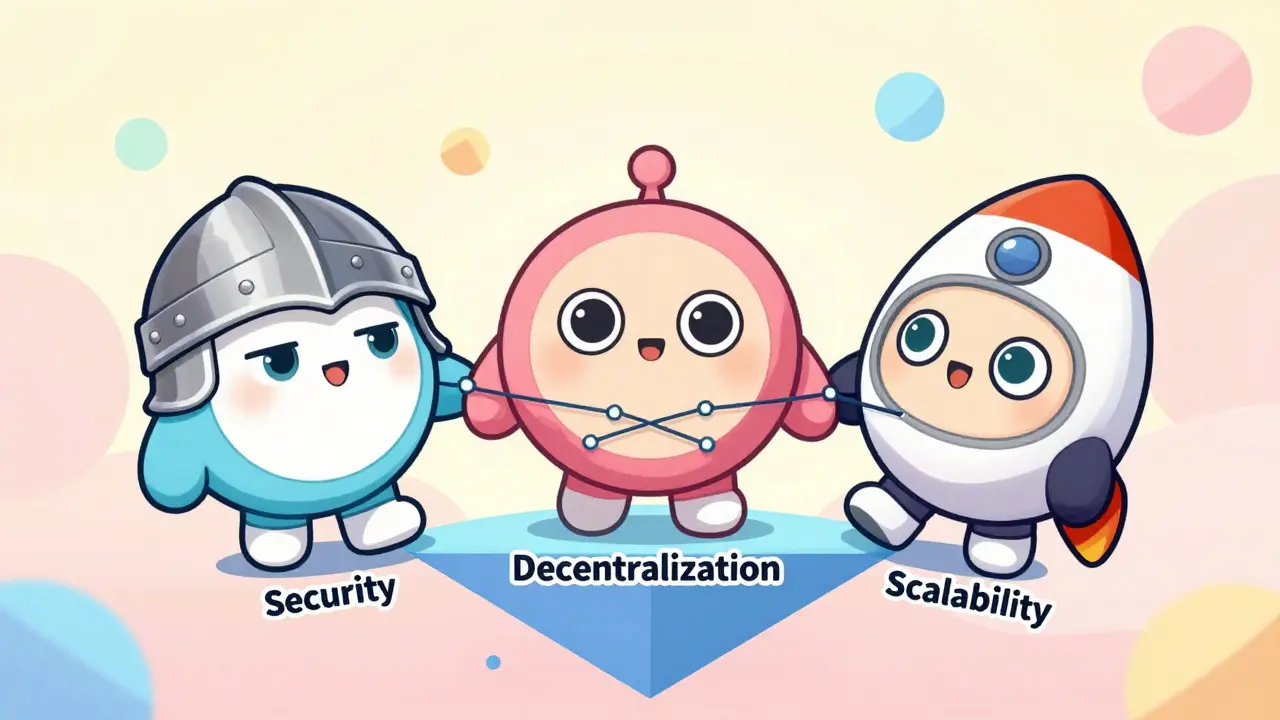
You can't just "turn up the speed" on a blockchain. This is because of the Blockchain Trilemma, a concept that suggests a network can only prioritize two of three core properties: security, decentralization, and scalability. If you want a network to be incredibly fast (scalable) and secure, you usually have to centralize it by limiting the number of validators. If you keep it decentralized and secure, the network slows down because every single node has to agree on every transaction.
For example, Ripple manages to hit 1,500 transactions per second (TPS), but it does so by using a centralized list of validator nodes. Most cryptocurrency projects spend their time trying to "cheat" this trilemma using a multi-layered approach, where the main chain handles security while other layers handle the heavy lifting.
Layer 1 Solutions: Fixing the Foundation
Layer 1 (L1) solutions are changes made directly to the blockchain's core protocol. Think of this as widening the road itself. These changes usually require a "hard fork," meaning the majority of the network must agree to update their software.
Proof-of-Stake (PoS) is one of the most impactful L1 shifts. When Ethereum transitioned to PoS in September 2022, it didn't just slash energy use by 99.95%; it set the stage for faster block times. Instead of waiting 10-15 minutes for a block, the network moved to a fixed 12-second window. Another heavy hitter is Sharding, which splits the entire network into smaller pieces called "shards." Instead of every node processing every transaction, shards process transactions in parallel, potentially moving the network from a handful of TPS to thousands.
We also see things like Segregated Witness (SegWit). Implemented on Bitcoin in 2017, SegWit essentially stripped out the bulky signature data from the main transaction. Since signatures make up about 65-70% of the space in a block, removing them allowed more transactions to fit into the same 1MB limit without actually changing the limit itself.
Layer 2 Solutions: Building Express Lanes
If Layer 1 is the foundation, Layer 2 (L2) is the skyscraper built on top of it. These solutions process transactions off-chain and then settle the final result on the main blockchain. This keeps the main chain from getting clogged.
- Payment Channels: The Lightning Network is the gold standard here for Bitcoin. It allows two people to open a private tab, trade back and forth a thousand times, and only tell the main blockchain the final balance once they close the channel. It's great for buying coffee, but it struggles with very large transfers (over $1,000) due to routing failures.
- Rollups: These are currently the most popular for Ethereum. They "roll up" hundreds of transactions into a single batch. Optimistic Rollups (like Optimism) assume transactions are valid and only check them if someone challenges the data. Zero-Knowledge Rollups (like zkSync) use complex math to prove a transaction is valid instantly, without revealing the data.
- Sidechains: Polygon operates as a sidechain that processes transactions independently and periodically reports back to Ethereum. This is why 87% of top NFT marketplaces use it-it's incredibly cheap, often costing just $0.02 per transaction compared to the high fees of the Ethereum mainnet.

Comparing the Trade-offs of Scaling Models
Choosing a scaling solution isn't about finding the "best" one; it's about picking the right tool for the job. For instance, if you are building a high-frequency trading bot, you need sub-second finality. Avalanche is a beast in this regard, processing 4,500 TPS with almost instant confirmation. However, that speed requires a different wallet configuration and a different technical mental model than using Ethereum.
On the flip side, if you're moving millions of dollars in a DeFi protocol, you probably don't care if the transaction takes 15 seconds-you care that it's immutable and secure. This is why 63% of DeFi Total Value Locked (TVL) still stays on the Ethereum mainnet. The risk of a Layer 2 solution having a security flaw or a long "challenge period" (sometimes 7-14 days in early Plasma models) is too high for institutional money.
The Future: A Hybrid Multi-Layer World
We are moving toward a world where no single chain does everything. Vitalik Buterin has argued that the future is a multi-layered stack: Ethereum acts as the secure "settlement layer," while various Rollups act as "execution environments" for different apps. It's like having a secure vault (L1) and a fast-paced retail store (L2) attached to it.
New updates are already pushing this forward. The Dencun upgrade for Ethereum, featuring proto-danksharding, is designed to drop Rollup fees by 10 to 100 times. Meanwhile, Polkadot uses a "parachain" model, where specialized blockchains plug into a central relay chain. This allows a gaming chain and a financial chain to coexist and talk to each other without fighting for the same bandwidth.
What is the main difference between Layer 1 and Layer 2?
Layer 1 is the base protocol of the blockchain. Improving it requires changing the core code and getting network-wide consensus (like a hard fork). Layer 2 is a separate layer built on top of that base, processing transactions externally and only sending the final data back to the main chain to reduce congestion.
Are Zero-Knowledge Rollups better than Optimistic Rollups?
It depends on your needs. ZK-Rollups offer near-instant finality and higher security through mathematical proofs. However, they are computationally heavy and complex to build. Optimistic Rollups are easier to deploy and more compatible with existing Ethereum tools, but they have a 7-day window where transactions can be challenged before they are finalized.
Why does the Blockchain Trilemma matter for users?
It matters because it defines the user experience. If a platform claims to be incredibly fast, fully decentralized, and perfectly secure, it's likely lying or hiding a trade-off. Users usually have to choose between paying high fees for maximum security (Mainnet) or paying tiny fees for higher speed with slightly different security assumptions (L2s like Polygon).
Can Bitcoin actually scale with the Lightning Network?
Yes, for small-to-medium payments. By moving transactions off the main chain, the Lightning Network allows Bitcoin to function like a real payment system. However, it requires users to manage "channels" and liquidity, which is more complex than a simple wallet transfer. It's a solution for payments, not necessarily for the large-scale settlement of billions of dollars.
What is Sharding in simple terms?
Imagine a giant grocery store with 100 customers all waiting in one single line for one cashier. Sharding is like opening 64 different checkout lanes. Instead of one person processing everything, the work is split up among many "shards," allowing the store to handle way more customers at the same time.


Kathleen Bergin
April 20, 2026 AT 13:47Everyone knows L2s are just a band-aid for a broken base layer. It is pretty obvious that if the main chain cannot handle the load, the whole thing is just a house of cards
Tony Gurley-Ward
April 21, 2026 AT 21:59The whole trilemma is basically a digital existential crisis. We are chasing this phantom of perfect efficiency while ignoring the sheer poetic chaos of a slow network. Maybe the lag is where the real value lives, a sort of temporal tax on our impatience
Matthew Morse
April 23, 2026 AT 13:52too many words for a basic concept
Jagdish Sutar
April 24, 2026 AT 11:52It's really fascinating to see how these technologies are being adopted globally. In India, we are seeing a huge surge in L2 interest because the low fees make micro-transactions actually viable for the average person
Jennifer Taylor
April 25, 2026 AT 20:34The aether is being manipulated. These so-called rollups are just ways for the elites to hide the real transactions from the public eye until they decide to settle them. It is all a game of control
Mike Krasner
April 26, 2026 AT 15:44imagine thinking ZK rollups are actually secure lol just another way to lose your keys in a math equation that nobody understands
Hannah Rubia
April 28, 2026 AT 11:27While the technical aspects are impressive, one must consider the governance implications of hard forks. The social coordination required to implement a Layer 1 change is often far more complex than the code itself
Ali Tate
April 28, 2026 AT 13:13this whole debate is just peasant talk anyway. the real whales are just lounging in the ether while the rest of you squabble over a few cents in gas fees. it is absolutely hilarious how people think a sidechain is a revolutionary breakthrough when it is basically just a glorified database
Clair Geary
April 29, 2026 AT 03:19the lightning network is such a clever way to handle the coffee shop problem but the liquidity part is still such a head scratcher for newcomers’ maybe some better UX tools could bridge that gap
Gloris Young
April 30, 2026 AT 23:14Just keep learning. It's a wild ride!
Caiaphas Konkol
May 1, 2026 AT 09:05The institutional push toward Ethereum's mainnet despite the fees reveals the inherent distrust of the Layer 2 security models. Only a fool trusts a settlement that relies on a 'challenge period' when the stakes are in the millions
Candace Sherrard
May 2, 2026 AT 06:31I find myself wondering if the very concept of scaling is a distraction from the original ethos of blockchain, because when we prioritize speed over everything else, we are essentially recreating the centralized systems we sought to escape in the first place, which leads me to believe that the friction of a slow network is actually a necessary feature of a truly decentralized world where trust is earned through verifiable delay rather than promised by a high-speed corporate validator
Alex Wan
May 2, 2026 AT 14:11I am absolutly thrilled to see such a comprehensive breakdn of these concepts! It is truly a marvel how the community collaborates to solve these laaaaag issues
The synergy between L1 and L2 is simply magnifiscent
Mary Tawfall
May 3, 2026 AT 13:01It is so exciting to see how far we have come since those $55 fees! The future looks so bright for accessibility
Tara Aman
May 3, 2026 AT 14:52I totally agree with the points about Polygon! It has made getting into NFTs so much more accessible for everyone
Jennifer L
May 5, 2026 AT 10:31Oh my goodness, the stress of those high fees must have been absolutly TERRIBLE for people back then!!
I feel so bad for the users who just wanted to send a tiny bit of money and were hit with a fifty dollar fee, that is just heartbreakingly unfair
praveen subbiah
May 5, 2026 AT 17:19Our developers in India are leading the charge in these L2 innovations! It is a glorious time for our tech scene to show the world how it's done with such passion and brilliance
Sarah Ingrams
May 7, 2026 AT 11:36it's a lot to take in but it makes sense
Alex Hunter
May 8, 2026 AT 08:13For those just starting out, remember that the trade-offs are always there. You don't need to master the math of ZK-rollups to use them, but understanding that you're trading a bit of decentralization for a lot of speed is key. Keep experimenting with different wallets and you'll find the balance that works for your specific needs