
Jan 24, 2026
Hash Rate and Mining Profitability: How Much You Really Earn in 2026

When you hear someone say their Bitcoin miner is making $40 a day, they’re not telling you the whole story. That $40 might vanish overnight if electricity prices spike, the network difficulty jumps, or your machine overheats and dies. Mining isn’t a passive income stream-it’s a high-stakes operation where hash rate and mining profitability are locked in a constant tug-of-war. And in 2026, the rules have changed again.

What Hash Rate Actually Means for Your Wallet

Hash rate isn’t just a number on a chart. It’s the total computing power of the entire Bitcoin network, measured in exahashes per second (EH/s). As of October 2024, that number hit 690 EH/s. That’s 690 quintillion calculations per second trying to solve the same puzzle. The higher the hash rate, the harder it gets for any single miner to win the next block reward.

Your personal hash rate-say, 860 TH/s from an AntMiner S21e XP Hyd-is just a tiny fraction of that. But here’s the catch: your chance of finding a block is directly proportional to your share of the total network hash rate. If you control 0.0001% of the network’s power, you’ll theoretically find one block every 1,000 days. That’s why miners join pools: to combine hash power and split rewards more frequently.

The problem? As more miners join, the network automatically adjusts the difficulty every 2,016 blocks (roughly every two weeks). After the April 2024 Bitcoin halving, the hash rate dropped 19.3% overnight-but within six weeks, it climbed back past pre-halving levels. Why? Because profitable miners kept buying hardware. Unprofitable ones got crushed.

Why the 2024 Halving Changed Everything

On April 20, 2024, Bitcoin’s block reward dropped from 6.25 BTC to 3.125 BTC. That meant every miner’s income instantly halved. Sounds simple, right? But the real impact wasn’t immediate. It was delayed-by how long miners could survive without turning a profit.

Miners with cheap power (under $0.06/kWh) kept running. Those paying $0.12/kWh or more? Many shut down. According to JPMorgan’s September 2024 report, 32% of marginal miners went offline. That’s not a small number-it’s tens of thousands of machines. The network adjusted difficulty downward, then quickly rebounded as efficient miners expanded.

Today, profitability isn’t about having the latest rig-it’s about having the cheapest electricity. A miner in Texas paying $0.05/kWh can outlast one in Germany paying $0.30/kWh, even if the German machine is newer. The hardware race is secondary to the energy race.

ASIC vs GPU: The Real Profit Divide

You might think a high-end GPU like the NVIDIA RTX 4090 is a good entry point. It’s not. For Bitcoin mining, it’s a money pit.

An RTX 4090 produces about 0.000006 BTC per day-roughly $0.50. Meanwhile, a single AntMiner S21e XP Hyd, costing $5,999, earns $39.11 daily at current rates. That’s 78 times more profit per machine. And the S21e uses 11,180 watts. The 4090 uses 450. So why does the GPU lose? Efficiency.

Modern ASICs now hit 12.9 joules per terahash (J/TH). That’s a 99.9% improvement since 2013, when miners were burning 10,000 J/TH. GPUs can’t compete at SHA-256. They’re built for graphics, not brute-force hashing. Even if you could get free electricity, the GPU would still lose on ROI.

The only real alternatives are coins using different algorithms. Ethereum Classic (Ethash) and Ravencoin (KawPow) still run on GPUs. But even there, profitability shifts fast. In May 2024, miners switched from Ravencoin to Dynexcoin after KawPow’s profitability dropped 22.2% post-halving. One day’s profit can vanish in a week.
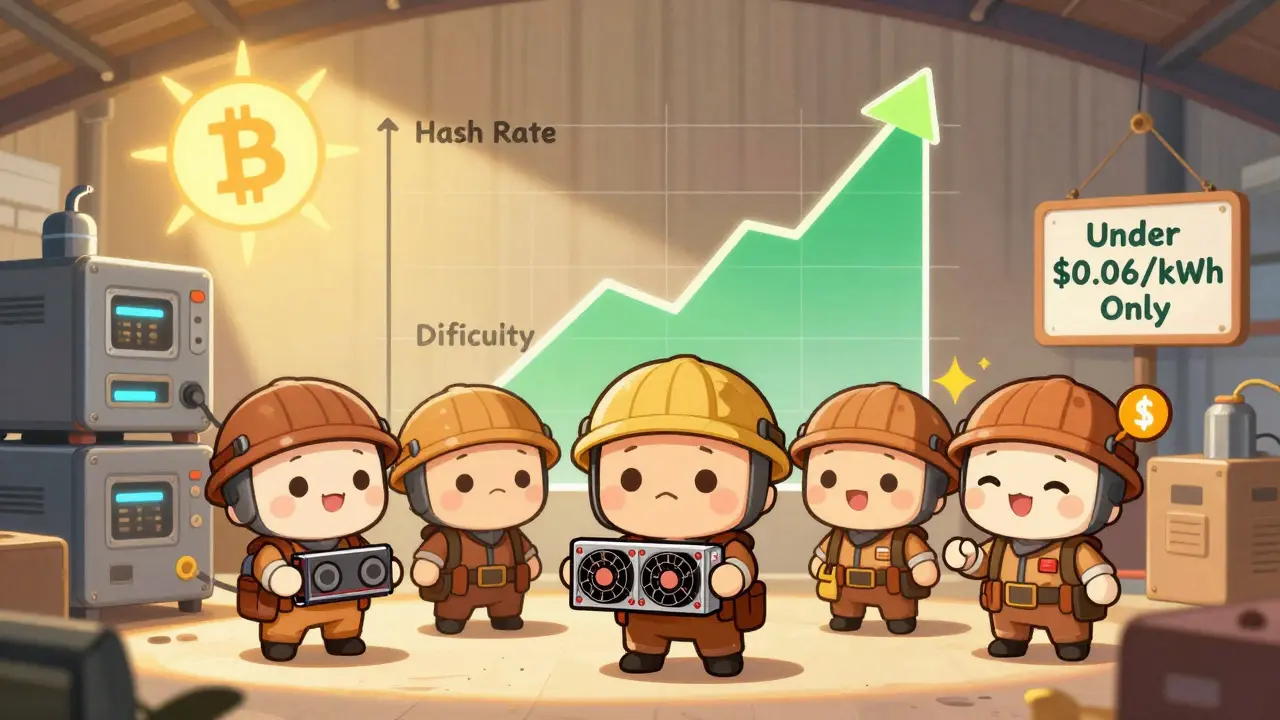
Chibi miners comparing GPU and ASIC mining with profit graph and energy cost sign

The Hidden Costs No One Talks About

You see the price tag on an ASIC miner: $6,000. That’s just the start.

Cooling? You need industrial-grade ventilation. For every $1 spent on the miner, you’ll spend $2.50 on cooling and airflow. Noise? AntMiners run at 75-85 decibels-like a vacuum cleaner in your bedroom. You can’t run them in your apartment. You need a warehouse, a shed, or a dedicated room with soundproofing.

Electricity? If you’re paying $0.10/kWh, your monthly bill for one S21e is $335. That’s $4,020 a year. Your miner earns $14,275 annually at $39.11/day. Sounds good? Until you factor in depreciation.

ASICs lose value fast. The AntMiner S21e XP Hyd was top-tier in 2024. By 2026, it’s already outdated. Newer models like Bitmain’s S21 Hydro hit 8.2 J/TH-30% more efficient. Your 2024 rig becomes a paperweight. Most miners break even in 12-18 months. After that, profit is pure gain.

And repairs? A failed power supply or control board can cost $287 per unit, according to a 2024 Mining Business Review survey. Warranty? Bitmain offers 180 days. Response time? Average 72 hours. If your miner dies in winter and you’re in a cold region? You’re out of luck for weeks.

Who’s Still Making Money in 2026?

The winners aren’t hobbyists. They’re institutions and energy specialists.

Foundry USA, AntPool, and F2Pool control nearly 62% of Bitcoin’s hash rate. Marathon Digital and Riot Platforms, public companies, own over 13 EH/s combined. They have legal teams, bulk power contracts, and data centers in places like Texas, Georgia, and Kazakhstan.

But the real edge? Stranded energy. Miners using flared natural gas from oil fields, or excess hydroelectric power from remote dams, pay as little as $0.03/kWh. Nic Carter of Castle Island Ventures found these operations now control 18.7% of Bitcoin’s hash rate-and they’re 11.3% cheaper to run than grid-powered miners.

Even in the EU, where a 20% energy tax on proof-of-work mining started in January 2025, miners are adapting. Some relocated to Portugal or Poland. Others shifted to renewable microgrids. Profitability isn’t dead-it’s just moving to where energy is cheap and regulation is light.
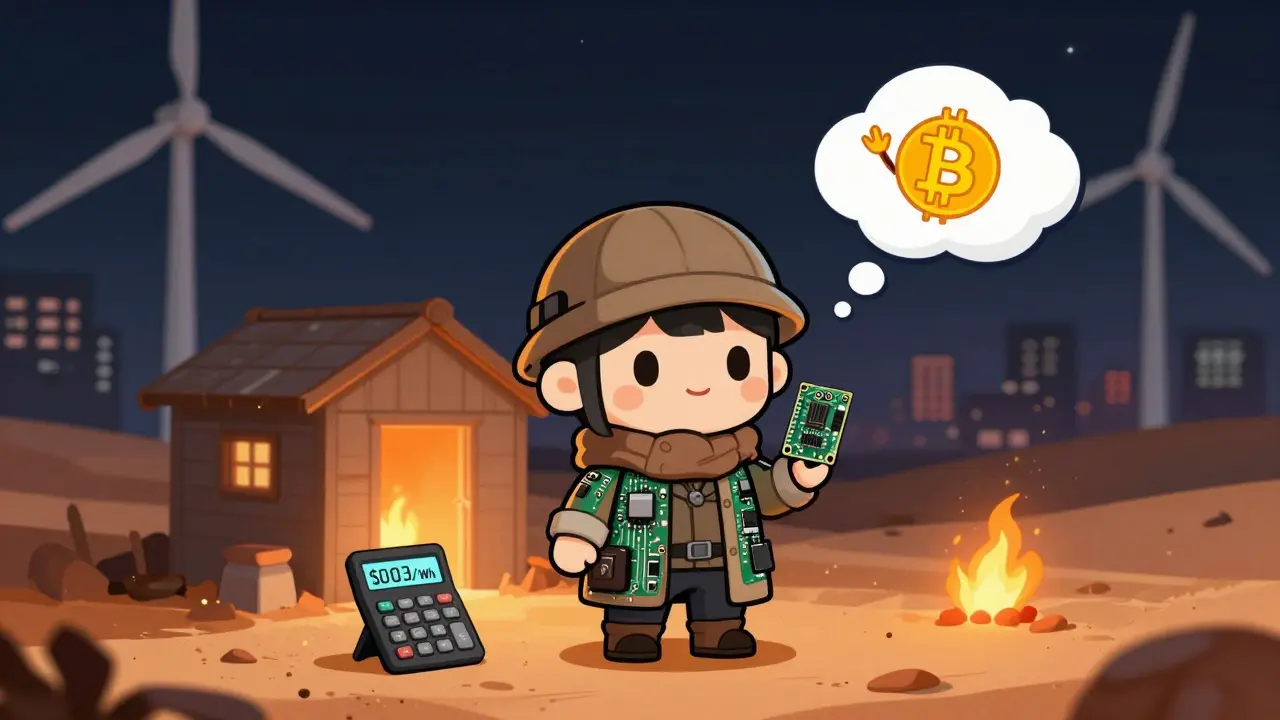


Chibi miner in desert shed powered by flared gas and wind turbines, smiling at low electricity cost

Can You Still Profit as a Solo Miner?

Yes-but only if you’re realistic.

If you’re paying more than $0.08/kWh, don’t bother with Bitcoin. Try a smaller coin with lower difficulty, like Dogecoin or Vertcoin. Use WhatToMine to compare algorithms. But even then, expect volatility. A 10% drop in coin price can flip your profit to loss in days.

Your best shot? Start small. Buy one used AntMiner S19 Pro for under $2,000. Run it in a garage with a dedicated 240V line. Use a power meter to track real consumption. Don’t trust manufacturer specs-Reddit users report 8-10% higher power draw than advertised.

Track your ROI daily. Use Jason Blevins’ calculator or ASIC Miner Value. But remember: their projections have a 5-7% error rate. If the tool says you’ll break even in 14 months, assume 18. Always plan for worst-case scenarios.

And never invest more than you can afford to lose. Mining isn’t investing. It’s running a factory. You’re not buying Bitcoin-you’re buying a machine that might not last two years.

What’s Next for Mining in 2026 and Beyond

By 2026, 68% of current mining operations will be unprofitable without efficiency upgrades, according to JPMorgan. That’s not a prediction-it’s a mathematical certainty. The network difficulty keeps rising. Block rewards keep halving. And new ASICs keep getting faster and cheaper to run.

The future belongs to those who use renewable energy. By 2027, Nic Carter predicts 45% of Bitcoin mining will run on stranded or wasted energy-flared gas, excess wind, or hydro surplus. These operations don’t just survive-they thrive.

Transaction fees will eventually replace block rewards. By 2140, Bitcoin’s supply cap will be reached. Miners will rely on fees alone. That’s why companies like Bitmain and Canaan are already building chips optimized for fee-heavy blocks, not just new coin issuance.

The era of the backyard miner is over. But if you’re smart, well-informed, and have access to cheap power, you can still make money. Just don’t believe the hype. Mining isn’t a get-rich-quick scheme. It’s a high-risk, high-effort business. And in 2026, only the disciplined survive.

12 Comments

  • Image placeholder

    Athena Mantle

    January 24, 2026 AT 07:18
    lol at people still thinking they can mine BTC in their garage 😂 my buddy tried it with a 4090 and his electric bill spiked to $800/month... he now sells crypto merch on Etsy. still better than mining 💸
  • Image placeholder

    Andy Simms

    January 24, 2026 AT 17:04
    The real issue no one talks about is that most ASICs are built in China and shipped with firmware that throttles performance after 6 months. I’ve seen S21s drop 22% hashrate after 180 days. Manufacturers know this. They count on you buying the next model. Don’t trust the specs. Test it yourself with NiceHash for 72 hours before you commit.
  • Image placeholder

    katie gibson

    January 26, 2026 AT 09:57
    I swear if one more person says 'just use cheap power' I'm gonna scream. My cousin in Texas has a 100k sq ft warehouse, 300 S21s, and still got fined $12k last year for noise violations. The city told him to turn them off before 8am. So he runs them at night... and now his neighbors think he's running a meth lab. 🤡
  • Image placeholder

    Kevin Pivko

    January 27, 2026 AT 18:25
    You think GPUs are bad? Try mining Ethereum Classic on a 3080 in 2025. The algorithm changed. Profit dropped 60% overnight. Now you’re stuck with a $1200 paperweight that only heats your apartment. Mining isn’t investing-it’s gambling with electricity. And the house always wins.
  • Image placeholder

    Nadia Silva

    January 27, 2026 AT 19:43
    Canada has the best conditions for mining. Hydro power is cheap, winters naturally cool the rigs, and the government doesn’t treat miners like criminals. If you’re serious, move here. Don’t waste your time in the US where every city wants to ban you for 'energy waste'. We’re not all Texas oil bros.
  • Image placeholder

    Roshmi Chatterjee

    January 28, 2026 AT 12:40
    I started with one S19 Pro in my garage last year. Made $1800 in 8 months. Then my power company raised rates by 22%. Now I’m barely breaking even. But I learned so much about electricity, cooling, and network difficulty. I’m not quitting-I’m upgrading to a solar setup. If you’re patient, this can work. Just don’t expect magic.
  • Image placeholder

    Andy Marsland

    January 28, 2026 AT 16:58
    The whole premise of this article is flawed. You’re assuming that hash rate and profitability are linear. They’re not. The market is a feedback loop. When difficulty spikes, miners sell their rigs. That drives down the price of ASICs. Then new entrants buy them used at 40% off. Then difficulty drops. Then the cycle repeats. The real winners aren’t the ones with the newest machines-they’re the ones who buy the old ones when everyone else is panicking. This isn’t mining-it’s contrarian arbitrage.
  • Image placeholder

    Sara Delgado Rivero

    January 30, 2026 AT 16:50
    I can't believe people still fall for this. Mining is a scam designed to sell ASICs. The only ones making money are the companies selling the hardware. The rest of us are just paying for the privilege of losing money slowly. And don't even get me started on the environmental damage
  • Image placeholder

    tim ang

    January 31, 2026 AT 03:13
    yo i just bought a used s19j pro for $1500 off facebook marketplace. ran it for 3 weeks. made $900. then the psu died. spent $280 to replace it. now im up $620. not bad for a weekend project. dont listen to the haters. just get a used one, monitor your watts, and dont be lazy. also get a good fan. i use a $40 industrial one and it cut my noise in half
  • Image placeholder

    Jeffrey Dufoe

    February 1, 2026 AT 20:00
    I used to think mining was cool until I saw my first ASIC meltdown. Smelled like burning plastic and regret. Now I just buy BTC on Coinbase. Less stress. Same end result. Sometimes the best investment is not doing the thing everyone says you should do.
  • Image placeholder

    Tselane Sebatane

    February 2, 2026 AT 21:16
    I live in Cape Town and I’ve been mining since 2021. We have load-shedding here-power cuts every day. But I turned it into an advantage. I run my rigs on solar during the day, and when the grid comes back, I use the cheap off-peak rates. My setup runs 90% of the time. I don’t care about the hype. I care about my ROI. If you’re smart, you can make this work anywhere-even in a developing country. Just adapt. Don’t complain.
  • Image placeholder

    Jonny Lindva

    February 3, 2026 AT 21:21
    I’m not a miner but I work with a few who are. They all say the same thing: don’t start with Bitcoin. Start with a coin that still mines on GPU-like Ergo or Flax. Learn the tools, track your power use, get comfortable with the tech. Then move to ASIC. It’s like learning to drive before you buy a Tesla. Most people skip the basics and crash on day one.

Write a comment