

Right now, over 6.65 million Bitcoin are sitting ducks. Not because someone stole them, but because their public keys are out in the open - and in the next few years, a quantum computer could crack them in minutes. That’s not science fiction. It’s the math we’re facing by 2030. Bitcoin wasn’t built for this. Its signature system, ECDSA, was designed for classical computers. Quantum computers? They laugh at it. The question isn’t if Bitcoin needs to change - it’s how, and who will make it happen.
Why ECDSA Is the Weak Link
Bitcoin uses elliptic curve cryptography to prove you own your coins. When you sign a transaction, you’re not sending your private key. You’re proving you have it, using a mathematical trick called ECDSA. It’s fast, small, and secure - against normal computers. But quantum computers? They use Shor’s algorithm to reverse-engineer public keys and steal private keys in hours, maybe minutes. Once that happens, anyone with access to a public key - which every Bitcoin transaction broadcasts - can drain the wallet. That’s not theoretical. It’s already possible in labs. And by 2030, it’ll be real on the blockchain.The NIST Standard That Changed Everything
In August 2024, NIST - the U.S. agency that sets cryptographic standards - picked its first post-quantum algorithms. The big one for Bitcoin? ML-DSA (formerly Dilithium). It’s a lattice-based signature scheme. Think of it like a lock that even a quantum computer can’t pick. ML-DSA is now FIPS 204 certified. It’s not just a proposal. It’s the official replacement. And in October 2025, BTQ Technologies showed the world it works on Bitcoin. They replaced every ECDSA signature with ML-DSA. Wallets still create keys. Transactions still get signed. Miners still verify. But now, it’s quantum-proof.The Catch: Size, Speed, and Storage
There’s no free lunch. ML-DSA signatures are 2 to 4 kilobytes each. ECDSA? About 64 bytes. That’s a 1,024x increase in size. What does that mean? Bitcoin blocks are 4 MB now. To fit the same number of transactions, you’d need 64 MB blocks. That’s not a tweak. That’s a full hard fork. And it’s not just block size. Full nodes now need 8 TB of storage instead of 500 GB. RAM? 32 GB instead of 8 GB. Signing a transaction on a phone? Went from 0.8 seconds to over 5 seconds. Syncing a node? From 2 minutes to 22. The system isn’t broken - it’s just bloated. And that’s the biggest hurdle.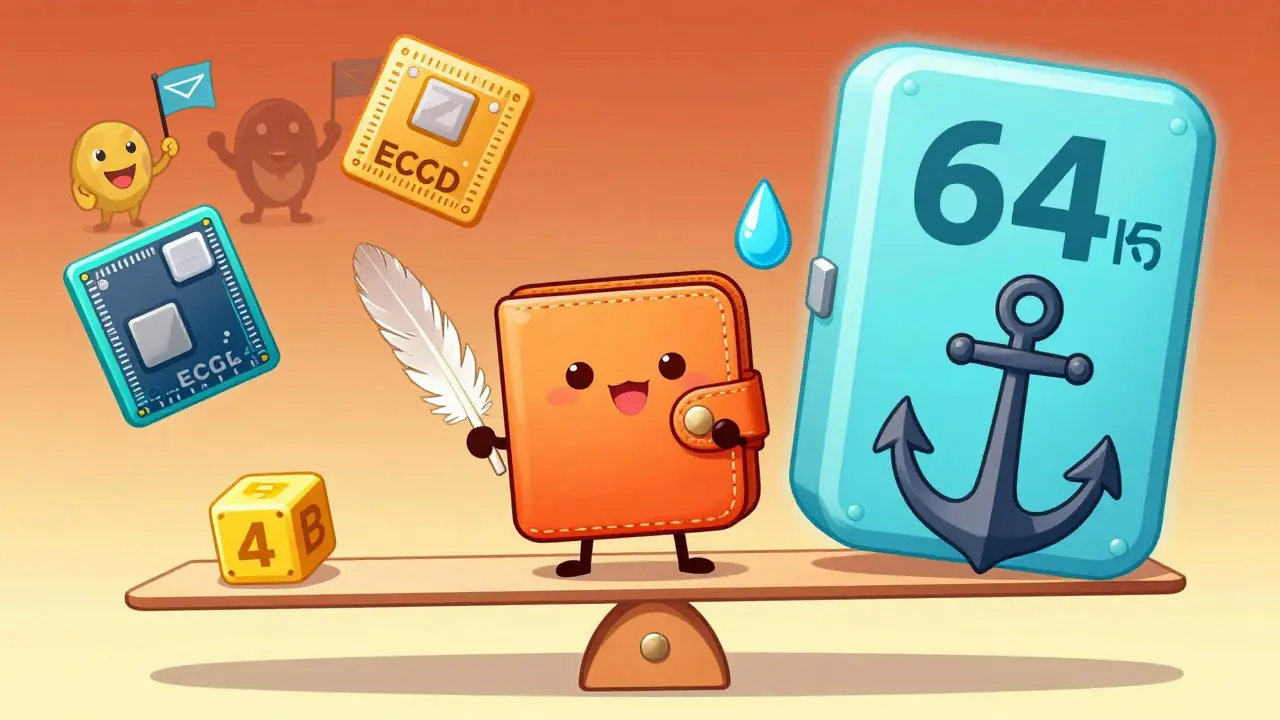
Three Ways to Fix It - And Why One Might Win
There are three real paths forward, each with trade-offs:- Direct Replacement (BTQ’s Model): Everyone upgrades at once. ECDSA dies. ML-DSA takes over. Secure? Yes. But it requires 95% miner support and every wallet, exchange, and node to update on the same day. Miss one, and you’re vulnerable. It’s clean, but risky.
- Hybrid Signatures (Cardano’s Approach): Keep ECDSA, add ML-DSA. Now every transaction has two signatures. More secure during transition? Yes. But you double the data. That means 128 MB blocks. Slower network. More cost. It’s a band-aid, not a cure.
- Address Migration (QRAMP Protocol): Don’t change the chain. Just move your coins to new quantum-safe addresses. Your old address stays open, but you stop using it. Users have to act. No fork needed. But history shows people won’t. Only 30-60% moved to SegWit. Will they move to quantum addresses? Maybe. But if half don’t, you still have billions at risk.
BTQ’s direct replacement is the only one that fully solves the problem. But it’s also the most disruptive. That’s why Bitcoin’s slow governance is the real bottleneck.
Who’s Ready? Who’s Not?
Institutional players are moving fast. Coinbase, Binance, Fidelity - all announced quantum-resistant wallet projects in November 2025. Mining pools? Only 68% support the BTQ fork. That’s not enough. You need 95%. Exchanges can upgrade. Wallets can update. But miners? They’re the gatekeepers. And they’re split. Meanwhile, Ethereum already has EIP-7212 in testnet. Solana deployed quantum signatures in September 2025. Bitcoin? Still waiting for a BIP. The Bitcoin Core team formed a Quantum Readiness Working Group in November 2025. Their first draft is due January 31, 2026. That’s progress - but it’s slow. And in crypto, slow can mean lost billions.
The Real Timeline: 2026 to 2030
Here’s what’s likely to happen:- Q4 2025: BTQ’s mainnet-ready version drops. It works. It’s stable. But it’s not on Bitcoin yet.
- Q1-Q3 2026: Institutional pilots. Exchanges start offering quantum-safe addresses. Wallets add migration tools. Full node operators upgrade hardware.
- Q4 2026: First testnet fork. Miners start signaling support. If 95% back it, the mainnet fork is scheduled.
- 2027: Hard fork goes live. Bitcoin is now quantum-resistant. Old wallets stop working. Users who didn’t migrate lose access.
- 2028-2030: Quantum computers hit 1,000+ logical qubits. If Bitcoin didn’t move by now, the thefts begin.
That’s the plan. But it’s not guaranteed. The biggest risk isn’t tech. It’s coordination. Bitcoin doesn’t have a CEO. It has thousands of nodes, miners, developers, and users - all with different incentives. If even 5% of miners refuse to upgrade, the chain splits. Two Bitcoins. One safe. One vulnerable. Chaos.
What You Need to Do Now
You don’t need to be a developer. But if you hold Bitcoin, here’s what you should do:- Don’t reuse addresses. Every time you receive Bitcoin, use a new one. That’s your best defense right now. It’s not perfect, but it delays the attack.
- Watch for wallet updates. When your wallet (like Electrum, BlueWallet, or Ledger) announces quantum-safe support, update immediately. Don’t wait.
- Move large holdings early. If you have more than $10,000 in Bitcoin, consider moving it to a new address as soon as migration tools go live. Don’t wait for a panic.
- Don’t trust “quantum-proof” scams. There are already fake wallets claiming to be quantum-safe. Only use official software from trusted developers.
What Happens If Nothing Changes?
If Bitcoin doesn’t upgrade, the math is clear: by 2030, quantum computers will be able to break ECDSA in under 30 minutes. That means anyone with access to a public key - which every transaction broadcasts - can steal those coins. The $745 billion in exposed Bitcoin? Gone. The $2.4 trillion market? Shattered. Trust in Bitcoin? Destroyed. The blockchain isn’t just a ledger. It’s a promise. And if that promise breaks, people walk away.It’s not about being paranoid. It’s about being prepared. The tools exist. The standards are set. The testnet works. The only thing missing is the will to change. And in Bitcoin, that’s the hardest part of all.
Can Bitcoin survive a quantum attack without a hard fork?
No. Bitcoin’s current ECDSA signature system is fundamentally broken against quantum computers. You can’t patch it. You can’t layer on a fix. You have to replace the entire signature mechanism. That requires a hard fork - a fundamental change to the protocol that all nodes must agree to. Without it, quantum computers will be able to steal Bitcoin from any address with a public key that’s been used in a transaction.
Is my Bitcoin safe if I don’t reuse addresses?
Yes - for now. If you never reuse a Bitcoin address, your private key stays hidden until you spend. Quantum computers can’t steal coins from an unused address. But once you spend from it, the public key is revealed, and your coins become vulnerable. That’s why moving funds to new quantum-safe addresses before the fork is critical. Don’t wait until the attack is possible.
Will my hardware wallet support quantum-resistant Bitcoin?
Maybe - but not automatically. Most hardware wallets (Ledger, Trezor) don’t yet support ML-DSA. Even if they do, they’ll need firmware updates. And because quantum signatures are much larger, some older devices may not have enough memory or processing power to handle them. Check with your wallet maker for official updates. Don’t assume compatibility.
How long will it take to upgrade my Bitcoin wallet?
If you’re using a standard wallet like Electrum or BlueWallet, the upgrade will likely be automatic once the fork happens. You’ll just need to update the app. But if you’re running a full node, you’ll need to download new software, upgrade your hardware (16 TB storage, 32 GB RAM), and resync the chain - which could take days or weeks. Plan ahead. Don’t wait until the last minute.
Why hasn’t Bitcoin Core implemented quantum resistance yet?
Bitcoin Core moves slowly by design. It prioritizes stability and consensus over speed. The Quantum Readiness Working Group only formed in November 2025. They’re still drafting a BIP. Even when it’s ready, getting 95% of miners to agree to a hard fork takes months - sometimes years. The technology is ready. The governance isn’t. That’s the real delay.
What’s the difference between ML-DSA and Kyber?
ML-DSA is for digital signatures - the thing Bitcoin uses to prove you own your coins. Kyber is for key encapsulation - used to securely exchange encryption keys. Bitcoin doesn’t need Kyber. It needs ML-DSA. Kyber might be used in future Bitcoin upgrades for encrypted communication between nodes, but for now, only ML-DSA matters for securing transactions.
Can I mine Bitcoin with a quantum computer?
No. Bitcoin mining uses SHA-256, which is resistant to quantum attacks. Grover’s algorithm can speed up brute-force searches, but it only gives a quadratic speedup - meaning you’d need a quantum computer with millions of qubits to meaningfully outpace ASIC miners. That’s decades away. The real threat isn’t mining. It’s stealing coins from public keys.




Janet Combs
December 19, 2025 AT 00:21so like... if my bitcoin is on an old address and i never spend it, im fine? but the second i try to use it, quantum bots just steal it? bruh. i thought crypto was supposed to be 'trustless' not 'trust-quantum-computers-not-to-steal-your-shit'.
Sheila Ayu
December 19, 2025 AT 03:23Wait-so you’re telling me the entire Bitcoin network is just… waiting for someone to flip a switch? And if they don’t? Everyone loses everything? I mean, I get it’s decentralized-but this isn’t democracy, it’s a time bomb with a 5% veto rule. Who’s in charge here? The miners? The devs? My cat?
Charles Freitas
December 19, 2025 AT 14:01Of course Bitcoin won’t upgrade. The same people who said ‘SegWit was unnecessary’ are now saying ‘quantum resistance is overkill’. They don’t want to fix anything-they just want to pretend the problem isn’t real. And now we’re all just sitting here like lambs waiting for the quantum butcher. Classic Bitcoin logic: wait until it’s too late, then blame the users.
vaibhav pushilkar
December 19, 2025 AT 14:46Use new addresses. Always. That’s your free shield right now. No upgrade needed. Just behavior change.
Ellen Sales
December 21, 2025 AT 07:40so like… ML-DSA is basically the crypto equivalent of switching from a paper lock to a titanium vault with a biometric scan? cool. but now my phone can’t sign txns? and my grandma’s ledger won’t work? so we’re trading security for usability? and calling it progress? 🤡
Jake Mepham
December 21, 2025 AT 13:14Let’s be real-this isn’t about tech. It’s about incentives. Miners get paid in fees. Bigger blocks = more fees. But they also need more hardware. So why would they upgrade unless forced? Exchanges will move first because they’re scared of lawsuits. Wallets will follow. But miners? They’ll wait until the first big theft hits. Then they’ll panic. And by then, it’s too late.
Sarah Glaser
December 22, 2025 AT 12:19The elegance of Bitcoin lies in its simplicity. To replace ECDSA with ML-DSA is to sacrifice that elegance for security. But is security worth the cost of bloated transactions, slower syncs, and inaccessible hardware? The answer depends on whether you believe Bitcoin is money-or a digital artifact.
Vyas Koduvayur
December 23, 2025 AT 02:54Look, the real issue here is that Bitcoin’s governance model is a glorified committee meeting where everyone has a mic but no one has a timer. You’ve got 68% of miners saying ‘maybe’, 15% saying ‘no’, and 17% saying ‘what’s quantum?’ Meanwhile, Ethereum already deployed their fix and is moving on. Bitcoin’s waiting for a consensus that doesn’t exist. This isn’t innovation-it’s institutional paralysis. And the victims? The people who held BTC because they trusted it to be immutable. Now it’s just… fragile.
roxanne nott
December 23, 2025 AT 07:04ML-DSA is 2-4kb? ECDSA is 64 bytes? That’s not a 1000x increase-it’s 64x. You’re bad at math. Also, storage isn’t 8TB-it’s 1.5TB with pruning. Stop fearmongering.
Dan Dellechiaie
December 23, 2025 AT 07:40Bro, you’re treating this like a software update. It’s not. This is a protocol-level earthquake. ML-DSA isn’t just bigger-it changes the entire transaction structure. You can’t ‘update’ a wallet. You need a new chain. And if even one miner refuses? You get Bitcoin and Bitcoin-Q. One’s secure. One’s a ghost town. And guess who gets blamed? The users. Again.
Sybille Wernheim
December 23, 2025 AT 20:50Just move your coins to a new address when the tools drop. Don’t wait. Don’t overthink it. Do it like you did with SegWit. Seriously. It’s not hard. Your future self will thank you. 💪
Shubham Singh
December 24, 2025 AT 19:06It’s amusing how the same people who scream ‘decentralization!’ when asked to upgrade their wallet now beg for centralized coordination to fix quantum vulnerability. You can’t have it both ways. Either Bitcoin is a religion-or it’s a system that requires leadership. Pick one.
Cathy Bounchareune
December 26, 2025 AT 17:30I love how we’re all talking about quantum computers like they’re aliens. But honestly? If a quantum computer can crack ECDSA in minutes… why aren’t we talking about how many other systems are already broken? Banks? Governments? Your email? Bitcoin’s just the first public one. The real story is how slow the world is to adapt to threats we’ve known about since the 90s.
Jordan Renaud
December 27, 2025 AT 02:37Maybe the answer isn’t forcing everyone to upgrade. Maybe it’s letting the market decide. If people want quantum-safe Bitcoin, they’ll use it. If they don’t, they’ll stick with the old chain. Two chains. Two values. Two truths. Maybe that’s the real Bitcoin spirit-not forcing unity, but allowing divergence.
Radha Reddy
December 27, 2025 AT 04:53While the technical challenges are significant, the ethical imperative is greater. To allow billions in value to be erased due to inaction is not merely a technical failure-it is a moral one. The community must rise above inertia and act with responsibility, not just ideology.
Craig Nikonov
December 27, 2025 AT 13:51Quantum computers? Nah. This is all a CIA plot to kill Bitcoin. They don’t want decentralized money. They invented quantum tech to scare people into accepting centralized digital currencies. The real threat isn’t quantum-it’s the Fed.
Zavier McGuire
December 27, 2025 AT 17:38Why are we even talking about this? The market will decide. If the price drops when the fork happens, people won’t upgrade. If it goes up, they will. No one needs to be told what to do. Let the price do the talking.
Luke Steven
December 29, 2025 AT 17:35It’s funny. We built Bitcoin to be unchangeable. But now the only way to save it is to change everything. Maybe that’s the lesson: nothing lasts forever. Not even the most beautiful systems. We’re not fixing Bitcoin. We’re saying goodbye to the version we knew. And that’s okay.
Craig Fraser
December 30, 2025 AT 13:01Let’s not pretend this is about security. It’s about control. The same people who opposed Taproot now want to force a hard fork. They want to dictate what Bitcoin is. And if you disagree? You’re ‘irresponsible’. Wake up. This isn’t progress-it’s a power grab dressed up as salvation.
Lloyd Yang
December 31, 2025 AT 20:55Imagine this: you’re holding a priceless Ming vase. You know a kid with a slingshot is coming. You’ve got a bulletproof glass case-huge, heavy, expensive-but it works. Do you put the vase in it? Or do you keep it on the shelf, hoping the kid misses? That’s Bitcoin right now. The case is ML-DSA. The kid is quantum computing. And we’re all arguing over whether the case looks ugly. Meanwhile, the vase is still sitting there… waiting.
Dan Dellechiaie
January 2, 2026 AT 06:25And yet… if you don’t upgrade, your coins are toast. If you do, your wallet dies. Either way, you lose something. That’s not a choice. That’s a trap. And Bitcoin’s whole philosophy was supposed to be about avoiding traps. Now it’s built one.
Jacob Lawrenson
January 3, 2026 AT 07:38Bro, just move your coins. Seriously. It’s 2026. We’ve got tools. We’ve got time. Don’t wait for someone else to fix it. Do it yourself. 🚀💎
Elvis Lam
January 3, 2026 AT 09:57Hybrid signatures are the only sane path. Double the size? Fine. Slower? Okay. But we keep the chain intact while transitioning. No hard fork. No chaos. Just gradual adoption. Why is this so hard to understand?
Greg Knapp
January 3, 2026 AT 11:40So let me get this straight-we’re going to upgrade Bitcoin to survive quantum computers… but we’re still using the same 10-year-old consensus algorithm? And no one’s worried about that? What’s next? Quantum miners?
SHEFFIN ANTONY
January 4, 2026 AT 04:56Oh wow, a BIP due in January 2026? That’s progress? Meanwhile, my toaster has more AI than Bitcoin Core. This isn’t a blockchain-it’s a museum exhibit with a wallet attached.