You want to earn passive income from your crypto holdings. It sounds simple enough: lock up your tokens, help secure the network, and get paid rewards. But there is a catch. Every blockchain has different rules about how much you need to stake before you can even start. Some networks let you in with a single dollar. Others demand thousands of dollars worth of tokens just to open the door.
If you are trying to figure out where to put your money, understanding these minimum staking requirements is the first step. These numbers are not arbitrary. They define who gets to run the network, how secure it is, and whether you need to buy expensive hardware or if you can do it all from your phone. Let's break down exactly what you need to stake on the major blockchains right now.
The Economics Behind the Minimum Stake
Before looking at specific numbers, it helps to understand why these barriers exist. In Proof of Stake (PoS) systems, validators must put their own skin in the game. This collateral acts as insurance for the network. If a validator behaves honestly, they earn rewards. If they act maliciously or go offline, they face "slashing"-a penalty where part of their staked funds are burned or confiscated.
Network designers set minimum stakes to balance two competing goals:
- Security: Higher minimums mean validators have more to lose, making attacks financially prohibitive.
- Decentralization: Lower minimums allow more people to participate, preventing power from concentrating in the hands of a few large entities.
This tension explains why you see such wild differences between chains. Ethereum prioritizes security with a high solo barrier, while newer chains often lower the entry point to encourage broader participation.
Ethereum: The 32 ETH Barrier
Ethereum is the giant in the room. After its transition to Proof of Stake in September 2022, known as the Merge, it became the most-staked cryptocurrency in the world. But running an independent validator node on Ethereum is not cheap.
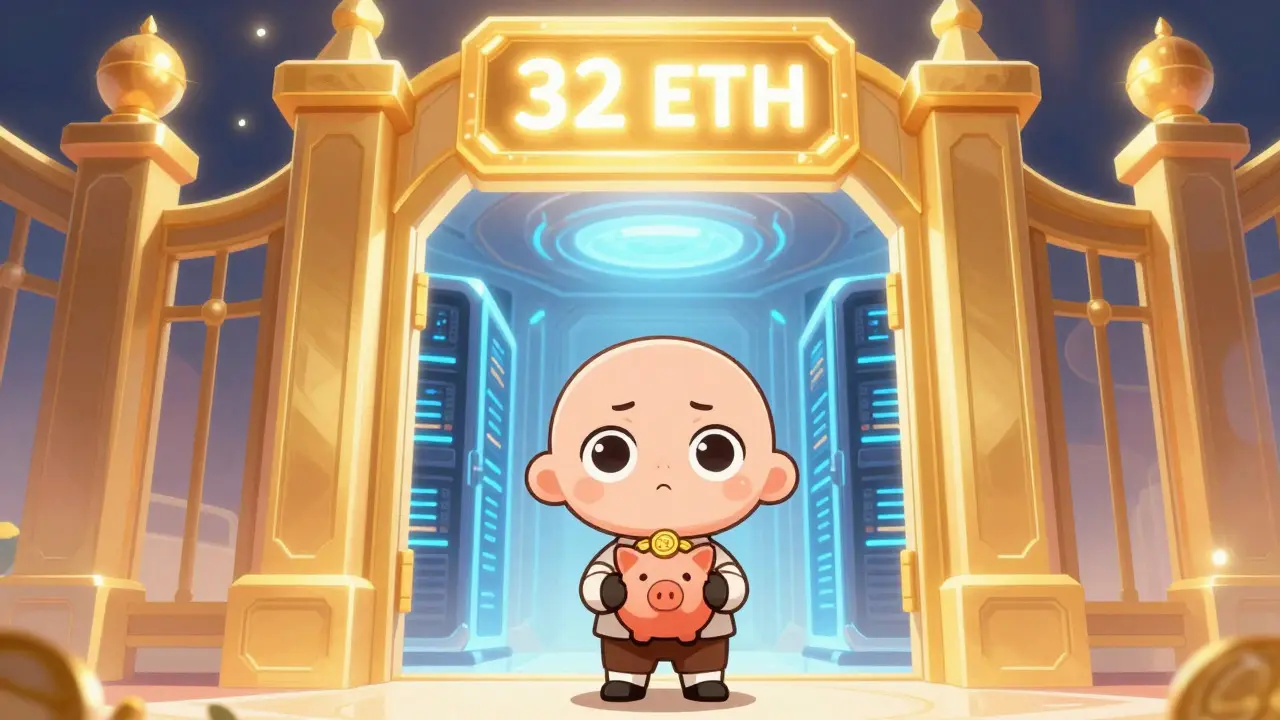
To become a solo validator, you must deposit exactly 32 ETH. As of mid-2026, with ETH prices fluctuating, this represents a significant capital outlay. On top of the token cost, you need reliable hardware-a computer that runs 24/7 with fast internet and ample storage. Ethereum.org calls this the "gold standard" because it maximizes decentralization and removes trust in third parties. You control your keys, and you keep all your rewards.
But what if you don't have 32 ETH? You are not locked out. The ecosystem has evolved several workarounds:
- Pooled Staking: Platforms like Lido or Rocket Pool allow you to contribute smaller amounts. Some pools accept as little as 0.01 ETH. Your tokens are combined with others to meet the 32 ETH threshold.
- Exchange Staking: Centralized exchanges like Bitstamp or Robinhood let you stake small amounts. Bitstamp requires a minimum of 0.1 ETH. Robinhood batches user deposits to activate validators, distributing rewards proportionally. Some platforms even allow starting with $1 USD equivalent.
- Liquid Staking: You receive a derivative token (like stETH) representing your stake. You can use this token in DeFi applications while still earning staking rewards, effectively putting your idle assets to work twice.
The trade-off here is centralization risk. When you pool or use an exchange, you trust a third party with your funds. Solo staking keeps that trust local but demands higher capital.
Polkadot: The Nominator Threshold
Polkadot operates differently. It uses a nominator model where users delegate their tokens to validators rather than running nodes themselves. To be eligible to nominate a validator and earn a share of their rewards, you must stake a minimum of 502 DOT.
This number might seem low compared to Ethereum's 32 ETH, but DOT has a much lower price per token. Still, 502 DOT is a deliberate filter. It ensures that nominators have a meaningful economic interest in selecting honest validators. If a validator gets slashed, nominators also lose a portion of their stake. This alignment discourages casual delegation and encourages active monitoring of validator performance.
Unlike Ethereum, there is no "solo" option for average users in the same sense. You are always delegating. The 502 DOT minimum is the gatekeeper for participating in the consensus layer directly. Below that amount, your tokens sit idle unless you find a way to bundle them through specialized services, which are less common than Ethereum's liquid staking derivatives.

Tezos: Baking and Delegation
Tezos takes yet another approach. To become a "baker" (Tezos' term for validator), you technically need to hold 8,000 XTZ and run a full node. This is a high barrier for individual participants.
However, Tezos was designed with accessibility in mind. Most XTZ holders do not bake. Instead, they delegate their tokens to existing bakers. There is no minimum stake required to delegate. You can hold 1 XTZ or 1,000 XTZ and delegate it to a baker of your choice. The baker then includes your tokens in their baking operations, increasing their chance of being selected to produce blocks. Rewards are shared between the baker and the delegators.
This model lowers the entry barrier to near zero for passive participants. You don't need to worry about hardware or uptime. You just choose a reputable baker and click delegate. The APY for Tezos staking typically ranges between 5% and 6%, providing a steady, predictable return without the complexity of managing infrastructure.
Comparison of Major Blockchain Staking Requirements
| Blockchain | Solo Validator Min | Delegated/Pooled Min | Key Mechanism |
|---|---|---|---|
| Ethereum | 32 ETH | ~$1 - 0.01 ETH | Proof of Stake / Liquid Staking |
| Polkadot | N/A (Nominator Model) | 502 DOT | Nomination Pools |
| Tezos | 8,000 XTZ | No Minimum | Baking & Delegation |

Choosing the Right Path for Your Portfolio
Your decision depends on three factors: capital, technical skill, and risk tolerance.
If you have significant capital and technical know-how, solo staking on Ethereum offers the highest autonomy. You avoid fees charged by pools and exchanges. However, you bear the full responsibility for uptime. A power outage or software bug could lead to slashing penalties.
If you want exposure to Ethereum yields without the hassle, pooled staking is the pragmatic choice. You sacrifice some control and pay a small fee to the pool operator, but you gain liquidity options through liquid staking tokens. Just be aware of the counterparty risk. If the pool provider goes insolvent or gets hacked, your funds are at risk.
For those seeking simplicity, Tezos delegation is hard to beat. No minimums, no hardware, no complex setup. You pick a baker, delegate, and collect rewards. It is the closest thing to a "set and forget" investment in the crypto space.
Polkadot sits in the middle. The 502 DOT requirement filters out micro-investors, creating a more serious community of nominators. If you are already invested in the Polkadot ecosystem, meeting this threshold allows you to actively shape network security by choosing which validators support.
Pitfalls to Avoid
Staking is not risk-free. Here are common mistakes new stakers make:
- Ignoring Lock-up Periods: Many networks impose unbonding periods. On Ethereum, withdrawing staked ETH can take days or weeks depending on network congestion. Plan your liquidity needs accordingly.
- Overlooking Fees: Pooled staking providers charge fees ranging from 5% to 20% of rewards. Always check the fine print before committing funds.
- Chasing High APY: Extremely high yields often signal high risk. A project promising 50% APY may be unsustainable or prone to inflation. Stick to established networks with transparent reward mechanisms.
Understanding these minimums gives you clarity. You now know whether you need to save up for 32 ETH, gather 502 DOT, or simply delegate your XTZ. The barrier is no longer a mystery-it is a choice.
What is the absolute minimum amount needed to stake on Ethereum?
To run a solo validator node, you need exactly 32 ETH. However, using pooled staking services or centralized exchanges, you can start with as little as $1 USD or 0.01 ETH.
Do I need special hardware to stake Polkadot?
No. As a nominator, you do not run any hardware. You simply stake your DOT tokens and delegate them to a validator who runs the infrastructure. You need a minimum of 502 DOT to participate.
Is Tezos staking safer than Ethereum staking?
Safety depends on your method. Delegating on Tezos is operationally simpler with no hardware risks, but you rely on the baker's honesty. Solo staking on Ethereum gives you full control but requires technical maintenance. Both are secure against network attacks due to their PoS models.
Can I unstake my tokens instantly?
Rarely. Most blockchains have unbonding periods to ensure network stability. Ethereum currently has a withdrawal queue that can take time. Tezos allows quicker unbonding, but it is not instantaneous. Always check the specific chain's current unbonding duration.
What happens if I fall below the minimum stake requirement?
If your stake drops below the minimum due to slashing or market fluctuations, you may be removed from the active validator set. For example, on Ethereum, if a validator's balance falls below 16 ETH, they are considered "exiting" and will stop producing blocks. On Polkadot, falling below 502 DOT disqualifies you from nominating.