
Ever tried swapping $20 worth of crypto on Ethereum and watched half your money vanish into gas fees? It hurts. Now imagine doing that same trade for five cents. That is the promise of PancakeSwap a decentralized exchange built on the Binance Smart Chain that uses an Automated Market Maker model to enable fast, low-cost token swaps without intermediaries. Since its launch in September 2020, this platform has grown from a simple swap tool into the dominant DeFi hub on the Binance Smart Chain (BSC). But with so many options out there, does PancakeSwap v2 actually deliver on its hype? Let's break down the fees, features, and real-world performance to see if it belongs in your wallet.
Why PancakeSwap Dominates the BSC Ecosystem
If you are active in the crypto space, you have likely heard of Uniswap. It is the giant of Ethereum. But when you move over to the Binance Smart Chain, PancakeSwap CakeSwap isn't just a competitor; it is the standard. According to data from TokenTerminal cited in recent 2025 reviews, PancakeSwap controls over 60% of all decentralized exchange volume on BSC. Why the dominance? It comes down to liquidity and speed. While other exchanges struggle to attract traders, PancakeSwap holds a Total Value Locked (TVL) of approximately $2.95 billion. This massive pool of assets means you can trade large amounts without moving the price too much, which is crucial if you want to avoid slippage.
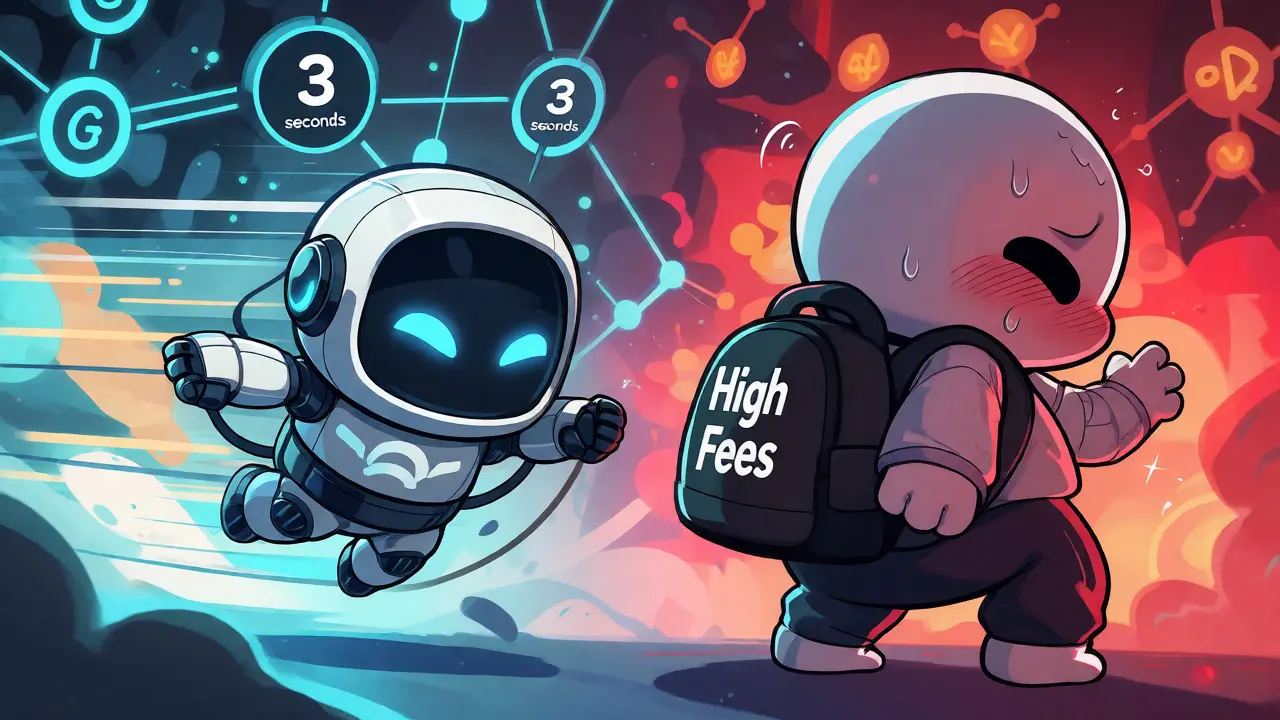
The platform operates on an Automated Market Maker (AMM) model. Unlike traditional exchanges where buyers and sellers match via an order book, here you trade directly against a pool of tokens. This design choice allows for instant settlement-transactions confirm in about three seconds. Compare that to Ethereum’s 13-15 second block times, and you see why traders who need quick execution prefer BSC-based solutions. It is not just about speed, though. The ecosystem is deeply integrated with the broader Binance world, making it a natural home for users already holding BNB or BEP-20 tokens.
Fees and Cost Efficiency: The Real Draw
Let's talk money. The biggest reason people switch to PancakeSwap v2 is cost. On centralized exchanges like Coinbase or Kraken, you might pay spread markups plus withdrawal fees. On Ethereum DEXs, network congestion can spike gas fees to $10 or more during busy periods. PancakeSwap charges a flat 0.25% commission on spot trades. That is lower than Uniswap’s 0.30%, but the real savings come from the underlying chain. Because BSC transactions are cheap, your total cost per trade often stays under $0.10. For small traders, this is a game-changer. You can make ten small trades on PancakeSwap for less than the cost of one trade on Ethereum mainnet.
For those interested in derivatives, the Perpetual Futures section offers maker/taker fees of 0.02% and 0.07% respectively. These rates are competitive even against some centralized futures platforms. However, keep in mind that while the swap fee is fixed, the gas fee fluctuates based on network demand. During peak hours, gas costs rise, but they rarely reach the prohibitive levels seen on other Layer 1 chains. If you are trading meme coins or new listings frequently, these low barriers to entry allow you to experiment without worrying about eating up your capital in fees.
| Feature | PancakeSwap v2 (BSC) | Uniswap (Ethereum) | SushiSwap (Multi-chain) |
|---|---|---|---|
| Spot Swap Fee | 0.25% | 0.30% | 0.30% |
| Avg Transaction Time | ~3 seconds | ~13-15 seconds | Varies by chain |
| Total Value Locked (TVL) | $2.95 Billion | $4+ Billion (ETH only) | $420 Million (BSC) |
| KYC Required | No | No | No |
| Native Token Utility | Governance, Farming, Lottery | Governance, Liquidity Rewards | Governance, Yield Farming |
Beyond Swapping: The Full DeFi Suite
Calling PancakeSwap just an "exchange" undersells it. It is more like a Swiss Army knife for DeFi. Once you connect your wallet, you unlock access to yield farming, prediction markets, lotteries, and an NFT marketplace. The yield farming options are particularly popular. Users provide liquidity to pools and earn CAKE tokens as rewards. Some pools offer high Annual Percentage Yields (APY), sometimes exceeding 50%, though these rates drop as more capital flows in.
The introduction of Perpetual V2 added another layer of complexity and opportunity. You can now trade leveraged positions on trending tokens, including specific listings like Test Token ($TST). This feature appeals to traders who want to speculate on price movements without owning the underlying asset. There is also a robust IDO (Initial DEX Offering) platform. Recent launches, such as MyShell ($SHELL), raised nearly 28,000 BNB, showing strong community appetite for new projects launching here. Whether you are staking CAKE for governance rights or playing the daily lottery for fun, the platform keeps you engaged beyond simple buying and selling.
Security and Trust: Is Your Money Safe?
Security is the elephant in the room for any DEX. Without a central authority holding your keys, you are responsible for your own safety. PancakeSwap mitigates risks through rigorous smart contract audits. Firms like Certik, Peckshield, and SlowMist have reviewed the code multiple times. Their reports generally highlight comprehensive security measures with no critical vulnerabilities found in recent cycles. The platform uses multi-signature wallets for treasury management, adding a layer of protection against single points of failure.
However, remember that using a DEX means interacting directly with blockchain protocols. If you send funds to the wrong address or approve a malicious contract, there is no customer support line to call. The team remains anonymous, which aligns with the crypto ethos but can feel unsettling for newcomers accustomed to regulated banks. Community trust is high, evidenced by the platform hitting $1 trillion in cumulative trading volume-a first for a BSC project. Still, always double-check contract addresses and revoke unnecessary permissions regularly.

User Experience: Beginner Friendly or Overwhelming?
How hard is it to use? If you have used MetaMask before, you will feel at home. Connecting your wallet takes minutes. The interface is clean, with clear tabs for Trade, Earn, and More. However, "More" is where things get tricky. New users often report confusion around impermanent loss when providing liquidity. A survey by 3Commas indicated that 68% of new users experienced at least one transaction failure in their first week, usually due to misconfigured slippage settings or insufficient BNB for gas.
Support is community-driven. There is no official help desk, but the Telegram channel is active, with responses typically arriving within two hours. Documentation is extensive, covering everything from basic swaps to complex farming strategies. For complete beginners, expect a learning curve of 2-3 hours to grasp core concepts. Experienced DeFi users, however, can navigate the platform proficiently in under 30 minutes. The UI rating sits at 4.2/5, praised for intuition among pros but noted as potentially overwhelming for novices.
Verdict: Who Should Use PancakeSwap v2?
PancakeSwap v2 is not perfect, but it is exceptionally good at what it does best: providing cheap, fast access to the BSC ecosystem. It excels for retail investors, meme coin traders, and yield farmers looking for high APYs. If you are tired of paying $10 gas fees for a $50 trade, this is your solution. However, if you require deep institutional-grade liquidity for massive OTC trades or prefer the perceived security of Ethereum's validator set, you might stick with Uniswap or centralized alternatives.
The regulatory landscape remains a wildcard. With the SEC scrutinizing non-KYC platforms, PancakeSwap operates in a gray area. Yet, its integration with Binance’s ecosystem provides a buffer that smaller DEXs lack. As long as BSC maintains its position as a low-cost alternative to Ethereum, PancakeSwap will remain the go-to destination for millions of daily users. Start small, learn the ropes, and never invest more than you can afford to lose while experimenting with new protocols.
Do I need to pass KYC verification to use PancakeSwap?
No, PancakeSwap is a decentralized exchange, meaning there is no Know Your Customer (KYC) process. You simply connect a Web3 wallet like MetaMask or Trust Wallet to start trading immediately. This preserves your privacy but also means you are fully responsible for managing your own private keys and security.
What is the CAKE token used for?
CAKE is the native utility token of PancakeSwap. It serves several purposes: governance (voting on protocol changes), fee reductions for holders, and rewards for providing liquidity or participating in farming pools. It also powers the platform's lottery and prediction market games.
Can I buy crypto with fiat currency directly on PancakeSwap?
Generally, no. PancakeSwap is designed for crypto-to-crypto swaps. To buy tokens, you typically need to bridge stablecoins (like USDT or BUSD) or BNB from a centralized exchange. Some third-party integrations may offer fiat on-ramps, but the core experience requires you to hold digital assets already.
Is PancakeSwap safer than Uniswap?
Both platforms undergo rigorous auditing. However, Ethereum is often viewed as having a larger, more decentralized validator set, which some institutions prefer for security reasons. PancakeSwap runs on BSC, which is faster and cheaper but relies on fewer validators. Security-wise, both are robust, but the risk profile differs slightly due to the underlying blockchain architecture.
What happens if I set my slippage tolerance too low?
If your slippage tolerance is lower than the actual price movement during your transaction, the trade will fail. You will still pay the gas fee for the failed attempt, but you won't execute the swap. For volatile tokens or new listings, it is often wise to increase slippage tolerance to ensure the transaction goes through.