
Crypto Policy Comparison Tool
Compare Crypto Regulations Across Muslim-Majority Countries
Select countries to compare:
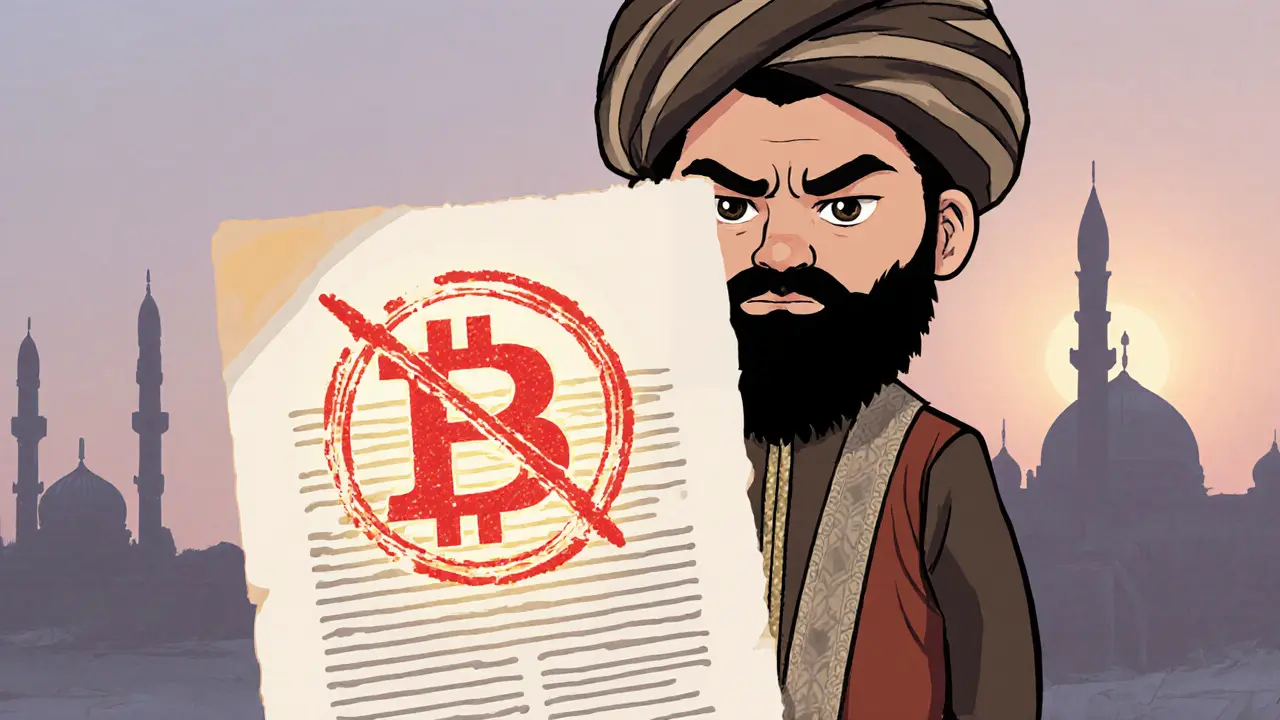
When the Taliban the de‑facto government of Afghanistan since 2021 announced a sweeping prohibition on digital assets, the world got a stark example of religion‑driven finance policy. The Taliban Bitcoin ban isn’t just a headline; it reshapes how millions move money, especially in a country where banks have crumbled and remittances are a lifeline.
What the ban actually says
On 15 August 2022, Sayed Shah Sa’adat head of Herat Police’s counter‑crime unit publicly ordered the closure of 16 crypto exchanges in Herat. The decree covered every crypto‑related activity - trading, mining, wallet services, even peer‑to‑peer (P2P) trades. No licence, no exemption: the regime labeled all crypto “haram forbidden under Islamic law”. The central bank, Da Afghanistan Bank Afghanistan’s national monetary authority, echoed the stance, declaring Bitcoin and stablecoins like USDT illegal under Sharia.
Sharia law interpretation behind the ban
The Taliban’s religious rationale hinges on two classic concepts: maysir (gambling) and the lack of intrinsic value. In their view, Bitcoin’s price volatility makes it a speculative game, which Islam prohibits. They also argue that an asset without a physical backing cannot serve as a true ‘medium of exchange’, violating the principle that money must have a tangible, socially accepted value.
Opposing voices exist. Dr. Mohsin Choudhry, in a 2022 paper in the *Journal of Islamic Accounting and Business Research*, argued that if crypto is used solely as a transfer tool - not as a speculative instrument - it satisfies the Sharia requirement of a permissible medium of exchange. The OIC’s Fiqh Academy issued a non‑binding opinion in June 2022 stating that digital currencies may be allowed if they advance the objectives of Sharia, directly challenging the Taliban’s absolute ban.
How the ban is enforced
Enforcement blends religious edicts with existing anti‑money‑laundering law. The Financial Transactions and Reports Analysis Center of Afghanistan (FinTRACA) the country’s financial intelligence unit monitors suspicious activity under the Money Laundering and Proceeds of Crime Act 2013. Since the decree, the Taliban have staged dozens of raids - notably in Herat Q4 2022 - seizing hardware wallets, freezing accounts, and arresting traders.
Technical controls supplement the legal ones. A 48‑hour nation‑wide internet blackout in October 2024 showed the regime’s ability to choke blockchain access. During that period, experts noted a surge in mesh‑network usage and SMS‑based wallet tools, but overall transaction volume dropped by roughly 30 % for the month, according to Chainalysis.

Economic fallout and underground resilience
Despite the ban, crypto remains a crucial lifeline. UNDP’s 2024 survey reported that 38 % of Afghans used cryptocurrency for remittances - up from 2 % pre‑2021 - because traditional banking channels disappeared after international sanctions froze $9.5 billion of foreign reserves. Peer‑to‑peer platforms on Telegram, such as “AfghanCryptoHelp”, processed an average of $38,500 in USDT trades per week in 2024, even as authorities threatened users with imprisonment.
Women are both the most vulnerable and the most innovative users. The Digital Citizen Fund trained 687 Afghan women in Bitcoin basics in 2024; 89 % reported greater financial autonomy, yet 42 % faced harassment when attempting transactions. Real stories circulate on Reddit and X: one trader, “KabulTrader88”, lost 1.2 BTC (≈ $52,800) after a raid in November 2022, while another user successfully moved $4.2 million in P2P volume in Q1 2025, showing a stark contrast between risk and reward.
Afghanistan’s stance vs. other Muslim‑majority countries
| Country | Legal status of crypto | Key regulator | Notable policy nuance |
|---|---|---|---|
| Afghanistan | Complete ban (crypto = haram) | FinTRACA & Da Afghanistan Bank | Zero‑tolerance, no licensing pathway |
| Saudi Arabia | Allowed with licensing | Saudi Central Bank (SAMA) | Exchanges must comply with AML and Sharia‑compliant tokens only |
| UAE | Regulated market | Virtual Assets Regulatory Authority (VARA) | Full crypto ecosystem, sandbox for DeFi |
| Iran | Mining permitted, trading restricted | Central Bank of Iran | State‑approved mining licences, no foreign exchanges |
| Indonesia | Trading allowed under regulations | Financial Services Authority (OJK) | Must register with OJK, KYC mandatory |
Afghanistan stands alone as the only country that enforces a blanket prohibition without a parallel licensing framework. While Saudi Arabia and the UAE have built Sharia‑compatible regulatory sandboxes, Afghanistan’s approach eliminates any legal pathway for crypto, even for humanitarian use.

Scholarly debate: is crypto truly haram?
The crux of the disagreement lies in how scholars define “value” and “speculation”. The Taliban’s decree leans on classical jurisprudence that demands a tangible asset backing money - a view shared by Da Afghanistan Bank’s governor Mullah Noori in early 2023. In contrast, contemporary scholars cite the concept of *‘riba‑free exchange’* and argue that Bitcoin’s limited supply gives it intrinsic scarcity, satisfying the requirement for a stable medium of exchange.
Roya Mahboob, founder of the Digital Citizen Fund, highlighted Bitcoin’s role as a “survival tool” for Afghan women excluded from the formal banking system. Her 2024 address at the Bitcoin Policy Summit warned that the ban exacerbates gender inequality, a point echoed by the Human Rights Foundation, which documented 127 cases (2022‑2024) where women used Bitcoin to sidestep banking bans.
Future outlook: will the ban hold?
Analysts disagree on the ban’s durability. The Atlantic Council’s 2025 forecast gave a 65 % probability the prohibition will stay in place through 2027, citing the Taliban’s ideological rigidity. However, Goldman Sachs’ Emerging Markets Report assigned only a 30 % chance the ban survives past 2028, noting Afghanistan’s GDP contracted by 20.7 % (2021‑2023) and that P2P volumes rose 22 % YoY in Q1 2025.
Two scenarios seem plausible:
- Tacit tolerance: The regime continues official prohibitions but turns a blind eye to low‑volume P2P trades, similar to Iran’s post‑2022 stance.
- Policy reversal under pressure: A severe economic shock forces the Taliban to grudgingly allow limited crypto channels for remittances, perhaps through state‑run wallets that meet their religious criteria.
For now, the ban remains absolute, reinforced by repeated statements from Deputy Prime Minister Mullah Abdul Ghani Baradar in February 2025: “digital currency has no place in an Islamic system.” Yet the underground ecosystem keeps evolving, with innovations like “CryptoSMS” - an SMS‑based wallet that served 12,500 users after the 2024 blackout.
Key takeaways
- The Taliban’s ban is rooted in a strict Sharia interpretation that labels all crypto as haram.
- Enforcement mixes religious edicts, FinTRACA monitoring, and occasional internet shutdowns.
- Despite the ban, crypto usage for remittances and personal finance has surged, especially among women.
- Afghanistan’s policy is the harshest globally, with no licensing path unlike Saudi Arabia, UAE, or Iran.
- Scholarly dissent exists, and economic pressures may eventually force a softened approach.
Why does the Taliban consider Bitcoin haram?
The regime argues Bitcoin lacks intrinsic, tangible value and its price swings make it a form of gambling (maysir), both prohibited under traditional Islamic jurisprudence.
Are there any legal ways to use crypto in Afghanistan?
Officially, no. The Taliban’s decree bans all crypto activities. In practice, underground P2P trading on Telegram and SMS‑based wallets continues, but users risk arrest.
How does Afghanistan’s crypto ban compare to Iran’s policy?
Iran permits mining under state licences but bans most trading, while Afghanistan bans both mining and trading with no licensing route. Iran’s approach is more flexible, allowing limited economic activity.
What alternatives do Afghans have for international remittances?
Traditional channels are scarce due to sanctions; many rely on informal hawala networks, P2P crypto trades, or SMS‑based wallet services that bypass formal banking.
Could international pressure force the Taliban to lift the ban?
External pressure alone has limited effect; economic necessity is a stronger driver. If the cash crunch deepens, the regime may tolerate limited crypto use, but a full reversal is unlikely without a shift in religious interpretation.





Joseph Eckelkamp
October 24, 2025 AT 08:06So the Taliban's stance on Bitcoin, in its infinite wisdom, hinges on the classic “no intrinsic value” argument, right? They point to volatility as gambling-maysir-, which, according to their reading, makes every price swing a sin; yet they ignore that any fiat currency also fluctuates, but we don’t hear the clerics declaring dollars haram. The ban, while drummed up as a pure religious decree, also conveniently plugs a massive revenue vacuum left by frozen foreign reserves; it’s a theological cover for a fiscal crisis. Moreover, the enforcement tactics-raids, internet blackouts, hardware wallet seizures-reveal a security apparatus more interested in control than spiritual purity. In short, the ban is a perfect storm of ideology, economics, and power, wrapped in a Sharia‑friendly narrative.
adam pop
October 24, 2025 AT 22:00They’re using the ban to hide a deeper agenda of monitoring every digital transaction.
Dimitri Breiner
October 25, 2025 AT 09:06Exactly, the economic angle is hard to miss-if you look at the remittance flow, crypto fills a gap that conventional banking won't, and the Taliban’s prohibition simply pushes that activity further underground, making it even harder to regulate.
angela sastre
October 26, 2025 AT 01:46Wow, the numbers about women using crypto for financial freedom are really eye‑opening; it shows how essential these tools have become when the formal banking system collapses. The training programs mentioned are doing great work, giving Afghan women a chance to manage money themselves. Still, the harassment they face is heartbreaking, and it highlights how policy and culture intersect in painful ways. It’s a reminder that technology alone can’t solve gender inequality without broader societal change.
Claymore girl Claymoreanime
October 26, 2025 AT 14:40One must, however, adopt a more nuanced perspective when evaluating the purported “harmlessness” of peer‑to‑peer crypto exchanges within an authoritarian milieu. The simplistic narrative that crypto merely serves as a benevolent conduit for remittances obscures the intricate web of sociopolitical ramifications inherent in such decentralized networks. Firstly, the diffusion of digital assets circumvents not only state‑mandated fiscal oversight but also the traditional mechanisms of community accountability that have historically moderated economic exchange. Secondly, the very architecture of blockchain, with its pseudo‑anonymous transaction ledger, furnishes a fertile ground for illicit financing, ranging from narcotics traffickers to extremist recruitment-an eventuality that the Taliban’s religious rhetoric conveniently ignores. Thirdly, the reliance on Telegram channels and SMS‑based wallets introduces a layer of technological dependency that can be weaponized through state‑controlled internet blackouts, thereby rendering end‑users vulnerably exposed to both technical failures and coercive surveillance. Moreover, the reported surge from 2 % to 38 % in crypto usage, while statistically impressive, fails to account for the qualitative disparities in transaction size, risk exposure, and user literacy. Fourth, the gendered dimension of crypto adoption, as highlighted by the Digital Citizen Fund, underscores a paradox: empowerment through financial autonomy paradoxically coexists with heightened exposure to gender‑based harassment, a collateral consequence of operating in a clandestine economy. Fifth, the macro‑economic implications cannot be dismissed; the influx of crypto capital, albeit informal, interacts with a stagnant GDP and exacerbates monetary policy vacuums, potentially destabilizing any nascent attempts at fiscal normalization. Sixth, the international community’s response, oscillating between sanctions and humanitarian aid, inadvertently amplifies the utility of crypto as a conduit for circumventing external controls, thereby embedding it further into the fabric of Afghan daily life. Seventh, the epistemological debate among Islamic scholars regarding the permissibility of digital assets reveals a doctrinal fissure that the Taliban's monolithic edict fails to acknowledge, rendering the ban both theologically and pragmatically contested. In summation, while the surface‑level benefits of crypto for remittances and individual empowerment are palpable, a rigorous, multi‑dimensional analysis unveils a tapestry of unintended consequences that demand scholarly attention and policy deliberation. Future research should thus prioritize longitudinal studies tracking user behavior across regulatory shocks. Policymakers ought to engage with religious authorities to craft a more balanced framework that respects doctrinal concerns while acknowledging economic realities. Finally, the diaspora community can play a pivotal role by channeling resources through vetted channels, mitigating the reliance on opaque crypto pathways. Only through such interdisciplinary collaboration can the paradox of empowerment versus exposure be resolved.
Will Atkinson
October 27, 2025 AT 12:53Honestly, it’s fascinating to see how a blanket ban can’t really stop the flow-people get creative, using everything from SMS wallets to mesh networks; it’s like watching a techy Robin Hood story unfold in real time!
Elizabeth Mitchell
October 28, 2025 AT 00:00True, the resilience is impressive, but the constant threat of shutdowns must take a toll on everyday users.
Chris Houser
October 28, 2025 AT 19:26From a systems‑engineering standpoint, the FinTRACA’s monitoring architecture leverages transaction‑level analytics combined with heuristic anomaly detection to flag illicit crypto activity, yet the lack of a licensing framework limits its efficacy.
William Burns
October 29, 2025 AT 09:20One must concede that the current regulatory vacuum engenders a suboptimal equilibrium wherein compliance incentives are misaligned, thereby precipitating a proliferation of clandestine exchange mechanisms that evade both doctrinal scrutiny and forensic audit trails.
Ashley Cecil
October 30, 2025 AT 10:20It is indefensible that any regime would impose such draconian restrictions on financial liberty, contravening fundamental human rights and the moral imperative to support those most vulnerable.
Jennifer Rosada
October 30, 2025 AT 21:26While the moral outrage is warranted, it is essential to recognize that blaming the Taliban exclusively overlooks the geopolitical complexities that perpetuate economic isolation, thereby inadvertently simplifying a multifaceted crisis.
John Dixon
October 31, 2025 AT 19:40Ah - because nothing says “progress” quite like outlawing a technology that already saved countless families from poverty, right? It’s almost poetic how a ban on crypto can simultaneously underscore a nation’s desperate need for financial innovation and its resolute unwillingness to embrace it.
Brody Dixon
November 1, 2025 AT 09:33Indeed, the juxtaposition highlights the paradox; perhaps a measured, low‑key approach to integrating crypto solutions could bridge the gap without triggering ideological backlash.