
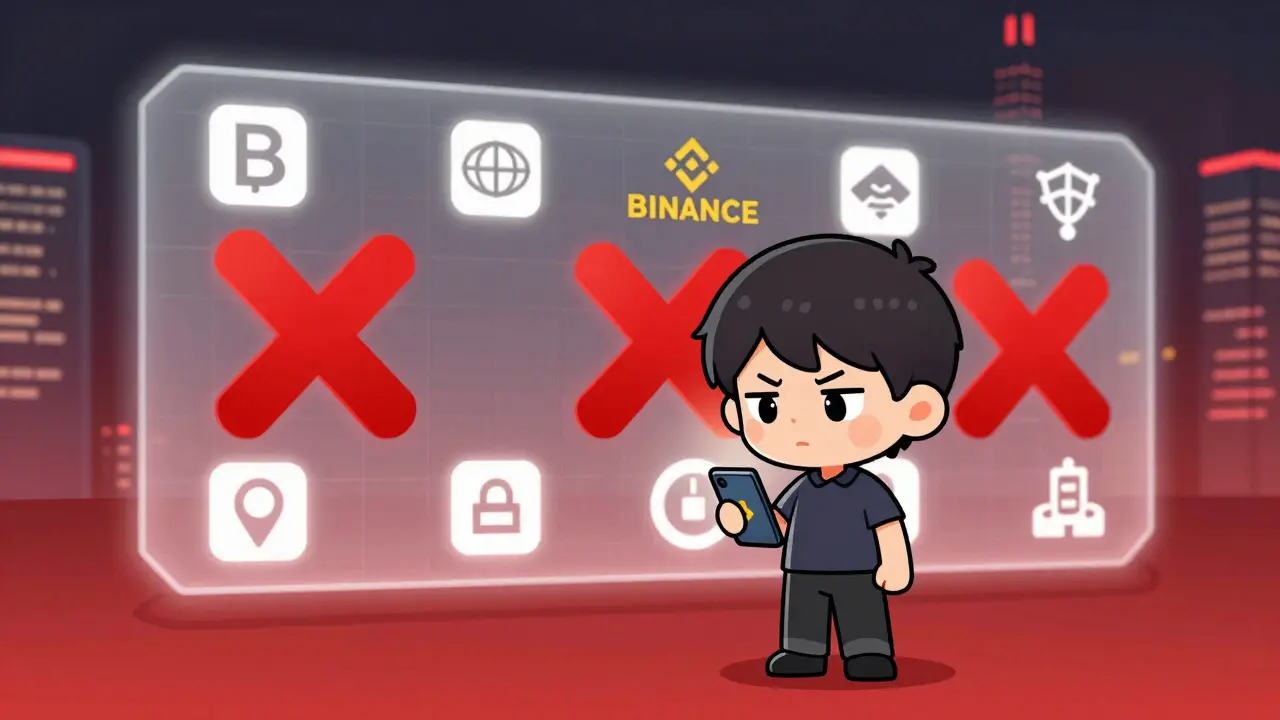
It is a common misconception that you can simply find a list of "banned" crypto exchanges on a government website. In reality, the situation in China is far more absolute. Since September 2017, and reinforced by sweeping regulations in September 2021, all centralized cryptocurrency exchanges are effectively banned for Chinese residents. This includes global giants like Binance, the world's largest cryptocurrency exchange by trading volume, Coinbase, a leading US-based digital asset exchange, Kraken, a secure cryptocurrency exchange founded in San Francisco, and even formerly Chinese-founded platforms like Huobi (now HTX), a major global cryptocurrency exchange originally based in Beijing.
If you are living in China or using a Chinese bank account, accessing these platforms is not just difficult-it is illegal. The ban is not a selective blacklist; it is a blanket prohibition on all cryptocurrency-related financial services. But what does this mean for your assets? Can you still hold Bitcoin? And how do authorities enforce such a broad restriction?
The Scope of the Ban: More Than Just Exchanges
To understand why specific names like Binance or Coinbase don't appear on an official "banned list," you need to look at the regulatory framework itself. The People's Bank of China (PBOC) and seven other government agencies issued a joint notice in September 2021 that classified all cryptocurrency business activities as "illegal financial activities." This wasn't just about stopping people from buying tokens; it was about dismantling the entire infrastructure that supports trading.
This means that any platform facilitating the exchange of fiat currency (like the Renminbi) for cryptocurrencies is prohibited. It also bans initial coin offerings (ICOs), cryptocurrency mining operations, and foreign trading platforms that attempt to serve Chinese customers. The enforcement mechanism relies heavily on the Great Firewall of China, China's state-sponsored internet censorship system. This sophisticated network blocks direct access to major international exchange websites and apps. If you try to open the Binance app while connected to a local Chinese IP address, it will likely fail to load or redirect you to a warning page.
Furthermore, domestic internet service providers have been ordered to restrict Virtual Private Networks (VPNs). While many users still find ways to bypass these blocks, doing so carries significant legal risk. The government views circumventing the firewall to access financial services as a violation of cybersecurity laws. This creates a high-stakes environment where even casual interest in crypto trading can lead to scrutiny.
Who Is Affected? Residents vs. Foreigners
The ban applies primarily to Chinese citizens and entities operating within mainland China. However, the reach extends further than you might think. Chinese nationals traveling abroad or holding dual citizenship may still face complications if they attempt to use their Chinese identification documents on foreign exchanges. Many international platforms have implemented strict Know Your Customer (KYC) protocols that flag Chinese ID cards, leading to account freezes or closures to avoid regulatory backlash.
For foreigners living in China, the rules are slightly different but still restrictive. You cannot legally trade crypto using Chinese banks. Attempting to wire funds from a local bank account to an exchange like Kraken will result in the transaction being blocked by the bank. Financial institutions in China are explicitly prohibited from providing services to cryptocurrency-related businesses. This cuts off the banking relationship entirely, making it nearly impossible to move money in or out of the country for crypto purposes without triggering alerts for capital flight.

Common Misconceptions and Fake News
In May and June 2025, social media exploded with rumors claiming that China had made private ownership of cryptocurrency completely illegal. Posts suggested that holding Bitcoin or Ethereum in a personal wallet could lead to criminal charges. These claims caused panic, driving Bitcoin prices down from $111,000 to under $104,000 within hours.
However, authoritative fact-checking analysis published in August 2025 by outlets like Bitcoin Junkies and Grok confirmed that these reports were recycled news from the 2021 ban. As of today, in May 2026, owning cryptocurrency is not technically illegal for individuals. The ban targets the service providers-the exchanges, miners, and payment processors-not the individual holders. You can own Bitcoin. You just cannot buy it through a regulated channel, sell it for Renminbi via a bank, or mine it commercially. This distinction is crucial for anyone trying to navigate the gray areas of the law.
| Activity | Legal Status | Enforcement Method |
|---|---|---|
| Using Centralized Exchanges (e.g., Binance) | Illegal | Website blocking, KYC flags, account freezes |
| Private Wallet Ownership | Tolerated / Gray Area | No direct enforcement, but transactions monitored |
| Cryptocurrency Mining | Banned | Power cuts, equipment confiscation, fines |
| Fiat-to-Crypto Banking Transfers | Prohibited | Bank transaction blocks, capital flight investigations |
| Using e-CNY (Digital Yuan) | Legal / Encouraged | Government-backed promotion |
The Rise of e-CNY and State Control
While banning decentralized cryptocurrencies, the Chinese government has been aggressively promoting its own digital alternative: the e-CNY (digital yuan), China's central bank digital currency (CBDC). Unlike Bitcoin or Ethereum, which operate on decentralized networks, the e-CNY is fully controlled by the People's Bank of China. It offers the convenience of digital payments while maintaining complete transparency for authorities.
Beijing officials position the e-CNY as the safe, legal alternative to risky crypto assets. They are actively exploring the launch of yuan-backed stablecoins for cross-border transactions, aiming to reduce reliance on the US dollar in international trade. For users inside China, the message is clear: participate in the state-approved digital economy, or face exclusion from the broader financial system. This strategic shift underscores the government's desire to maintain monetary policy control while preventing capital flight through unregulated channels.

How People Still Trade: The Underground Market
Despite the comprehensive ban, demand for cryptocurrency remains high among Chinese investors. According to industry analysts at ThinkBRG, over-the-counter (OTC) trading and peer-to-peer (P2P) platforms continue to operate in the shadows. Users often migrate to decentralized exchanges (DEXs) like Uniswap, which do not require KYC verification, though accessing these sites requires bypassing the Great Firewall.
Reddit communities and Telegram groups document various methods used to circumvent restrictions, including offshore corporate structures, foreign bank accounts, and specialized VPN services. However, these methods come with increased risks. Transaction costs are higher due to liquidity constraints, and there is a persistent threat of government surveillance. Authorities have developed sophisticated systems to monitor blockchain transactions linked to Chinese IP addresses or identification documents. If flagged, users may face frozen assets, legal investigation for illegal fundraising, or charges related to capital flight.
Future Outlook: Will the Ban Lift?
As of May 2026, there is no indication that China will lift its ban on cryptocurrency exchanges. The government's commitment to financial stability and control suggests that restrictions will remain strict. However, some experts note potential softening in specific areas. Statements from the Shanghai State-owned Assets Supervision and Administration Commission in July 2025 hinted that the rapid evolution of digital assets might lead to a more targeted regulatory approach, such as allowing trading on licensed exchanges with stricter controls.
Until such changes occur, the status quo remains: all centralized exchanges are banned, mining is prohibited, and banking links are severed. For those interested in crypto, the only legal path forward is through the state-sanctioned e-CNY. Any engagement with international platforms remains a legal gamble with serious consequences.
Is it illegal to own Bitcoin in China in 2026?
No, owning Bitcoin is not technically illegal for individuals. The ban targets cryptocurrency business activities, including exchanges, mining, and payment processing. However, you cannot legally buy or sell Bitcoin using Chinese banks or fiat currency, and attempting to do so may trigger legal issues related to capital flight.
Can I use Binance if I live in China?
No. Binance and other major exchanges are blocked by the Great Firewall. Additionally, Binance has restricted services for Chinese users to comply with local regulations. Using a VPN to access Binance is illegal and carries significant legal risks, including account closure and potential prosecution.
Why did China ban cryptocurrency exchanges?
China banned exchanges to prevent capital flight, protect consumers from fraud, and maintain control over its monetary policy. The government views decentralized cryptocurrencies as a threat to financial stability and national security, preferring instead to promote its own digital currency, the e-CNY.
Are there any legal ways to trade crypto in China?
Currently, there are no legal ways to trade decentralized cryptocurrencies like Bitcoin or Ethereum using domestic banks or exchanges. The only legal digital asset is the e-CNY (digital yuan), which is issued and controlled by the People's Bank of China.
What happens if my bank account is linked to crypto?
Chinese banks are required to block transactions related to cryptocurrency. If your account is flagged for suspicious activity linked to crypto, it may be frozen. Repeated violations can lead to legal investigation for illegal fundraising or capital flight, resulting in fines or criminal charges.





Caique Muniz
May 7, 2026 AT 12:30another day another ban lol
robert Whitehead
May 8, 2026 AT 17:29You are all missing the point entirely. This isn't about freedom, it's about control. The state needs to know where every single yuan is going at all times. Crypto is just noise in their system and they will crush it like a bug. People who think they can outsmart the PBOC with some sketchy VPN are delusional. The infrastructure for surveillance is too robust now.
Kiran CS
May 9, 2026 AT 07:13Oh please, spare me the simplistic take on this complex geopolitical maneuver. It is quite amusing how the masses cling to these decentralized fantasies while ignoring the sheer brute force of centralized power structures. China knows exactly what it is doing by promoting the e-CNY. It is not merely a currency; it is a tool of absolute governance. Your little Bitcoin wallet means nothing when the electricity is cut off and your bank account is frozen because you tried to buy a sandwich with crypto. How quaint.
Michael Berggren
May 10, 2026 AT 21:11Hey everyone! 👋 Just wanted to add that the distinction between owning and trading is super important here 📝 Many people panic sell when they hear 'ban' but remember you can still hold BTC in cold storage 💻 It’s all about understanding the legal gray areas vs outright criminal activity ⚖️ Stay safe out there friends! ✌️
robert Whitehead
May 12, 2026 AT 18:24@Michael Berggren You are naive if you think holding it is safe. They track blockchain addresses linked to Chinese IPs. If you move funds, you get flagged. It is a trap for idiots.
Michael Berggren
May 14, 2026 AT 09:05@robert Whitehead I hear your concern 😟 But many users use privacy coins or mixers to avoid detection 🔒 It is a cat and mouse game indeed 🐱🐭 We just need to be smart about our ops!
Bradley Geldenhuys
May 16, 2026 AT 03:23The philosophical implication here is profound. By banning crypto, China is essentially declaring war on the concept of individual sovereignty over assets. They want you to trust the state with everything. It is an aggressive move against human nature itself. We must consider if this centralization is truly sustainable long term or if it will collapse under its own weight due to lack of trust.
beti macedo
May 17, 2026 AT 22:32I hope everyone stays safe and follows the laws properly. It is very important to respect local regulations even if we disagree with them. Maybe one day things will change for the better and we can all trade freely again. Let us keep a positive mindset and support each other through these difficult times.
Caique Muniz
May 19, 2026 AT 19:23@beti macedo yeah right sure bet
Ruben Michel
May 21, 2026 AT 02:05The pretension of believing that a digital token can overthrow a nation's monetary policy is laughable. The e-CNY is superior because it offers stability and integration with existing financial systems. Those who advocate for Bitcoin are either ignorant of economics or actively seeking chaos. The formal structure of the ban is necessary for societal order.
Gavin Wonnacott
May 22, 2026 AT 15:01You people are pathetic. I wonder if you actually read the article or just skimmed it. The enforcement mechanisms are terrifyingly efficient. Do you really think your little offshore accounts are safe? I have seen friends lose everything because they thought they were smarter than the system. It is disgusting how reckless you all are.
Tobias Gjerlufsen
May 24, 2026 AT 05:59listen up losers the truth is simple. china wants control period. any attempt to bypass this is stupid. you think uniswap saves you? no. they trace the entry points. stop acting like victims and take responsibility for your own stupidity. the ban is total and you are failing to adapt.
Sheldon Friesen
May 26, 2026 AT 03:05Look, folks! I know this sounds harsh! But seriously! Don't risk it! The banks are watching! Every transaction! Is monitored! So please! Be careful! And maybe stick to the e-CNY! It is safer! Trust me on this one!
Samara McCallum
May 27, 2026 AT 11:24oh wow such drama everyone is so scared of a few lines of code being blocked lol i mean sure it is illegal but like do they really care about your tiny bitcoin stash? probably not unless you are moving millions. let us not blow this out of proportion shall we?
robert Whitehead
May 29, 2026 AT 07:08@Samara McCallum You are wrong. They care about every cent because it represents capital flight. Ignorance is not a strategy.
Samara McCallum
May 29, 2026 AT 08:32@robert Whitehead whatever dude chill out. you are too intense.
Sudarshan Anbazhagan
May 30, 2026 AT 02:13It is imperative that we understand the broader implications of this regulatory framework which extends far beyond mere financial transactions into the realm of national security and social stability. The prohibition on mining is particularly significant as it removes the energy-intensive aspect of cryptocurrency from within borders thereby reducing carbon footprint while simultaneously preventing the decentralization of economic power. One must appreciate the sophistication of this approach.
John Gonzalez Bentham
May 31, 2026 AT 10:41you guys are all wrong about the legality part. owning is fine but buying is not. stop confusing people. also the vpn thing is risky dont do it if you value your freedom.
Jerry CUNNINGHAM SR
June 1, 2026 AT 18:21As someone who respects boundaries and legal frameworks, I find this situation quite clear. The government has stated its position unequivocally. To engage in prohibited activities is to invite consequences. I encourage everyone to adhere to the law and utilize the sanctioned e-CNY system. It promotes harmony and security for all citizens involved.
Shelby Cantu
June 1, 2026 AT 20:08Stay safe everyone. Follow the rules.
Destiny Kilby
June 3, 2026 AT 07:42i feel for those trying to navigate this. it is confusing and stressful. please be careful with your personal information and do not share sensitive details online. the risks are real and emotional toll is high.
Bronwen Butler
June 3, 2026 AT 18:00actually the ban is not as strict as people think. there are loopholes. p2p works fine if you are smart enough. stop listening to fear mongers.
robert Whitehead
June 4, 2026 AT 17:08@Bronwen Butler Loopholes close fast. You will get banned eventually. Stop giving bad advice.
H F
June 5, 2026 AT 19:38Wow! What a dramatic turn of events for the crypto world! It is absolutely wild to see how quickly regulations can shift the landscape! I am amazed by the resilience of the community despite these hurdles! Keep fighting the good fight! The future is uncertain but exciting!