
Launching a blockchain project used to require a team of senior engineers, six-figure audit budgets, and months of coding. That barrier kept most ideas on the drawing board. Enter Bonsai3, a no-code Web3 development platform designed to let founders deploy secure tokens and smart contracts without writing code. But here is the catch: while the technology promises speed and accessibility, the market reality for its native coin, BAI, tells a much more complex story of volatility, liquidity challenges, and conflicting data.
If you are looking at BAI, you probably want to know two things: does the platform actually work as advertised, and is this token worth your attention right now? The answer requires separating the utility of the software from the speculative nature of the asset. Let’s break down what Bonsai3 is, how it fits into the broader Web3 ecosystem, and what the current numbers say about its viability in mid-2026.
The Core Problem: Why No-Code Matters in Web3
Before we talk about price, we need to understand why a platform like Bonsai3 exists. In traditional software, you can build an app using drag-and-drop tools. In blockchain development, that luxury didn’t really exist until recently. Writing smart contracts is dangerous. One line of bad code can lead to millions of dollars being drained by hackers. This fear created a massive bottleneck.
Bonsai3 aims to solve this by providing pre-audited templates. Think of it as a factory for digital assets. Instead of hiring a lawyer to write every clause of a contract from scratch, you pick a template that has already been checked by experts. You fill in the blanks-token name, supply, tax rules-and hit deploy. This democratizes access to decentralized finance (DeFi) infrastructure. It allows non-technical founders to launch projects that previously required deep technical expertise.
Tokenomics: Supply, Circulation, and Mechanics
To evaluate any crypto asset, you must look at its economics. For BAI, the structure is straightforward but aggressive in terms of distribution.
- Total Maximum Supply: 1,000,000,000 (1 Billion) BAI tokens.
- Circulating Supply: Approximately 528,333,333 BAI tokens.
- Circulation Percentage: Roughly 52.8% of the total supply is already in circulation.
This high percentage of circulating supply is notable. Many newer projects release only 10-20% initially, holding the rest for future vesting or team rewards. With over half the supply out there, inflationary pressure from new unlocks might be lower than typical startups, but selling pressure from early holders could be higher. The remaining ~471 million tokens are likely reserved for development, partnerships, or liquidity pools.
A key feature of the BAI token is its deflationary mechanism. The protocol uses automated buyback and burn functions embedded in its smart contracts. When the platform generates revenue or activity, it buys back BAI tokens from the open market and destroys them. This reduces the total supply over time, theoretically increasing scarcity and value for remaining holders. However, this only works if the platform actually sees significant usage and revenue generation.
The Price Puzzle: Conflicting Data and Volatility
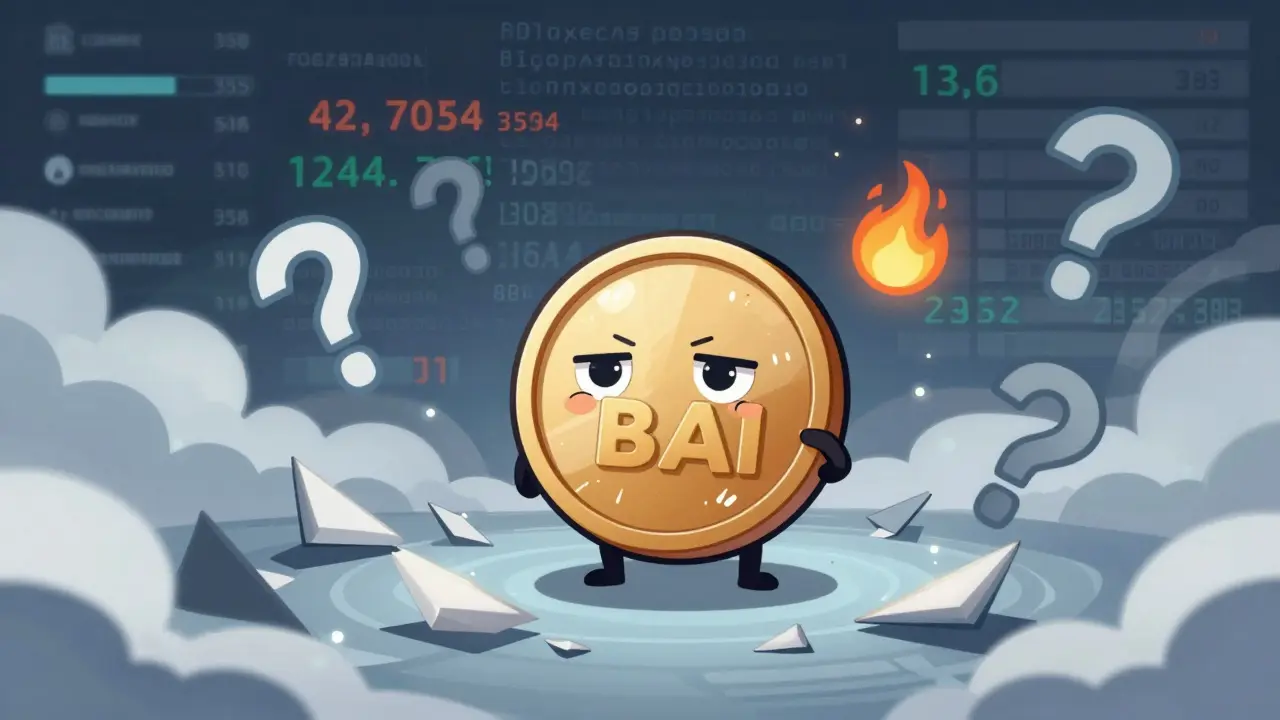
Here is where things get messy. If you check different tracking sites today, you will see wildly different prices for BAI. This isn’t just normal variance; it suggests fragmented liquidity and potential data errors across aggregators.
| Metric | Coinbase Data | CoinCheckup Data | CoinRanking Data |
|---|---|---|---|
| Current Price | $0.000479 | $0.000040 | $0.00268 (Uniswap ETH) |
| Market Cap | $255,152 | $21,346 | $1.52M (FDV) |
| All-Time High (ATH) | $2.07 | $0.067 | $0.003 |
| 24h Volume | $1.94 | N/A | Minimal |
Notice the discrepancy in the All-Time High. Coinbase lists an ATH of $2.07, while CoinCheckup shows $0.067. A drop from $2.07 to $0.0004 is a 99.98% decline. This extreme devaluation usually indicates one of three things: a catastrophic security breach, a token split that wasn't properly adjusted on charts, or simply a collapse in demand due to lack of adoption. Given the minimal trading volume-often less than $2 per day on some exchanges-the latter is the most likely scenario. Low volume means the price can be manipulated easily with small trades, leading to these erratic spikes and drops.
The Relative Strength Index (RSI) sits around 52.8, which is neutral. It’s not oversold, nor is it overbought. It’s just... flat. This reflects a market that has largely ignored the asset. The "very low" volatility reading over the past month doesn’t mean stability; it means nobody is trading it enough to move the needle significantly.
Where Can You Trade BAI?
You won’t find BAI on major centralized exchanges like Binance or Coinbase Pro. It lives exclusively in the decentralized world. Specifically, it trades on Uniswap v2, deployed on both the Ethereum mainnet and the Base chain (a Layer 2 solution).
This distinction matters. Trading on Uniswap means you are swapping directly against a liquidity pool, not an order book. This introduces slippage. If you try to buy $1,000 worth of BAI, you might not get the exact price shown because the pool depth is shallow. The slight price difference between Ethereum ($0.00268) and Base ($0.00276) listings highlights this fragmentation. Liquidity is spread thin across two networks, making arbitrage difficult and execution risky for larger orders.

Is Bonsai3 Actually Useful?
Let’s separate the coin from the tool. Even if BAI is a poor investment, the platform itself addresses a real pain point. The ability to deploy pre-audited smart contracts quickly is valuable for legitimate businesses entering Web3. Security audits cost tens of thousands of dollars. By offering standardized, audited templates, Bonsai3 lowers the entry cost dramatically.
However, utility does not automatically equal token value. For the BAI token to appreciate, people need to use the platform *and* choose to pay for services using BAI, or benefit from the buyback/burn mechanics. Currently, the low market cap and volume suggest that platform adoption hasn’t translated into meaningful token demand yet. It remains a micro-cap asset with high risk.
Risks and Considerations for Investors
If you are considering interacting with BAI, keep these risks front and center:
- Liquidity Risk: With daily volumes often under $5, exiting a large position could crash the price instantly. You might buy in, but finding a buyer later could be impossible without significant loss.
- Data Integrity: The conflicting price data across trackers makes it hard to know the "true" price. Always check the direct Uniswap pool interface before transacting.
- Smart Contract Risk: While Bonsai3 claims its contracts are pre-audited, relying on third-party audits is standard practice, not a guarantee. New vulnerabilities can emerge.
- Opportunity Cost: Capital tied up in illiquid micro-caps cannot be used elsewhere. The 99%+ drop from ATH serves as a stark reminder of how quickly value can evaporate in this sector.
In summary, Bonsai3 offers an interesting technological solution to the complexity of Web3 development. But the BAI token itself remains a highly speculative, low-liquidity asset. It is not for the faint of heart, nor for those seeking stable growth. It is a bet on the future adoption of no-code blockchain tools-a bet that currently has very little backing from actual market activity.
What is the current price of Bonsai3 (BAI)?
The price of BAI varies significantly depending on the data source and exchange. As of May 2026, reports range from $0.00004 to $0.00268. Most reliable decentralized exchange data (Uniswap) places it near $0.00268, but liquidity is extremely low, meaning prices can swing wildly with small trades.
Can I buy BAI on Coinbase or Binance?
No. BAI is not listed on major centralized exchanges like Coinbase or Binance. It is traded exclusively on decentralized platforms, primarily Uniswap v2 on the Ethereum and Base blockchains. You will need a Web3 wallet like MetaMask to interact with these pools.
Why do different websites show different all-time highs for BAI?
This discrepancy often results from fragmented liquidity pools, token splits, or data aggregation errors. Some trackers may have recorded a brief spike on a low-volume pair that isn't representative of the broader market consensus. Always cross-reference multiple sources and check on-chain data for accuracy.
How does the Bonsai3 buyback and burn mechanism work?
The protocol automates the purchase of BAI tokens from the open market using platform revenue or fees. These purchased tokens are then sent to a burn address, permanently removing them from circulation. This creates deflationary pressure, potentially increasing the value of remaining tokens if platform usage grows.
Is Bonsai3 safe for launching my own token?
Bonsai3 provides pre-audited smart contract templates, which reduces the risk of common coding errors compared to writing custom code. However, no system is immune to all exploits. You should still conduct your own due diligence and consider additional security reviews for high-value projects.