
Imagine trying to move money between five different bank accounts, each with its own currency, exchange rate, and waiting time. That’s essentially what happens in the current blockchain world when you try to use assets across multiple networks. It’s fragmented, slow, and expensive. Sunrise, represented by the RISE token, is a new Layer 1 blockchain designed specifically as a Data Availability (DA) layer and liquidity hub. It aims to fix this fragmentation by combining high-speed data security with a native liquidity pool system, all secured by a unique mechanism called Proof-of-Liquidity.
If you’ve seen the ticker RISE popping up on trackers but aren’t sure what it actually does, you’re not alone. The project launched its community sale in June 2025, and as of late 2026, it’s still in a critical phase of building out its ecosystem. This guide breaks down exactly what Sunrise is, how its three-token economy works, and why it might matter for the future of rollups and Layer 2 solutions.
The Core Problem: Why We Need a Liquidity Hub
Most blockchains today suffer from "liquidity fragmentation." If you want to trade tokens on a new Layer 2 network, you often have to bridge your funds there first. Once you’re there, the trading pools are shallow, meaning large trades cause massive price slippage. You’re isolated in a small pond instead of swimming in the ocean.
Sunrise solves this by acting as a shared base layer. Think of it as a central bank that also provides the roads (data availability) for other chains to drive on. Instead of every rollup needing to bootstrap its own deep liquidity, they can tap into Sunrise’s shared pools. This design targets two main jobs:
- Data Availability (DA): Securing transaction data for rollups so they don’t have to do it themselves.
- Liquidity Aggregation: Providing deep, unified liquidity pools that multiple chains can access simultaneously.
This approach distinguishes Sunrise from competitors like Celestia, which focuses purely on data availability without embedding a complex liquidity layer. By merging these functions, Sunrise tries to create a more efficient economic engine for the multi-chain future.
How Proof-of-Liquidity Works
You might be familiar with Proof-of-Stake (PoS), where validators lock up tokens to secure the network. Sunrise uses a variation called Proof-of-Liquidity (PoL). Originally popularized by Berachain, PoL changes the incentive structure entirely.
In standard PoS, you just hold coins. In PoL, you provide value to the network through liquidity pools. Here’s the logic:
- Stake Liquidity: Users deposit their assets into designated liquidity pools on Sunrise.
- Earn Governance Power: By providing liquidity, users earn vRISE, a non-transferable token that grants voting rights.
- Secure the Chain: Validators run nodes that help process transactions and store data. They are rewarded based on how much liquidity is backing the network.
This creates a tighter alignment between security and utility. The network isn’t just secured by idle capital; it’s secured by capital that is actively being used to facilitate trades. For developers, this means the chain has built-in demand for its assets because people need them to participate in governance and earn rewards.
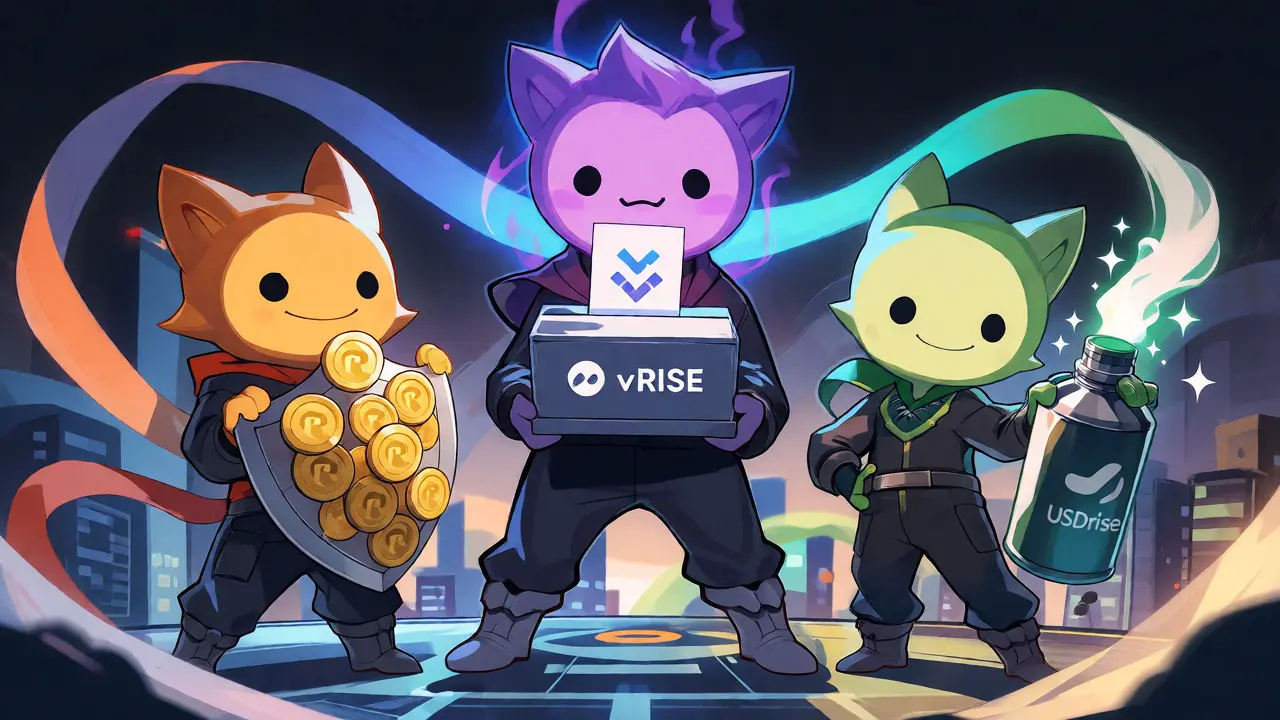
The Three-Token Economy: RISE, vRISE, and USDrise
One of the most confusing aspects of new crypto projects is tokenomics. Sunrise simplifies this with a clear separation of roles among three distinct tokens. Understanding who holds what-and why-is crucial before investing.
| Token | Type | Primary Function | Transferable? |
|---|---|---|---|
| RISE | Consensus Asset | Staking, Value Accrual, Trading | Yes |
| vRISE | Governance Utility | Voting on Protocol Parameters | No |
| USDrise | Gas Token | Paying Transaction Fees | Yes |
RISE is the primary asset you’ll see traded on exchanges. It’s transferable and can be staked to help secure the network. However, holding RISE doesn’t give you voting power. That’s reserved for vRISE.
vRISE is earned only by providing liquidity. Because it’s non-transferable, you can’t buy governance rights on an open market. You have to actively contribute to the ecosystem to get a say in how it evolves. This prevents whales from buying up votes and ensures that decision-makers are active participants.
Finally, USDrise handles gas fees. Unlike Ethereum, where you must pay in ETH, Sunrise allows fee abstraction. You can pay fees in various supported tokens, which are automatically swapped into USDrise. Here’s the clever part: 50% of the USDrise used for fees is swapped into RISE and burned. This creates a deflationary pressure on RISE whenever the network is busy.

Token Supply and Distribution
When evaluating any crypto asset, supply mechanics are key. Sunrise has a total supply cap of 1 billion RISE, though early documentation sometimes cited 500 million. As of September 2026, the circulating supply remains low, with many tokens still locked in vesting schedules or held by the team and investors.
The distribution model leans heavily toward the community. Approximately 65.5% of the total supply is allocated to ecosystem incentives, including airdrops and liquidity bootstrapping. Only about 34.5% goes to the team and venture capital backers. This ratio suggests a strong desire to decentralize ownership early on, rather than keeping control concentrated among insiders.
The initial community sale took place in June 2025 at a fixed price of $0.08 per RISE. Since then, market prices have fluctuated significantly. By mid-2026, trackers showed prices ranging from $0.00019 to $0.0023 depending on the platform and timing. This volatility highlights the risks associated with early-stage infrastructure tokens, especially those with limited circulating supply.
Technical Architecture and Interliquid Networks
Sunrise isn’t just another smart contract platform. It’s positioned as the base layer for "Interliquid Networks." This concept envisions a web of rollups and Layer 2 chains that share a common liquidity backbone. Technically, Sunrise maintains compatibility with architectures similar to Celestia, using blob-style data availability to keep costs low for connected chains.
For developers, integrating with Sunrise means less hassle. Instead of managing separate bridges and liquidity pools for each new deployment, they can plug into Sunrise’s existing infrastructure. The protocol handles the heavy lifting of data posting and liquidity routing. This reduces the operational burden and allows teams to focus on building applications rather than plumbing.
However, technical complexity comes with requirements. Interacting with Sunrise requires understanding the micro-denomination system where 1 RISE equals 1,000,000 urise. While this sounds minor, it affects how balances are calculated and displayed in wallets and dashboards. Developers need to ensure their tools correctly handle these integer multiples to avoid rounding errors.
Risks and Considerations for Investors
No investment is without risk, and Sunrise has several factors to consider. First, the project is relatively young. Launched in 2024 with a public sale in 2025, it hasn’t yet proven its long-term resilience under heavy load. Many competing DA layers exist, and winning developer mindshare is a tough battle.
Second, the price action has been bearish compared to the initial sale price. Trading far below $0.08 indicates either market skepticism or simply the natural correction after a hype cycle. Investors should look beyond the price chart and monitor actual usage metrics-such as the number of rollups connected and the total value locked (TVL) in liquidity pools-to gauge real adoption.
Third, the reliance on vRISE for governance means that passive holders have no direct voice. If you buy RISE hoping to influence protocol changes, you’ll need to convert some holdings into liquidity positions to earn vRISE. This adds a layer of complexity and potential impermanent loss risk for those seeking governance rights.
Frequently Asked Questions
Is RISE the same as Bitcoin or Ethereum?
No. While RISE is a cryptocurrency token, it operates on the Sunrise Layer 1 blockchain. Its primary purpose is to secure a Data Availability layer and facilitate liquidity sharing across multiple chains, rather than serving as a general-purpose digital currency or smart contract platform like Ethereum.
How do I get governance rights on Sunrise?
You cannot buy governance rights directly with RISE. You must provide liquidity to designated pools on the Sunrise network to earn vRISE. This non-transferable token grants you voting power on protocol parameters such as AMM fee rates and incentive distributions.
What is the difference between RISE and vRISE?
RISE is a transferable consensus token used for staking and trading. vRISE is a non-transferable governance token earned by providing liquidity. You can mint RISE by burning vRISE, but you cannot transfer vRISE to another wallet.
Why is the circulating supply of RISE reported as zero on some sites?
Many tokens are currently locked in vesting schedules for the team, investors, and ecosystem reserves. Market trackers may report zero circulating supply if they haven't updated their data or if the free float is negligible compared to the total supply cap of 1 billion tokens.
How does the fee burn mechanism work?
When users pay gas fees in USDrise, 50% of that amount is swapped into RISE and permanently burned. This reduces the total supply of RISE over time, potentially increasing scarcity as network usage grows.