

Imagine spending months securing your code against every known exploit, only to have an attacker drain your funds by simply voting 'yes' on a malicious proposal. This isn't a glitch in the matrix; it's a Governance Attack Vector. In the world of blockchain technology, we often obsess over cryptography and smart contract bugs. But as the industry matures, the weakest link is rarely the code itself-it's the human process that controls it.
Unlike traditional cyberattacks that target software vulnerabilities, governance attacks exploit flaws in decision-making structures, oversight mechanisms, and policy enforcement. They turn legitimate business processes into security liabilities. For decentralized organizations, where power is distributed among token holders, these attacks can be devastatingly effective because they use the system's own rules against it.
The Anatomy of a Governance Attack
To understand how to defend against these threats, you first need to recognize what they look like. A governance attack vector doesn't break into your server; it walks through the front door with a key you gave them. It targets the framework of authority within an organization or protocol.
In centralized companies, this might mean exploiting poor segregation of duties or weak third-party vendor checks. In blockchain ecosystems, specifically Decentralized Autonomous Organizations (DAOs), it manifests as attackers accumulating voting power to pass proposals that benefit them at the expense of the community. The core mechanism remains the same: bypassing technical controls by manipulating the rules that govern access and change.
- Policy Exploitation: Finding loopholes in written rules that allow unauthorized actions under the guise of compliance.
- Identity Manipulation: Using multiple identities or compromised credentials to influence decisions or escalate privileges.
- Oversight Failure: Taking advantage of gaps in audit trails or lack of independent verification.
According to recent cybersecurity research, governance-related weaknesses account for a significant portion of successful breaches. When technical defenses are strong, attackers pivot to the people and processes managing those defenses. They look for the path of least resistance, which is often a poorly defined approval workflow or an unchallenged assumption about trust.
Why Blockchain Is Uniquely Vulnerable
You might wonder why this matters more for blockchain than for traditional IT. The answer lies in the nature of decentralization. In a traditional company, a CEO or board can reverse a bad decision. In many blockchain protocols, once a governance vote passes and the code executes, the action is immutable. You can't just call support to undo a transaction.
This creates a high-stakes environment where governance attacks have immediate, irreversible financial consequences. Consider the concept of "vote buying." An attacker doesn't need to hack the network; they just need to buy enough tokens to control the majority vote. If the protocol allows borrowing tokens without locking them up (a flaw known as flash loan governance), an attacker can borrow millions worth of voting power for a few hours, pass a proposal to drain the treasury, repay the loan, and vanish-all before anyone realizes what happened.
This specific vector highlights a critical difference between traditional governance and blockchain governance. Traditional systems rely on legal recourse and reputational damage to deter abuse. Blockchain systems often rely solely on economic incentives and technical constraints. When those incentives are misaligned, the system collapses.
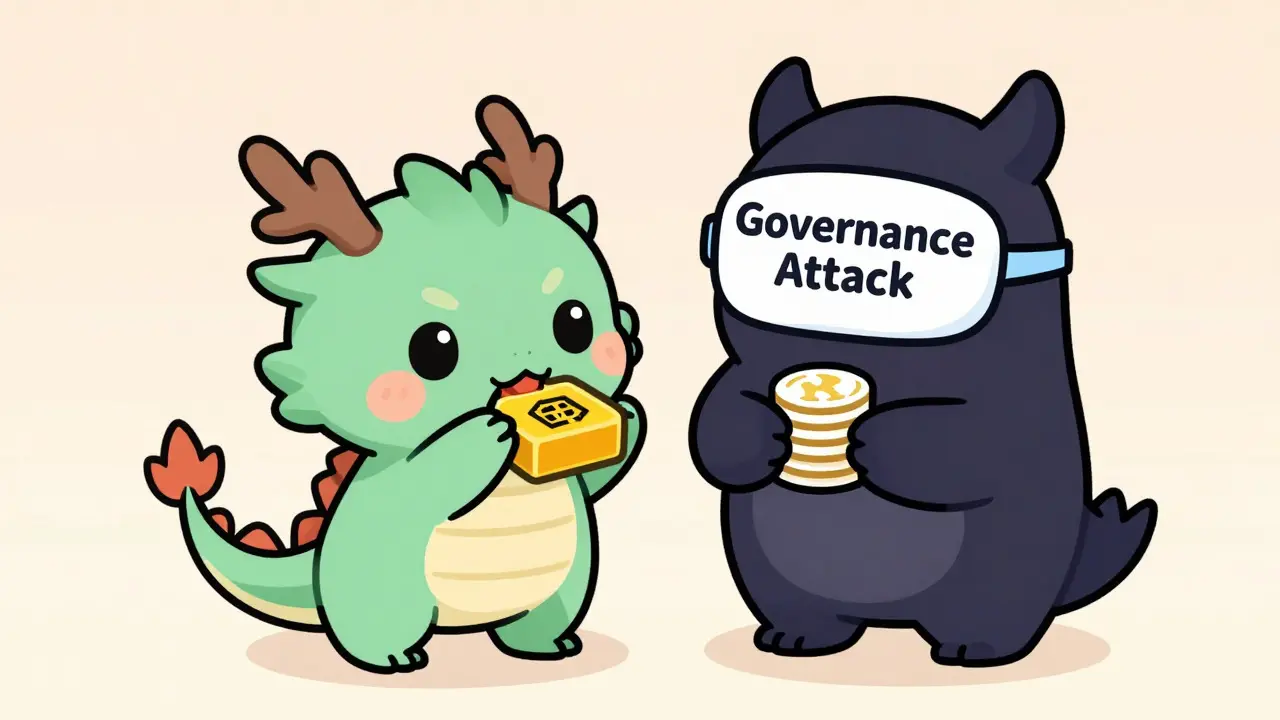
Common Governance Attack Strategies
Attackers have developed sophisticated methods to exploit governance frameworks. Understanding these strategies helps you identify red flags in your own organization or the protocols you invest in.
| Attack Type | Methodology | Primary Target | Detection Difficulty |
|---|---|---|---|
| Vote Buying | Accumulating tokens via market purchase or lending | DAO Treasuries | Medium (visible on-chain) |
| Flash Loan Governance | Borrowing massive capital temporarily to sway votes | Lending Protocols | High (rapid execution) |
| Sybil Attacks | Creating multiple fake identities to dilute honest votes | Quadratic Voting Systems | Very High (requires identity proof) |
| Proposal Spamming | Flooding the queue with low-quality proposals to delay action | Decision-Making Speed | Low (easily visible) |
One particularly insidious method is the Sybil attack. Named after the dissociative identity disorder case study, this involves one actor creating hundreds of pseudonymous accounts to simulate broad consensus. In quadratic voting systems, where the cost of voting increases quadratically, this can be expensive but still profitable if the reward is large enough. Defending against this requires robust identity verification, which ironically conflicts with the anonymity many users seek in blockchain.
Another common tactic is proposal spamming. While not directly stealing funds, it clogs the governance pipeline, preventing timely responses to genuine emergencies. It's a denial-of-service attack on the decision-making process itself. By forcing the community to waste time reviewing junk proposals, attackers create windows of opportunity for other exploits.
The Human Element: Insider Threats and Negligence
Not all governance attacks come from external hackers. Often, the threat comes from within. Insider threats in blockchain projects usually stem from negligence rather than malice. A developer might leave a backdoor in a smart contract during testing, assuming the testnet environment is safe. Later, when that code is accidentally deployed to the mainnet, the backdoor becomes a live exploit.
Consider the role of multi-signature wallets. These require multiple keys to authorize transactions, designed to prevent single points of failure. However, if the key holders are colluding, or if one key is stolen and the others are inactive, the security model fails. We've seen cases where developers held too much power over their own creations, effectively centralizing control while claiming decentralization. When governance is an illusion, the "attack" is simply the revelation of the truth.
Furthermore, inadequate audit trails make post-incident analysis nearly impossible. If a project doesn't record who voted for what, or why certain parameters were changed, it becomes difficult to hold anyone accountable. This lack of transparency erodes trust and makes future governance actions suspect. Users start to question whether the current state of the protocol is the result of democratic will or hidden manipulation.
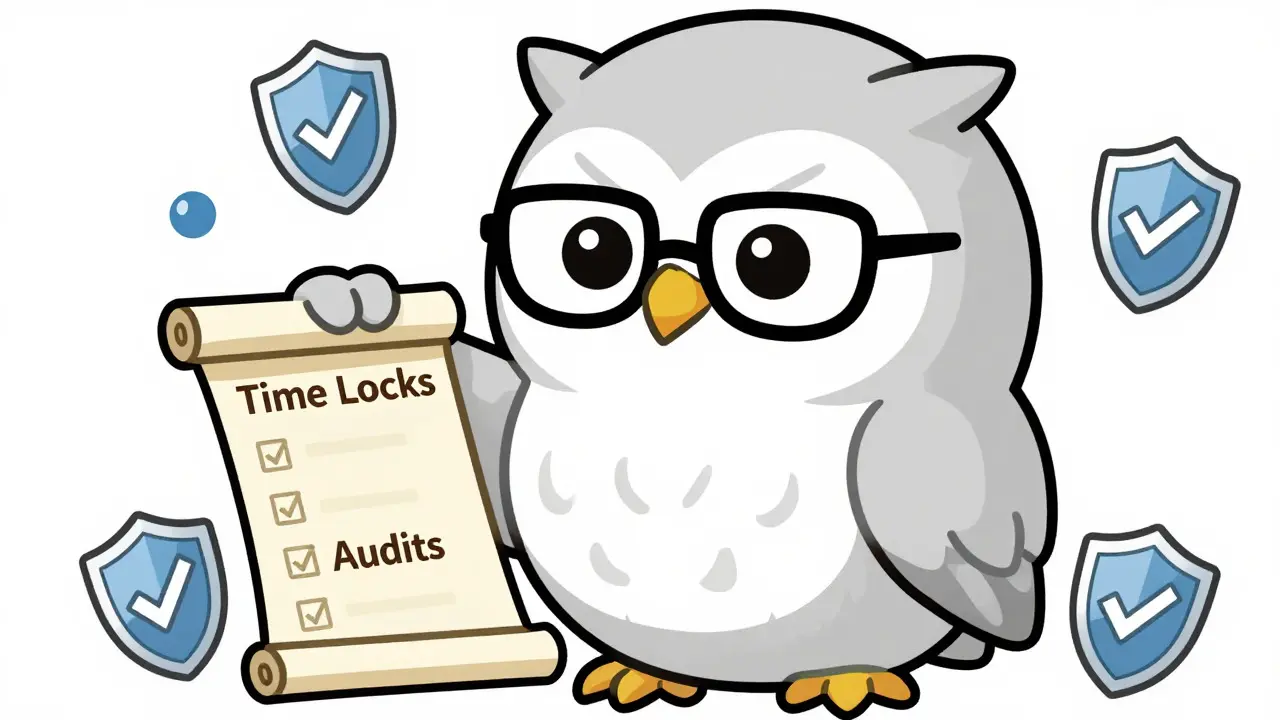
Defending Against Governance Attacks
So, how do you protect yourself? There is no silver bullet, but a layered defense strategy significantly reduces risk. Start by examining your own governance structure. Are there clear checks and balances? Is voting power distributed fairly, or does it concentrate in the hands of a few early adopters?
- Implement Time Locks: Require a waiting period between a proposal passing and its execution. This gives the community time to react if something looks wrong.
- Use Quadratic Voting: Make it increasingly expensive to cast additional votes, reducing the impact of whale dominance.
- Require Identity Verification: For high-stakes decisions, mandate some form of proof-of-personhood to prevent Sybil attacks.
- Conduct Regular Audits: Don't just audit the code; audit the governance process itself. Look for patterns of unusual voting behavior or concentrated power.
Technology also plays a role. Tools that monitor on-chain activity for signs of vote buying or flash loan manipulation can provide early warnings. Some platforms now integrate machine learning to detect anomalous voting patterns, flagging potential Sybil networks before they can exert influence.
Education is equally important. Community members need to understand the stakes. Encourage active participation in governance discussions. A silent community is a vulnerable one. When users are engaged and informed, they become the best line of defense against bad actors trying to slip through the cracks.
Future Trends in Governance Security
As blockchain technology evolves, so do the attacks. We're seeing a rise in AI-driven governance exploitation, where bots analyze historical voting data to predict outcomes and manipulate sentiment. Future defenses will likely involve more sophisticated identity solutions, perhaps leveraging zero-knowledge proofs to verify uniqueness without revealing personal information.
Regulatory pressure is also increasing. Governments are beginning to view governance failures as material risks, requiring stricter disclosure standards. This could lead to a hybrid model where on-chain governance is supplemented by off-chain legal frameworks, adding another layer of accountability.
Ultimately, governance security is not a destination but a continuous process. It requires vigilance, adaptability, and a willingness to challenge assumptions. By recognizing that the rules themselves can be attacked, you take the first step toward building a more resilient system.
What is a governance attack vector in blockchain?
A governance attack vector is a method used by attackers to exploit weaknesses in the decision-making processes, policies, or oversight mechanisms of a blockchain protocol or DAO, rather than targeting technical code vulnerabilities directly.
How does a flash loan governance attack work?
An attacker borrows a massive amount of tokens using a flash loan, uses those tokens to gain voting power in a DAO, passes a malicious proposal to drain funds, repays the loan, and exits-all within a single blockchain transaction block.
Can governance attacks be prevented entirely?
While complete prevention is difficult, risks can be minimized through measures like time locks, quadratic voting, identity verification, and regular audits of both code and governance processes.
What is a Sybil attack in the context of governance?
A Sybil attack occurs when a single entity creates multiple fake identities to artificially inflate their voting power or influence in a decentralized system, undermining the fairness of the decision-making process.
Why are DAOs more susceptible to governance attacks?
DAOs often lack traditional legal recourse and rely heavily on token-based voting, which can be manipulated through wealth concentration or temporary borrowing. Additionally, executed governance changes are often irreversible on-chain.