

Blockchain technology has always hit a wall. You want your app to be fast, private, and secure, but the network can only handle so much computation before gas fees skyrocket or transactions stall. This is known as the scalability trilemma. Enter Boundless, a protocol that promises to solve this by turning computational power into a tradable financial asset. Its native token, Zero Knowledge Coin (ZKC), sits at the center of a new decentralized marketplace for verification.
If you’ve heard whispers about “verifiable computing” or seen projects like Polygon or Ethereum struggling with high load, Boundless is designed to plug directly into those ecosystems. It doesn’t just offer faster transactions; it offers a way to prove complex calculations happened correctly without revealing the data behind them. Let’s break down exactly what Boundless is, how its unique Proof of Verifiable Work mechanism works, and why the ZKC token matters in this evolving landscape.
The Core Problem: Why We Need Off-Chain Verification
Imagine you’re running a decentralized finance (DeFi) platform. You need to assess risk for thousands of loans every second. Doing this on-chain-meaning inside the blockchain itself-is incredibly expensive. Every calculation costs gas, and if too many people try to do it at once, the network clogs up.
Traditional solutions often rely on centralized servers or trusted oracles, which reintroduces the very trust issues blockchain aims to eliminate. Boundless addresses this by decoupling execution from consensus. Instead of forcing the main blockchain to do the heavy lifting, Boundless moves the computation off-chain. A network of independent provers performs the work, generates a cryptographic receipt called a zero-knowledge proof (ZKP), and sends that tiny packet back to the chain for verification. The chain checks the proof instantly, confirming the result is correct without needing to re-run the entire calculation.
How Boundless Works: The Technical Stack
Boundless isn’t just another layer-2 solution; it’s a universal, permissionless protocol. It relies on two major technological pillars to function efficiently.
- RISC-V zkVMs: At its heart, Boundless uses RISC Zero zkVM (zero-knowledge virtual machines). Unlike specialized hardware, these are software-based virtual machines compatible with mainstream programming languages like Rust and C++. This means developers don’t need to learn obscure cryptographic coding standards. They can write standard code, and the zkVM wraps it in a zero-knowledge proof.
- Cross-Chain Settlement: Boundless is chain-agnostic. It can settle proofs on Bitcoin, Ethereum, Polygon, Base, and others. By using Bitcoin as a final verification layer for proofs originating from other chains, it leverages Bitcoin’s immense security hash rate without requiring changes to the underlying protocols.
This architecture creates a decentralized marketplace. Developers submit tasks, and provers bid to complete them. The system scales linearly: add more prover nodes, and you get more computational capacity. There is no hard cap on throughput, unlike traditional blockchains limited by block size.
Proof of Verifiable Work (PoVW): A New Consensus Mechanism
The most innovative aspect of Boundless is its consensus mechanism, called Proof of Verifiable Work (PoVW). In traditional Proof of Work (like early Bitcoin), miners burn electricity to solve arbitrary mathematical puzzles. The difficulty is adjusted to ensure blocks are mined every 10 minutes, regardless of how useful the computation was.
PoVW flips this model. Provers are rewarded based on the useful ZK computation they perform. Here’s how it works:
- Complexity as Value: The protocol measures the computational cost of a proof. More complex computations require more resources, generating higher verifiable metadata.
- Market Dynamics: Provers compete to generate proofs for specific requests. They aren’t guessing hashes; they are executing real-world tasks requested by developers.
- Incentive Alignment: Since rewards are tied to the actual work done, the network naturally optimizes for efficiency and speed rather than energy waste.
This transforms compute power into a financial asset. If you have powerful GPUs or CPUs, you can participate in the network not by mining empty air, but by providing valuable verification services to the broader crypto ecosystem.
The Role of ZKC Token
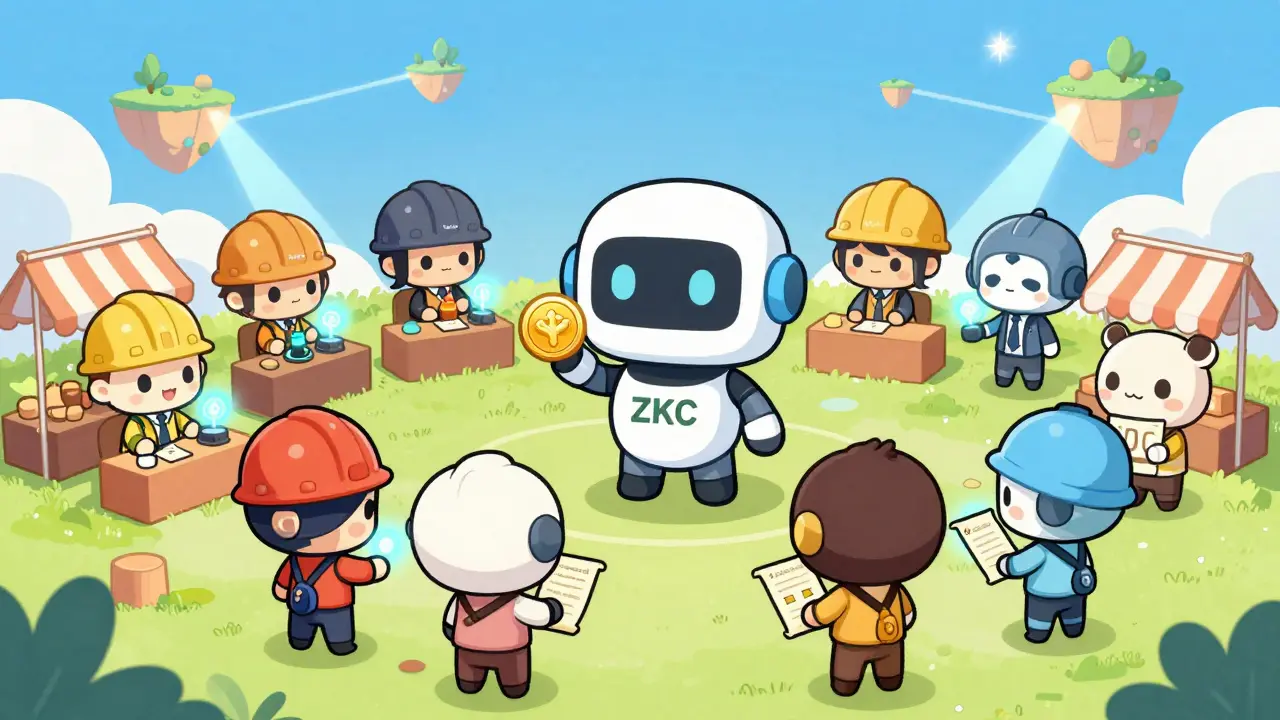
The Zero Knowledge Coin (ZKC) is the fuel that keeps this engine running. It serves three distinct purposes within the Boundless ecosystem.
| Function | Description | Benefit |
|---|---|---|
| Collateral Staking | Provers must stake ZKC to mint sZKC (staked ZKC). This acts as insurance against dishonesty. | Ensures network integrity and prevents malicious behavior. |
| Rewards & Inflation | New ZKC tokens are minted and distributed to provers every 48-hour epoch based on their PoVW output. | Incentivizes participation and aligns economic interests with network growth. |
| Governance | Holders vote on protocol upgrades, new zkVM integrations, and settlement contract deployments. | Decentralizes decision-making and allows the community to steer development. |
As of September 2025, the total supply of ZKC was capped at 1 billion tokens, with approximately 20.1% in circulation. The staking mechanism includes slashing penalties. If a prover fails to deliver a valid proof or attempts to cheat, their staked sZKC is slashed, with a portion returned to the requester. This creates a high-trust environment where honesty is economically enforced.
Economic Model and Market Context
Boundless operates as a two-sided marketplace. On one side, you have proof requesters (developers building DeFi apps, privacy tools, or rollups). On the other, you have provers (node operators with compute power).
Requesters pay for compute using native assets on their respective chains, but the economic stability comes from the ZKC ecosystem. The slashable amount specified in each proof request ensures that provers have skin in the game. This model reduces the risk for developers while creating steady revenue streams for node operators.
From a market perspective, Boundless raised significant capital early on. Through a launchpad on Kaito, it secured over $71 million in pledged demand. By March 2026, ZKC was trading between $0.0749 and $0.0791 USD, showing steady liquidity with daily volumes exceeding $17 million. This price action reflects growing interest in infrastructure plays that solve fundamental scaling issues rather than speculative meme coins.
Real-World Use Cases
So, who actually uses Boundless? It’s not just for theorists. Several practical applications benefit from its architecture:
- Rollup Upgrades: Layer-2 solutions like Optimistic Rollups rely on fraud proofs. Boundless can provide instant, cheap ZK proofs to finalize states faster, reducing withdrawal times from seven days to seconds.
- DeFi Risk Assessment: Complex lending protocols can run sophisticated risk models off-chain via Boundless, posting only the verified result on-chain. This saves massive amounts of gas for users.
- Privacy-Preserving Transactions: Users can prove they meet certain criteria (e.g., having sufficient funds or being over 18) without revealing their identity or exact balance, thanks to the zero-knowledge nature of the proofs.
- Cross-Chain Trust: By settling proofs on Bitcoin, assets on Ethereum or Solana can leverage Bitcoin’s security model for cross-chain interactions without trusting intermediaries.
Challenges and Considerations
No technology is perfect. Boundless faces challenges common to emerging ZK protocols. First, the complexity of setting up prover nodes requires technical expertise, though the use of Rust and C++ helps lower the barrier compared to custom cryptography. Second, as a newer protocol, it competes with established players like StarkWare and Polygon ID. Its success depends on developer adoption and the ability to integrate seamlessly with existing smart contracts.
Additionally, the reliance on inflationary rewards for provers means long-term sustainability will depend on transaction fees eventually covering operational costs as the network matures. Investors should monitor the ratio of fee revenue to reward issuance to gauge economic health.
Is Boundless (ZKC) a Layer 1 or Layer 2 blockchain?
Boundless is neither a traditional Layer 1 nor Layer 2. It is a universal, permissionless protocol that operates across multiple chains. It provides a decentralized marketplace for zero-knowledge proofs that can be settled on any blockchain, including Bitcoin, Ethereum, and Polygon. Think of it as an interoperability and scalability layer that enhances existing networks rather than replacing them.
How does Proof of Verifiable Work differ from Proof of Stake?
Proof of Stake (PoS) rewards validators based on the amount of cryptocurrency they lock up, regardless of the work performed. Proof of Verifiable Work (PoVW) rewards provers based on the actual computational complexity and utility of the zero-knowledge proofs they generate. PoVW ties rewards directly to useful computation, creating a market for compute power rather than just capital accumulation.
Can I use Boundless if I don't know Rust or C++?
If you are a developer looking to integrate Boundless, you may need some familiarity with Rust or C++ to interact with the zkVM effectively. However, the goal of the protocol is to abstract away cryptographic complexity. As the ecosystem matures, higher-level SDKs and libraries will likely emerge, allowing developers to use familiar languages like JavaScript or Python to submit proof requests without writing low-level code.
What happens if a prover acts dishonestly?
Provers must stake ZKC tokens to mint sZKC, which serves as collateral. If a prover fails to generate a valid proof or attempts to cheat, the protocol triggers a slashing mechanism. Their staked sZKC is confiscated, and a portion is returned to the proof requester as compensation. This economic penalty ensures that honest behavior is the most profitable strategy.
How does Boundless utilize Bitcoin for settlement?
Boundless uses Bitcoin as a final verification layer for proofs generated on other chains, such as Ethereum or Polygon. By anchoring these proofs to Bitcoin’s blockchain, the protocol leverages Bitcoin’s robust security and decentralization without requiring changes to Bitcoin’s core code. This creates a trust-minimized bridge between different blockchain ecosystems.