
Gameswap (GSWAP) is a cryptocurrency built to let gamers trade in-game items like skins, weapons, or characters as if they were real money. Sounds simple, right? But in 2026, the reality is far from it. The token exists on the Ethereum blockchain as an ERC-20 token with a fixed supply of 20 million coins. Its contract address is 0xaac41ec512808d64625576eddd580e7ea40ef8b2, and it was designed to be a peer-to-peer marketplace where players could sell virtual goods for crypto instead of getting scammed on shady forums. But here’s the catch: almost no one is using it.
How Gameswap was supposed to work
The idea behind Gameswap was solid. Most games lock your items behind their own servers. You can’t sell your rare Fortnite skin legally. You can’t cash out your Valorant weapon skins. Gameswap wanted to change that by creating a neutral platform where any game asset - if tokenized as an NFT - could be traded directly between players using GSWAP as the currency. It wasn’t trying to build games. It wasn’t trying to be a wallet. It just wanted to be the middleman for digital item sales. The project claimed to be community-owned, meaning token holders could vote on changes. That’s a common pitch in DeFi, but without active users or game integrations, voting power means nothing. No major game studio ever partnered with Gameswap. No popular title like Minecraft, Apex Legends, or Genshin Impact ever allowed direct linking to its marketplace. Without those integrations, the whole concept stayed theoretical.Current market status: A ghost town
As of February 2026, Gameswap’s market cap sits at around $213,790. That’s less than the cost of a decent gaming PC. For comparison, Enjin Coin, another gaming token, has a market cap over $1 billion. GSWAP ranks #2666 out of over 2,600 cryptocurrencies tracked by CoinMarketCap - dead last in practical relevance. Trading volume is even worse. Some exchanges report $0 in daily volume. Others show $35,000 - still tiny. If you tried to sell $1,000 worth of GSWAP, you’d likely crash the price because there aren’t enough buyers. The token has about 3,150 holders. That’s fewer than a small Discord server. Compare that to Gala, which has over 1.2 million holders, or Immutable X with 350,000. GSWAP’s community is barely alive. Price data varies wildly between exchanges. On Binance, it’s around $0.028. On Bybit, it was $0.047 in July 2025. That kind of inconsistency signals low liquidity and possible manipulation. There’s no stable trading pattern. No institutional interest. No analyst coverage from Messari, CoinDesk, or Delphi Digital. Even the project’s own website and GitHub show no updates since 2023.Where you can buy GSWAP - and why you shouldn’t
You won’t find GSWAP on Coinbase, Kraken, or Binance’s main platform. It’s only listed on smaller, less regulated exchanges like MEXC and Bybit. To buy it, you need to sign up, verify your identity, deposit funds, then hunt for the GSWAP trading pair. It’s not user-friendly. It’s not secure. And it’s not liquid. If you’re thinking of investing, ask yourself: what’s the utility? You can’t spend GSWAP in any game. You can’t use it to pay for anything outside its own broken marketplace. It doesn’t earn interest. It doesn’t offer staking rewards. It doesn’t have a team pushing updates. The only reason someone would hold it is hope - hope that someone else will pay more for it later. That’s speculation, not investment.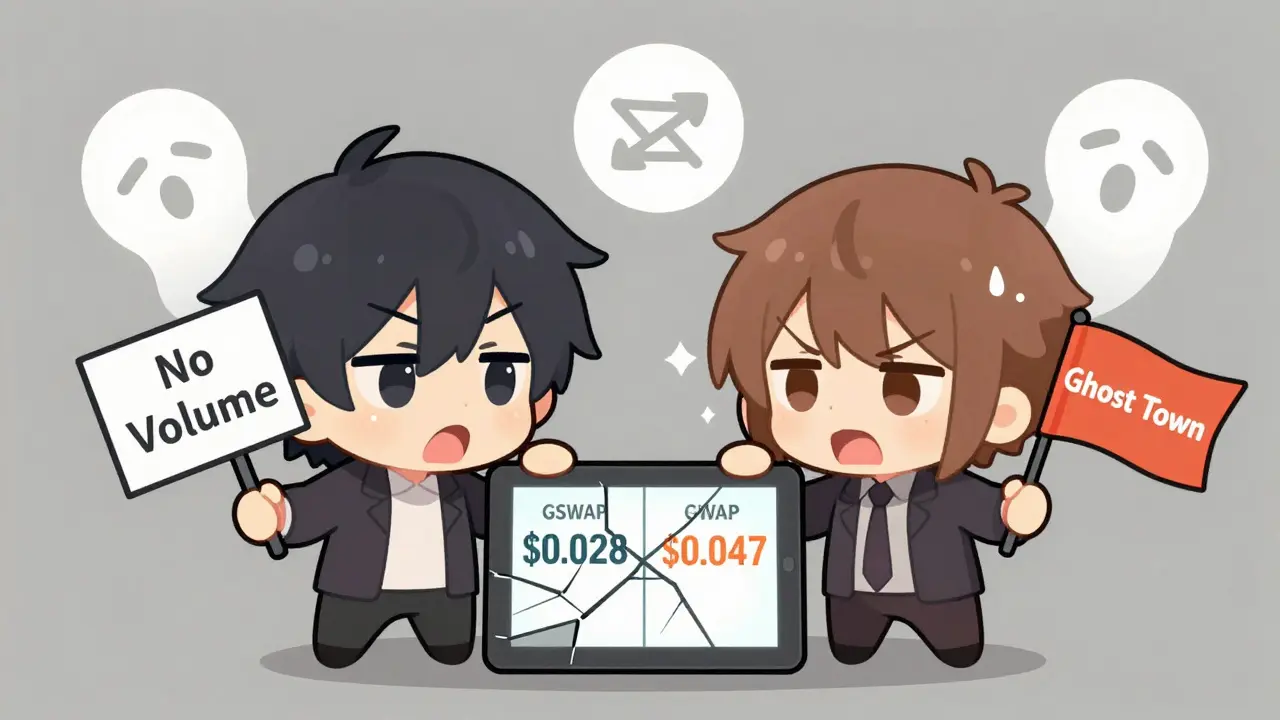
Why it’s failing while others succeed
Other gaming tokens like Chiliz or Enjin didn’t just launch a coin. They built ecosystems. Chiliz partnered with major sports teams like FC Barcelona and Paris Saint-Germain, letting fans buy tokens to vote on team decisions. Enjin integrated directly into game engines, letting developers mint NFTs with a single click. Both have real developers, active communities, and clear roadmaps. Gameswap has none of that. No developer updates. No partnerships. No marketing. No documentation beyond a basic whitepaper from 2021. The project appears abandoned. Industry reports show that 38% of gaming tokens launched between 2021 and 2024 are now inactive. GSWAP fits that pattern perfectly.Is GSWAP a scam?
It’s not technically a scam - there’s no evidence of fraud or stolen funds. The contract is open-source and verified on Etherscan. The tokens were fairly minted. But that doesn’t make it safe. A project can be legitimate and still be worthless. Think of it like a car with no engine. The body is real. The wheels are there. But it won’t move. Regulators haven’t targeted Gameswap, but that’s because it’s too small to matter. If the SEC ever decides to crack down on unregistered gaming tokens that promise future utility, GSWAP would be an easy target. Its entire value proposition hinges on future development that never came.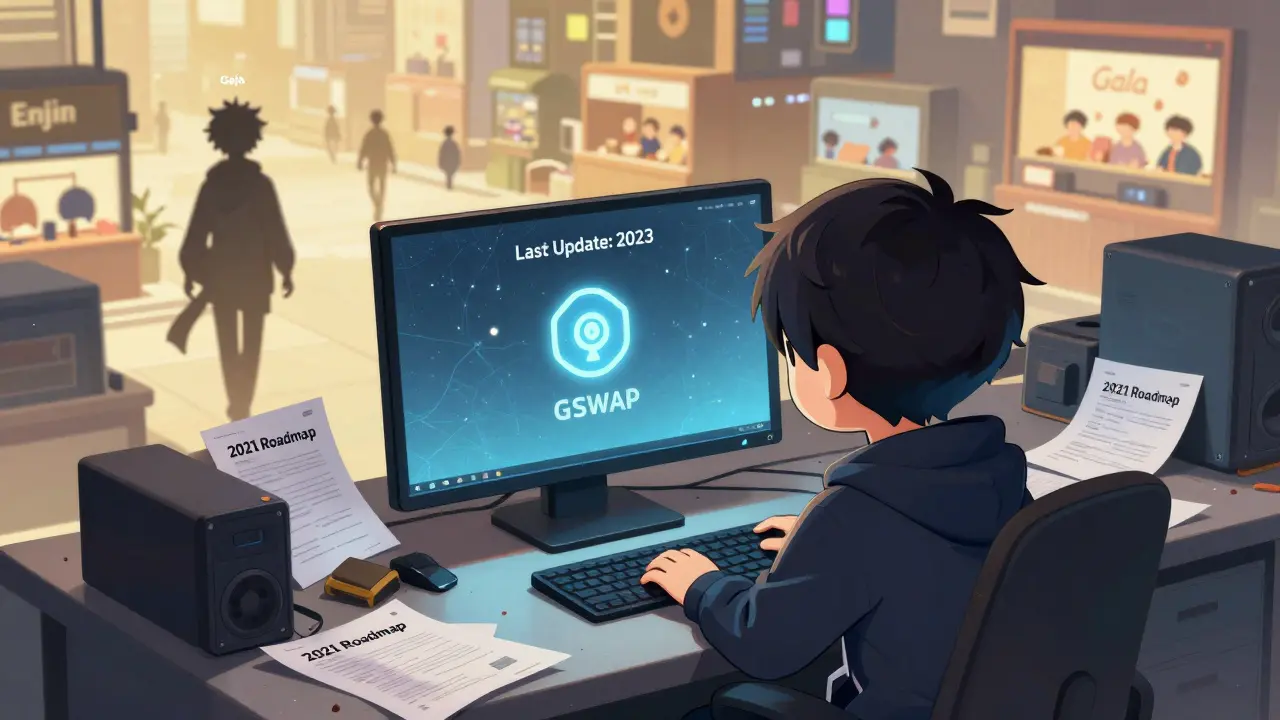
Will Pimblett
February 2, 2026 AT 01:06GSWAP is a textbook example of a project that confused tokenomics with actual utility. The idea was fine, but execution? Zero. No devs, no games, no users. Just a smart contract collecting dust. I’ve seen dead crypto projects with more life than this.
Parth Makwana
February 2, 2026 AT 04:45The structural deficiency of GSWAP lies in its ontological misalignment with market realities. While the theoretical architecture exhibits syntactic elegance-ERC-20 compliance, fixed supply, peer-to-peer ethos-the absence of network effects renders it a mathematical artifact devoid of economic agency. The liquidity vacuum is not a bug; it is the inevitable consequence of ontological neglect.
Elle M
February 2, 2026 AT 06:50So let me get this straight-Americans spent millions on NFT monkeys, but a crypto that actually lets you sell your Fortnite skins? Nah, that’s too real. We’d rather throw money at JPEGs than support something that works. America: where capitalism dies in a hype bubble.
Rico Romano
February 2, 2026 AT 10:21It’s not that GSWAP failed-it’s that the entire Web3 gaming ecosystem is populated by toddlers with MetaMask wallets who think ‘utility’ means a Discord emoji. The fact that this token even exists on a major exchange is a testament to how low the bar has sunk. Real innovation requires discipline. This? This is a garage sale for delusional speculators.
Crystal Underwood
February 2, 2026 AT 22:44Let’s be real-this isn’t a failed project, it’s a moral failure. People poured money into this knowing it had no future. They didn’t care about gamers. They cared about flipping a token before the rug pull. And now they’re crying because the rug didn’t pull fast enough? Wake up. You weren’t investing-you were gambling with your conscience.
Raymond Pute
February 4, 2026 AT 07:47Look, I get it, the narrative is ‘GSWAP is dead,’ but isn’t that kind of the point? The entire crypto space is built on the corpse of dead ideas-Bitcoin was supposed to be digital gold, Ethereum was supposed to be the world computer, and now we’re here with a token for trading in-game weapons that nobody wants to trade. The real tragedy isn’t GSWAP-it’s that we keep pretending any of this is sustainable. We’re not building the future; we’re just repackaging the same delusions with new logos.
Jack Petty
February 4, 2026 AT 19:30GSWAP isn’t dead. It’s in witness protection. The devs ran with the cash, left the contract, and now the community’s just a graveyard with a ticker. You think this is about gaming? Nah. It’s about laundering hype into exit liquidity. The SEC doesn’t care because the numbers are too small. But if it hits $10M market cap? Boom-lawsuit city.
Meenal Sharma
February 6, 2026 AT 02:06There is a metaphysical emptiness to GSWAP. It was conceived as a bridge between virtual and real value, yet it never transcended its own symbolic nature. The contract is verified, yes-but verification does not equal legitimacy. The absence of movement is not stagnation; it is the silence of a promise never kept. We mourn not the token, but the illusion it represented.
Tressie Trezza
February 6, 2026 AT 02:59I used to believe in this stuff. I really did. But GSWAP taught me that good ideas don’t matter if no one’s willing to build them. I wish the team had just said, ‘We can’t make this work,’ instead of letting it rot for three years. That’s the real crime-not failure, but silence.
Wayne mutunga
February 7, 2026 AT 09:25It’s sad. I remember when I first heard about GSWAP. Thought, ‘finally, someone’s fixing this.’ Then I checked the Discord. Two people online. One was a bot. The other was me. I just… walked away. No drama. No rage. Just… quiet disappointment.
Gareth Fitzjohn
February 8, 2026 AT 19:05Simple truth: if you can’t buy it on Coinbase, and no one’s trading it, it’s not a currency. It’s a digital trinket. GSWAP is the crypto equivalent of a novelty keychain. Looks cool on paper. Useless in real life.
Dylan Morrison
February 9, 2026 AT 03:53💀 RIP GSWAP. 2021–2026. You had potential. We believed. We bought. We lost. Rest in peace, you beautiful ghost. 🕯️🎮
Lori Quarles
February 11, 2026 AT 01:32Stop hating on GSWAP! Maybe it’s just taking its time! Maybe the devs are working in secret! Maybe the next update will blow up everything! Don’t be negative-believe in the vision! 🌟
josh gander
February 11, 2026 AT 14:26I know it’s easy to tear this down, but let’s give credit where it’s due: the idea was ahead of its time. The problem isn’t GSWAP-it’s the industry. Game companies are terrified of losing control. They’d rather lock your skins in a vault than let you own them. GSWAP tried to break that chain. Even if it failed, it was brave. And that’s worth something.
Akhil Mathew
February 12, 2026 AT 17:09Wait, so if no game uses it, how was the token even supposed to be useful? Was there a plan? Did they even have a roadmap? Or was this just ‘build it and hope someone shows up’? That’s not innovation. That’s wishful thinking with a whitepaper.
Ramona Langthaler
February 14, 2026 AT 02:46LOL GSWAP. 213k market cap. 3k holders. 0 updates. 0 devs. 0 hope. Someone please tell me why im even reading this. i thought this was a joke post. its like reading the obituary of a toaster that never worked.
Jerry Ogah
February 14, 2026 AT 12:58They didn’t just fail-they betrayed the community. People bought this thinking they were supporting gamers. Instead, they funded a vanity project that vanished into thin air. The real scam isn’t fraud-it’s false hope. And that hurts more than any rug pull.
Gurpreet Singh
February 14, 2026 AT 21:33My cousin in Mumbai bought GSWAP because he saw it on a YouTube ad. He lost $500. He didn’t know what ERC-20 meant. He just thought, ‘maybe I can sell my Valorant skins for crypto.’ I told him it was dead. He still checks the price every day. That’s the saddest part.
Gavin Francis
February 15, 2026 AT 23:45GSWAP is like a ghost town with a website. The signs still say ‘Welcome’ but the doors are boarded up. The people are gone. The lights are off. But someone still updates the homepage with ‘Coming Soon!’ every six months. It’s not a project anymore. It’s a haunted house.
Joshua Clark
February 17, 2026 AT 04:40Let’s not forget: the entire crypto space is built on the ashes of projects like this. GSWAP isn’t unique. It’s just the latest in a long line of ‘revolutionary’ tokens that never delivered. The difference? Most of them at least had a team that tried. GSWAP just… stopped. And that’s worse than a scam-it’s negligence.
Brandon Vaidyanathan
February 18, 2026 AT 04:30GSWAP? Oh yeah, that’s the one where the devs disappeared after the airdrop. I remember. I bought it because I liked their Discord mascot-a cartoon owl holding a sword. Cute. Now the server’s got 12 members. 11 bots. 1 guy still saying ‘HODL.’ 😭
Moray Wallace
February 19, 2026 AT 09:04It’s not about whether GSWAP was a scam. It’s about whether we, as a community, are willing to tolerate projects that promise change but deliver silence. We keep rewarding the hype, not the execution. And that’s why these ghosts keep rising.
Dahlia Nurcahya
February 19, 2026 AT 19:21I’m not mad at GSWAP. I’m mad at myself. I believed. I invested. I waited. And I kept hoping because I wanted to believe in something good. Sometimes, the hardest lesson isn’t that the project failed-it’s that you were too kind to let it die.
William Hanson
February 19, 2026 AT 19:49Why are we even talking about this? It’s dead. Move on. There’s 10,000 other coins trying to be the next big thing. This one’s a tombstone. Don’t water it.